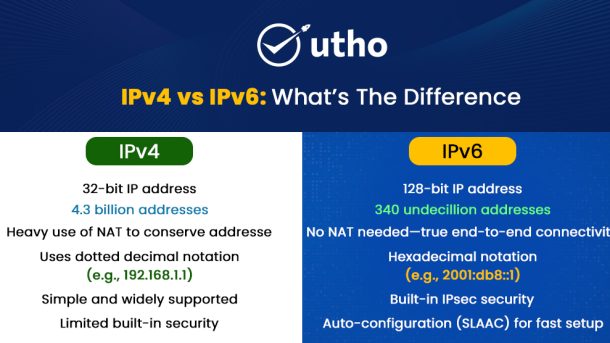
The internet works using numbers. Every device you use and every website you open uses a number system called Internet Protocol or IP. An IP address is like a home address for your phone, computer or laptop. It helps devices find each other and talk properly on the internet.
For many years the internet used IPv4. IPv4 means Internet Protocol version 4. It worked well in the beginning. But slowly more and more devices started using the internet. Now there are billions of devices. Because of this IPv4 ran out of address numbers. There were not enough IP addresses left for new devices.
To solve this problem IPv6 was created. IPv6 means Internet Protocol version 6. It is a newer and better system. It gives a very large number of IP addresses. It also helps the internet work faster and more safely and more smoothly.
This blog explains IPv4 and IPv6 in very simple words. It shows how both work and how they are different. It also explains why IPv6 is important and why it is the future of the internet.
Table of Contents
- Introduction
- What Is IPv4 and IPv6?
- Why Did We Need a New Version of IP?
- How Do IPv4 and IPv6 Work?
- What’s the Difference Between IPv4 and IPv6?
- Benefits of IPv6 Over IPv4
- Challenges in Migrating from IPv4 to IPv6
- Real-World Use Cases of IPv6
- IPv6 Adoption Across the World
- IPv4 vs IPv6: Which One Should You Use?
- Final Thoughts
The Internet Protocol is the main system of the internet. It helps data go from one device to another in the right way. It makes sure information reaches the correct place safely and properly. For more than 40 years IPv4 was used to run the internet. IPv4 means Internet Protocol version 4. It had around 4.3 billion IP addresses.
At that time this number felt very big. In the early 1980s no one thought that so many people and devices would use the internet. People could not imagine that every device would need its own internet identity.
Today the world has changed. We use smartphones, laptops, tablets, smart TVs, smart watches, cars and smart home devices. All these devices need an IP address to work on the internet. Because of this IPv4 addresses started running out and became not enough.
To solve this problem IPv6 was created. IPv6 means Internet Protocol version 6. It gives a very very large number of IP addresses. IPv6 can support an almost unlimited number of devices and helps the internet grow in the future.
This blog will examine the two protocols in extreme depth, so you can understand:
- Why IPv4 dominated for decades
- What the limitations of IPv4 are
- Why IPv6 is essential for modern networks
- How IPv6 unlocks better speed, security, and scalability
- And ultimately, which protocol is better for your business, network, or application
Let’s get started.
What Is IPv4 and IPv6?
The internet works using some simple rules called Internet Protocol or IP. These rules help the internet find devices, send data and connect the whole world. Today there are two main types of IP called IPv4 and IPv6. Both are used to do the same work but they are different in how they are built and how many devices they can support. Knowing about them is important for people who work with computers, networks or the internet.
Below this blog explains IPv4 and IPv6 in very easy words. It tells what IPv4 and IPv6 are how they work and why IPv6 is becoming more important. It also explains why IPv6 is the future of the internet in a way that is easy to understand.
What Is IPv4?
IPv4 means Internet Protocol version 4. It is the fourth type of internet rule system. It is still the most used system to find devices and send data on the internet. IPv4 was started in the year 1983 when the early internet called ARPANET was created. This system later became the base of the modern internet we use today.
32-Bit Addressing System
IPv4 uses a 32-bit numeric address format, which means it can generate:
4,294,967,296 (4.3 billion) unique IP addresses
When IPv4 was created, this number seemed practically infinite. At the time, computers were rare, and the idea of billions of devices connecting to one network felt unrealistic. But as the internet grew, the limited address capacity became one of IPv4’s biggest challenges.
Example of an IPv4 Address
192.168.1.1
IPv4 addresses consist of four octets, separated by dots, where each value ranges from 0 to 255.
For example:
- 192.168.0.1
- 10.0.0.5
- 172.16.254.7
This format is simple, readable, and easy to configure, which played a major role in IPv4’s rapid adoption worldwide.
Why IPv4 Became So Important
IPv4 was made at a time when the internet was not used by everyone. It was mostly used for research work and army communication. It was simple easy to use and very light so it became popular all over the world.
Even today many systems apps and websites still use IPv4. It still works well because of a method called NAT. NAT allows many devices to use the internet using one public IP address. This helps IPv4 last longer even though there are limited IP addresses.
Key Features of IPv4 (Detailed)
✔ 32-bit Address Format
Allows around 4.3 billion unique addresses. Initially adequate, now insufficient.
✔ Uses Dotted Decimal Notation
Human-friendly addresses like 192.168.1.1 are easy to read and manage.
✔ Supports NAT (Network Address Translation)
A major workaround used to conserve IPv4 addresses.
With NAT:
- A single public IP can serve hundreds of internal devices.
- Private networks can run on reserved address ranges (e.g., 192.168.x.x).
✔ Globally Recognized and Universally Deployed
Every device, operating system, and ISP supports IPv4.
This universal compatibility makes IPv4 difficult to replace.
✔ Simpler to Configure
Compared to IPv6, IPv4 settings are straightforward to manage using DHCP, static assignments, and familiar addressing.
✔ Works Across Almost All Legacy Systems
Older routers, IoT devices, and industrial equipment often do not support IPv6, making IPv4 essential.
Limitations of IPv4
Despite its strengths, IPv4 suffers from major limitations:
- Address exhaustion due to the global growth of internet users and devices
- Over-dependence on NAT, which can slow down communication
- Limited built-in security
- More complex routing as the internet scales
These limitations laid the groundwork for the creation of an improved protocol—IPv6.
What Is IPv6?
IPv6 means Internet Protocol version 6. It is the newest and most advanced system of the internet. It was introduced in 1998 to fix the problems of IPv4 and to help the internet grow in the future.
IPv4 was made for a small internet used mainly for research. IPv6 was made for a big world where every device needs its own IP address. This includes phones, computers, TVs and even home machines like refrigerators.
128-Bit Addressing System
IPv6 uses a 128-bit address format, enabling an astronomical number of unique IP addresses:
340 Undecillion Addresses
(That’s 340,282,366,920,938,463,463,374,607,431,768,211,456)
To put it simply:
IPv6 offers enough addresses to give every grain of sand on Earth its own IP address—plus more.
This ensures the internet will never run out of IP addresses again.
Example of an IPv6 Address
2001:0db8:85a3:0000:0000:8a2e:0370:7334
IPv6 addresses are written in hexadecimal and divided into eight groups separated by colons.
Abbreviation rules also exist to shorten IPv6 addresses, such as using :: to replace consecutive zero blocks.
Why IPv6 Was Created
IPv6 was not only built to solve IPv4 address exhaustion—it was created to modernize the internet entirely.
It introduces improvements in:
- Security
- Routing efficiency
- Auto-configuration
- Performance
- Scalability
- Mobility
- Multicasting
This makes IPv6 ideal for emerging technologies like IoT, 5G, smart cities, cloud platforms, and high-performance applications.
Key Features of IPv6 (Detailed)
✔ 128-bit Address Format
Provides virtually infinite IP address space, enabling seamless expansion of the internet.
✔ Hexadecimal Notation
More compact and structured, supporting hierarchical addressing for better routing.
✔ Built-in IPsec Security
Unlike IPv4, IPv6 integrates:
- Encryption
- Authentication
- Integrity protection
This makes IPv6 inherently more secure for today’s cyber-threat landscape.
✔ Auto-Configuration (SLAAC)
With Stateless Address Auto-Configuration:
- Devices can configure themselves automatically
- No need for DHCP
- Networks become plug-and-play
This simplifies deployment in large-scale networks.
✔ Simplified & Efficient Routing
IPv6 reduces header complexity, making routing:
- Faster
- More efficient
- Less resource-intensive
This benefits ISPs, cloud providers, and data centers.
✔ Virtually Infinite Address Availability
Every device can have its own globally unique IP address—no NAT required.
This is essential for:
- IoT ecosystems
- Smart homes
- 5G networks
- Autonomous vehicles
✔ Designed for the Future of the Internet
IPv6 is not just an improvement—it is a foundation for the next generation of connectivity.
Why Did We Need a New Version of IP?
The move from IPv4 to IPv6 was very important for the internet to survive. It was not just a small change. When IPv4 was created in the early 1980s the world was very different. Only a few computers were connected to the internet and no one thought that so many people would use it one day.
Later technology grew very fast. Mobile phones apps and cloud systems became common. Because of this the internet became very big. By the time the 2000s came IPv4 was no longer enough to handle so many devices.
Below are the simple and clear reasons that explain why a new version of the Internet Protocol was needed for the future of the internet.
- IPv4 Address Exhaustion (The Core Problem)
IPv4 can give only about four point three billion different IP addresses. When it was made this number looked very big. But later it became too small because of many reasons.
- The world population increased
- More people started using computers
- Smartphones became very common
- Big internet services started growing
By the end of the nineteen nineties the internet had grown much more than expected.
Early problems in giving IP addresses
In the early days IPv4 addresses were given in very big groups. These groups were called Class A Class B and Class C. Many companies and schools got millions of IP addresses even when they needed only a few.
Example
Big universities got very large blocks with millions of IP addresses
Big tech companies also got many IP addresses that were never used
Because of this many IP addresses were wasted.
When IPv4 addresses finished
Between the years two thousand eleven and two thousand fifteen most internet authorities said that IPv4 addresses were finished.
- IANA finished global IPv4 addresses in two thousand eleven
- APNIC finished IPv4 addresses in two thousand eleven
- ARIN finished IPv4 addresses in two thousand fifteen
- RIPE finished IPv4 addresses in two thousand nineteen
Today IPv4 addresses are very rare. Companies now buy and sell them just like land or buildings.
- Explosion of IoT (Internet of Things)
The Internet of Things revolution created a world where everything needs an IP address.
Examples include:
- Smart TVs
- Home assistants
- Wearable devices
- Smart security cameras
- Industrial sensors
- Smart meters
- Autonomous vehicles
We are talking about tens of billions of devices worldwide—and counting.
IPv4 Cannot Support IoT Growth
Even with NAT, IPv4 cannot handle a world where:
- 20+ devices exist in every home
- Cities run on millions of connected sensors
- Factories rely on machine-to-machine communication
IPv6, with its massive address space, was the only viable way to support the next era of connected devices.
- The Need for Stronger Security
In IPv4’s early days, cybersecurity was not a major concern.
Today, the internet is a battlefield of:
- DDoS attacks
- Spoofing
- Packet tampering
- Routing attacks
- Man-in-the-middle attacks
IPv4 does not include built-in mechanisms to prevent many of these threats.
IPv6 Integrates IPsec by Default
Unlike IPv4, IPv6 has:
- End-to-end encryption
- Authentication
- Integrity verification
This makes IPv6 inherently more secure, especially for:
- Financial transactions
- Cloud services
- Government communication
- Enterprise networks
IPv6 moves the internet toward a safer, more trusted communication standard.
- Improved Routing Efficiency & Performance
As the internet grew, IPv4 routing tables became enormous.
This led to:
- Longer routing paths
- Higher processing load on routers
- Slower network performance
- Inefficient interconnection between networks
IPv4’s structure simply wasn’t built for global-scale complexity.
IPv6 Fixes Routing Problems Through:
✔ Hierarchical addressing (better network organization)
✔ Simpler packet headers (faster processing)
✔ More efficient routing algorithms
✔ Elimination of NAT layers
This improves:
- Data transfer speed
- Reliability
- Latency
- Network stability
For ISPs and data centers, IPv6 is far more scalable and cost-efficient.
- Automated Network Configuration
In IPv4 networks, configuration often requires:
- Manual IP assignment
- DHCP server setup
- NAT traversal
- Complex management
This becomes a challenge when dealing with millions of devices, as seen in large enterprises or IoT networks.
IPv6 Introduces SLAAC (Stateless Address Auto-Configuration)
With SLAAC:
- Devices generate their own IP address automatically
- No DHCP required
- No manual setup needed
- Devices can join networks instantly
This makes IPv6 ideal for modern large-scale deployments like:
- Smart cities
- Cloud platforms
- Industrial automation
- Enterprise networks
- Distributed IoT systems
In Simple Words
The internet grew faster than anyone imagined. IPv4 was never built to support billions of users, trillions of devices, and massive cloud systems. IPv6 is not an option—it is a necessity for the future of global connectivity.
How Do IPv4 and IPv6 Work? (Deep, Detailed Explanation)
Although IPv4 and IPv6 are different technologies, their core purpose remains the same:
They identify devices and route data across networks.
But the way they function internally differs significantly.
Let's explore how both protocols operate.
How IPv4 Works – A Deep, Detailed Explanation
IPv4 was engineered in the early days of networking when the internet had only a few thousand connected systems. Despite its age, it still powers a large portion of today’s global internet. To understand its limitations—and why IPv6 became essential—we must first understand how IPv4 functions internally.
- 32-Bit Addressing Structure
IPv4 uses a 32-bit address, which means it can generate a maximum of 4.29 billion unique addresses.
An address is typically written in dotted decimal format, such as:
192.0.2.1
Internally, the IP is a binary number, but the dotted format makes it more readable.
How IPv4 Addressing Works
- The address is divided into four octets, each ranging from 0–255.
- These four octets define:
- Network portion → Identifies the network.
- Host portion → Identifies a specific device on that network.
- Network portion → Identifies the network.
Originally, IPv4 used “classes” (Class A, B, C), but modern networks rely on CIDR (Classless Inter-Domain Routing) for more flexible allocation.
- Packet-Based Communication
Every piece of data on the internet is transmitted as a packet.
Each packet contains:
Packet Header
- Source IPv4 address
- Destination IPv4 address
- Time-to-Live (TTL)
- Flags
- Protocol information (TCP/UDP/etc.)
Packet Payload
- The actual data being sent (e.g., message, file piece, video stream)
Routers across the internet read the packet headers and forward them toward the destination.
This method is fast, efficient, and highly scalable—but IPv4 packets have some limitations, such as smaller address space and optional security features.
- NAT (Network Address Translation)
One of the biggest reasons IPv4 survived this long is NAT.
Why NAT Exists
Because IPv4 addresses are limited, NAT allows multiple devices to share one public IP address.
How NAT Works
- Inside your home or office, devices use private IP addresses (192.168.x.x, 10.x.x.x).
- The router translates these private addresses into a single public IP when sending traffic to the internet.
- When responses return, the router maps them back to the correct device.
Benefits of NAT
- Conserves IPv4 addresses
- Allows entire networks to function with one public IP
- Adds a layer of basic security
Drawback
NAT breaks the original end-to-end communication model of the internet and complicates applications like VoIP, gaming, and peer-to-peer networks.
- DHCP for Automatic IP Assignment
IPv4 devices typically obtain an IP address using DHCP (Dynamic Host Configuration Protocol).
DHCP assigns:
- IP address
- Subnet mask
- Default gateway
- DNS server
Without DHCP, network administrators would have to manually configure every device—time-consuming and prone to errors.
- Optional IPsec (Not Built-In)
IPv4 does not include mandatory security.
While IPsec can be implemented, it’s optional and rarely used at the network level.
This means encryption and authentication are usually handled by higher-layer protocols like:
- HTTPS
- SSH
- VPNs
This is one of the major weaknesses of IPv4.
How IPv6 Works
IPv6 was designed to fix IPv4’s limitations—not just increase addresses but create a more intelligent, secure, and scalable internet protocol.
Let’s break down its core functionality.
- 128-Bit Addressing Structure
IPv6 uses 128 bits, enabling an unimaginable number of unique addresses:
340 Undecillion
(3.4 × 10³⁸ addresses)
To visualize: IPv6 offers enough addresses to assign trillions of IPs to every person on earth.
IPv6 Address Example:
2001:db8::1
Addresses are written in hexadecimal and separated by colons.
Leading zeros can be removed, and consecutive zeros can be collapsed using “::” to shorten the notation.
- Hierarchical, Hexadecimal Addressing
Unlike IPv4’s dotted decimal structure, IPv6 uses a more flexible addressing system divided into eight groups, enhancing readability and routing efficiency.
Benefits:
- Better subnetting
- More efficient network design
- Faster routing table lookups
- Built-In Security (IPsec Mandatory)
One of IPv6’s most important features is integrated security.
IPv6 requires:
- Data integrity
- Authentication
- Encryption
This built-in IPsec makes IPv6 inherently more secure than IPv4, reducing reliance on external tools and security add-ons.
- No NAT Required – True End-to-End Connectivity
With abundant IPv6 addresses, every device can have its own globally unique IP.
Benefits of removing NAT:
- Simpler network architecture
- Better peer-to-peer communication
- Faster connections for VoIP, gaming, and video conferencing
- More transparent routing
This restores the original internet design vision—direct device-to-device communication.
- Auto-Configuration (SLAAC)
One of IPv6’s biggest innovations is Stateless Address Auto Configuration (SLAAC).
What SLAAC Allows:
Devices can configure themselves without DHCP by:
- Reading router advertisements
- Generating their own address based on network prefixes
This feature greatly reduces network overhead and simplifies setup, especially in large and dynamic networks (like IoT environments).
- Simplified & Efficient Packet Headers
IPv6 headers are designed to be lean, simple, and optimized.
Benefits:
- Faster routing decisions
- Reduced processing load on routers
- Better performance under heavy network traffic
IPv6 removes unnecessary fields from IPv4 and introduces extension headers only when needed.
- Multicasting Instead of Broadcasting
IPv6 eliminates traditional broadcasting, which wastes bandwidth.
Instead, it uses:
- Multicast → Send data to a group of devices
- Anycast → Multiple devices share the same address, data goes to the nearest one
This drastically improves network efficiency.
What’s the Difference Between IPv4 and IPv6?
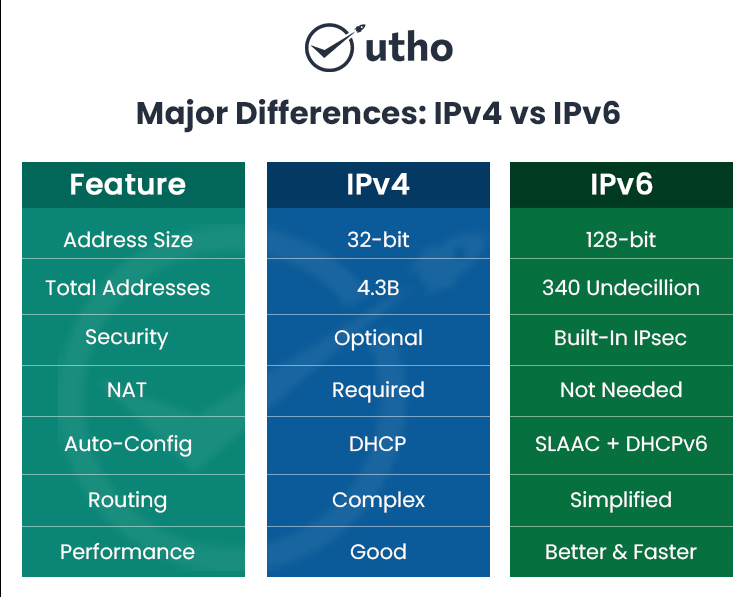
IPv4 and IPv6 serve the same fundamental purpose—identifying devices and enabling data communication across networks—but the way they achieve this is vastly different. IPv6 is not just a larger version of IPv4; it is a complete redesign built to secure and future-proof the global internet infrastructure.
Let’s explore these differences in depth.
- Address Size (32-bit vs 128-bit)
IPv4 – 32-bit Addressing
IPv4 was built with a 32-bit address structure, allowing a total of 4,294,967,296 unique addresses.
At the time of its creation, this seemed more than enough.
But today:
- Every smartphone
- Every laptop
- Every smart home device
- Every industrial sensor
- Every server
…all require unique IPs.
The 32-bit limit is one of IPv4’s biggest weaknesses.
IPv6 – 128-bit Addressing
IPv6 uses a much larger 128-bit structure.
This creates 340 undecillion (3.4 × 10³⁸) possible addresses.
To understand how massive this number is:
- IPv6 offers enough addresses to assign billions of IPs to every human.
- Or enough for every grain of sand on Earth.
- Even enough for every atom on the planet.
The result is a future-proof internet with effectively infinite address space.
- Number of Usable Addresses
| Protocol | Total Addresses | Practical Implication |
| IPv4 | 4.3 billion | Already exhausted |
| IPv6 | 340 undecillion | Practically unlimited |
The explosive growth of:
- Mobile devices
- IoT sensors
- Smart vehicles
- Cloud servers
…made IPv6 absolutely essential.
- Address Format and Representation
IPv4 Format
IPv4 addresses are shown in dotted decimal notation, e.g.:
172.16.254.1
It consists of four octets, each ranging from 0–255.
IPv6 Format
IPv6 uses hexadecimal notation separated by colons, e.g.:
2001:db8::ff00:42:8329
Differences include:
- Hexadecimal (0–9, a–f)
- Eight groups instead of four
- Compression rules (like using :: to shorten consecutive zeros)
IPv6 may look complex at first, but it is far more scalable and structured for large networks.
- Security Integration (Optional vs Mandatory IPsec)
IPv4 Security
IPv4 does not have built-in security.
IPsec can be added, but it’s optional and inconsistently adopted.
This leads to:
- Vulnerability to packet spoofing
- Weak source verification
- Inconsistent encryption across networks
IPv6 Security
IPv6 was designed with security at its core.
IPsec is mandatory, meaning:
- Packet authentication
- Data integrity
- Encryption
…are embedded at the protocol level.
This makes IPv6 inherently more secure for modern networks, cloud platforms, and IoT ecosystems.
- Configuration Methods (DHCP vs Auto-Configuration)
IPv4 Configuration
IPv4 typically uses:
- DHCP servers, or
- Manual configuration
This creates administrative overhead and slows down network deployment.
IPv6 Configuration
IPv6 introduces Stateless Address Auto Configuration (SLAAC).
With SLAAC:
- Devices automatically configure themselves
- No DHCP server required
- Networks become plug-and-play
- Ideal for large-scale IoT, cloud, and enterprise networks
This is one of IPv6’s most powerful features.
- NAT Usage (Essential vs Not Needed)
IPv4 Depends on NAT
Since IPv4 has limited addresses, NAT (Network Address Translation) became essential.
NAT allows:
- Many devices to share a single public IP
- Private IP addressing in homes and offices
But NAT creates problems:
- Breaks end-to-end connectivity
- Complicates peer-to-peer communication
- Causes issues with VoIP, gaming, and VPNs
- Adds overhead for routers
IPv6 Eliminates NAT
With IPv6:
- Every device can have its own unique public IP
- End-to-end communication is restored
- More transparent and efficient networks
This is a major architectural improvement.
- Header Complexity (Heavy vs Lightweight)
IPv4 Header
IPv4 headers are complex and contain many optional fields, which increases:
- Processing time
- Router workload
- Latency under heavy traffic
IPv6 Header
IPv6 headers are simplified and streamlined.
Benefits:
- Faster routing decisions
- Higher throughput
- More efficient packet forwarding
Routers can process IPv6 packets more quickly, improving overall internet performance.
- Speed and Network Performance
While raw speed depends on many factors, IPv6 has clear architectural advantages:
Why IPv6 Performs Better:
- Simplified packet headers
- More efficient routing
- No NAT overhead
- Native multicast support
- Cleaner end-to-end connections
Real-world benefits include:
- Lower latency
- Faster packet delivery
- More stable connectivity for streaming, gaming, and VoIP
- Broadcast vs Multicast Communication
IPv4: Broadcast
IPv4 uses broadcast to send packets to all devices on a network segment.
Problem:
- Wastes bandwidth
- Increases unnecessary processing on devices
- Causes network noise
IPv6: Multicast and Anycast
IPv6 removes broadcast entirely.
It uses:
- Multicast → Sends data only to subscribed devices
- Anycast → Sends data to the nearest available node
These techniques make IPv6 far more efficient and scalable.
- Packet Fragmentation Rules
IPv4 Fragmentation
In IPv4:
- Routers and hosts can both fragment packets
- Routers must reassemble fragmented packets
- Adds processing load and reduces performance
IPv6 Fragmentation
IPv6 simplifies this:
- Only end hosts perform fragmentation
- Routers never fragment packets
- Improves routing speed
- Reduces packet-handling complexity
This design makes the network core more efficient.
Summary Table
| Feature | IPv4 | IPv6 |
| Address Length | 32-bit | 128-bit |
| Total Addresses | 4.3B | 340 Undecillion |
| Security | Optional | Built-in |
| NAT | Required | Not required |
| Auto-Configuration | Limited | SLAAC & DHCPv6 |
| Routing | Moderate | Highly optimized |
| Performance | Good | Better |
| Best Use Cases | Legacy systems | Modern networks & IoT |
Benefits of IPv6 Over IPv4
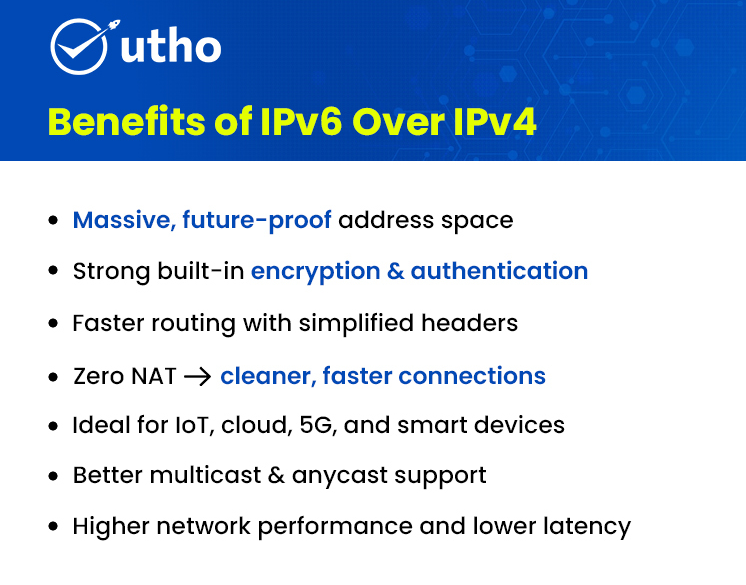
As the modern internet continues to expand—powering billions of devices, cloud services, IoT networks, mobile systems, and emerging technologies—IPv4’s limitations have become more visible than ever. IPv6 was engineered not only to solve IPv4’s address exhaustion but to create a more efficient, secure, and scalable foundation for the next evolution of global networking.
Here are the major advantages of IPv6 over IPv4 in detail.
- Virtually Unlimited Address Space
The most commonly known benefit of IPv6 is its massive address capacity.
IPv4 Address Space
- 32-bit
- 4.3 billion addresses
- Already exhausted
IPv6 Address Space
- 128-bit
- 340 undecillion addresses
- Sufficient for centuries to come
Why this matters:
- No need to recycle or ration IP addresses
- No dependency on NAT to conserve addresses
- Direct addressing for every device—servers, users, IoT endpoints, vehicles, sensors, and even future technologies
IPv6 makes it possible to assign unique public IPs to everything, restoring the original end-to-end design of the internet.
- Built-In, Next-Generation Security (Mandatory IPsec)
One of the biggest weaknesses of IPv4 is that security is optional. Encryption and authentication must be added separately.
IPv6 transforms this entirely by integrating IPsec as a mandatory component of the protocol.
IPv6 Security Enhancements Include:
- End-to-end encryption → Protects data during transmission
- Authentication headers → Confirms the identity of the packet sender
- Data integrity checks → Ensures packets are not modified in transit
- Anti-spoofing measures → Reduces fake source addresses
Applications Where IPv6 Security Makes a Big Difference:
- Cloud computing
- Financial transactions
- Government and defense networks
- Enterprise workloads
- Remote work environments
- Healthcare IT systems
By embedding encryption and authentication into the protocol itself, IPv6 establishes a more secure and resilient internet backbone.
- Faster Performance, Lower Latency, and Better Routing
IPv6 offers substantial performance improvements due to its optimized design.
Reasons IPv6 is Faster:
a. No NAT Overhead
NAT slows down IPv4 networks because:
- Routers must translate addresses
- Connections become stateful
- Applications require NAT traversal
IPv6 removes NAT completely, reducing delays.
b. Simplified Packet Headers
IPv6 headers are designed for efficiency:
- Less processing per packet
- Faster routing decisions
- Improved throughput under heavy traffic
c. Cleaner Routing Infrastructure
IPv6 supports:
- Multilevel hierarchical addressing
- Reduced routing table sizes
- More efficient route aggregation
This leads to lower hop counts, which translate directly to:
- Lower latency
- Faster content delivery
- Smoother real-time communication
- Simplified Network Management Through Auto-Configuration
Managing large networks in IPv4 requires:
- DHCP servers
- Manual IP assignment
- Subnet planning
- NAT configuration
IPv6 modernizes this process with SLAAC (Stateless Address Auto Configuration).
What SLAAC Allows:
- Devices self-configure with zero human involvement
- Network deployment becomes plug-and-play
- No need for NAT or complex IP planning
- Perfect for rapidly growing IoT networks and cloud data centers
IPv6 can also use DHCPv6, but it’s optional—not a requirement.
For network administrators, this translates into:
- Lower maintenance cost
- Fewer IP conflicts
- Faster network expansion
- Reduced configuration errors
- Better Multicast Handling (No Broadcast)
IPv4 relies heavily on broadcast, meaning packets are sent to all devices on the network—even when only a few need them.
This creates:
- Unnecessary noise
- Increased overhead
- Wasted bandwidth
- Slower performance
IPv6 Eliminates Broadcast Entirely
Instead, it uses:
- Multicast → Sends packets only to subscribed devices
- Anycast → Routes packets to the nearest available node
Benefits of IPv6 Multicast:
- Higher efficiency
- Lower network congestion
- Smoother video streaming
- Faster routing updates
- Reduced CPU usage on devices
This is crucial for:
- IPTV
- Real-time data feeds
- Video conferencing
- Cloud service synchronization
- Designed for the IoT Explosion
The Internet of Things represents billions of connected devices, all requiring unique IP addresses.
IoT Includes:
- Smart home devices
- Wearable
- Industrial sensors
- Autonomous vehicles
- Smart city infrastructure
- Healthcare devices
- Environmental monitoring systems
IPv4 simply cannot support this scale.
Why IPv6 is Perfect for IoT:
- Virtually unlimited addresses
- Built-in auto-configuration
- Better security
- No NAT restrictions
- Efficient multicast communication
IPv6 enables a world where everything—from refrigerators to robots—can communicate seamlessly and securely.
- No Need for NAT (Improved Connectivity and Application Performance)
NAT is one of the biggest bottlenecks in IPv4 networking.
With IPv6:
- NAT is unnecessary
- Every device gets its own real IP
- End-to-end connectivity is restored
This improves:
Peer-to-Peer Applications
- Torrents
- File sharing
- Distributed networks
- Blockchain nodes
VoIP and Video Calls
- Faster call setup
- Lower latency
- Fewer connection failures
Online Gaming
- Reduced lag
- Fewer NAT-type restrictions
- More stable matchmaking
Remote Access Tools
- Easier port forwarding
- Fewer firewall conflicts
- Direct host-to-host communication
Removing NAT improves both the performance and simplicity of modern internet applications.
Challenges in Migrating from IPv4 to IPv6
Although IPv6 is architecturally superior and built to replace IPv4, the real-world migration process has been surprisingly slow and complex. The shift isn’t as simple as flipping a switch—networks across the world are built on infrastructure, devices, and software that have been running IPv4 for decades.
Here are the major challenges that organizations face:
- Compatibility Issues with Existing Systems
One of the biggest roadblocks is that IPv4 and IPv6 are not directly compatible.
They use different addressing systems, packet structures, and communication formats.
Because of this:
- IPv6-only devices cannot communicate directly with IPv4-only devices.
- Many legacy applications assume IPv4 and break when presented with IPv6 addresses.
- Network tools for monitoring, logging, firewalls, and routing often require updates to understand IPv6 traffic.
This incompatibility forces organizations to maintain both protocols simultaneously, increasing complexity.
- Legacy Devices and Software That Don’t Support IPv6
Large enterprises, ISPs, data centers, and government agencies typically use hardware that lasts many years. Much of this older equipment:
- Does not support IPv6 natively,
- Requires firmware upgrades, or
- Needs to be replaced entirely.
Examples include:
- Old routers and switches
- Firewalls that cannot inspect IPv6 packets
- Operating systems with limited IPv6 functionality
- Proprietary software written only for IPv4
For many companies, replacing this infrastructure is costly and time-consuming—which slows down migration.
- Skill Gap and Training Requirements
IPv6 introduces new concepts—link-local addressing, new routing protocols, neighbor discovery, IPv6 security rules, etc.
Network engineers who have worked with IPv4 for years often need specialized training to:
- Configure dual-stack networks
- Design IPv6 addressing schemes
- Debug IPv6 routing issues
- Update security policies for IPv6 traffic
Without proper skill development, organizations hesitate to adopt IPv6, fearing misconfigurations or downtime.
- Cost of Upgrading Infrastructure
Migration to IPv6 is not just a technical process—it's also a financial one. Costs may include:
- Purchasing IPv6-compatible routers/switches
- Upgrading firewalls, load balancers, and monitoring tools
- Hiring consultants or training teams
- Testing new configurations
- Rewriting or modernizing old software
For small businesses or ISPs operating on tight margins, these costs significantly delay adoption.
- Dual-Stack Complexity
Most organizations transition using a dual-stack setup, where both IPv4 and IPv6 run simultaneously.
While dual-stack ensures compatibility, it introduces new problems:
- Double the routing tables
- Double the security rules
- Double the troubleshooting efforts
- Increased operational load on network administrators
Essentially, teams must manage two parallel networks during the transition period, which can last years.
- ISPs Still Relying Heavily on IPv4
Many Internet Service Providers (especially in developing regions) still rely primarily on IPv4 because:
- Their back-end systems and routers haven't been upgraded
- They use carrier-grade NAT (CGNAT) to extend IPv4 usage
- There is no regulatory or financial pressure to move to IPv6
- Customers are unaware of or indifferent to IPv6
Until ISPs adopt IPv6 at the core network level, end-to-end IPv6 connectivity will remain limited.
Transition Mechanisms Used to Bridge the Gap
To keep the internet functioning during this long migration, several transition strategies are used:
1. Dual Stack
Running IPv4 and IPv6 together on the same devices and networks.
Pros: Full compatibility
Cons: High cost and complexity
2. Tunneling
Encapsulating IPv6 packets inside IPv4 packets so they can travel over IPv4 infrastructure.
Examples: 6to4, Teredo, ISATAP
Pros: Works without upgrading the entire network
Cons: Adds latency and overhead
3. Translation Mechanisms
These convert IPv4 and IPv6 packets so devices using different protocols can communicate.
Examples: NAT64, DNS64
Pros: Allows IPv6-only devices to reach IPv4 content
Cons: Adds operational complexity
Real-World Use Cases of IPv6
1. Telecom networks
Most major carriers use IPv6 internally for better performance.
2. IoT ecosystems
Smart homes rely on IPv6 for device-to-device communication.
3. Cloud providers
AWS, Google Cloud, Azure support IPv6 natively.
4. Content delivery networks
Cloudflare, Akamai, and Fastly have IPv6 support for faster routing.
5. Government and enterprise modernization
Many governments now require IPv6 compatibility in infrastructure tenders.
IPv6 Adoption Across the World
Adoption varies:
- USA: ~50–60%
- India: ~60% (among highest globally)
- Europe: 30–40%
- Africa: Growing but limited
- China: Rapid rollout due to massive IoT usage
However, IPv4 is still widely used.
IPv4 vs IPv6: Which One Should You Use?
Use IPv4 If:
- You have legacy systems
- Your ISP doesn’t support IPv6
- Your network hardware isn't IPv6-ready
Use IPv6 If:
- You want faster performance
- You handle large-scale applications
- You rely on IoT devices
- You need better security
- You operate globally
Best Option: Dual Stack
Most modern networks run both IPv4 and IPv6 simultaneously, ensuring compatibility while preparing for the future.
Final Thoughts
The debate between IPv4 and IPv6 is not about choosing one over the other—it’s about progression. IPv4 has faithfully served as the foundation of the internet, but its limitations make it unsuitable for the hyper-connected world we are moving toward.
IPv6 is not just a replacement—it’s an upgrade designed for the next century. With better security, performance, scalability, and automation, IPv6 represents the future of digital communication.
Businesses, developers, network architects, and organizations must embrace IPv6 to stay ahead in a world where connectivity grows exponentially.