

SQL is an important skill for people who work with computers and data. It is used by developers, analysts, database engineers and testers. SQL interviews check how well you understand databases and how clearly you can write queries. This is useful for students who are new and also for people who already have work experience. That’s why this ultimate guide brings you the Top 50+ SQL Interview Questions and Answers for 2026, explained in a simple and beginner-friendly way.
In this complete guide, we have covered:
- Basic SQL Interview Questions
- Top SQL Interview Questions for Freshers
- Most Asked SQL Interview Questions
- SQL Interview Questions for Experienced
- MySQL Interview Questions
- Real-world scenarios & examples
- Performance-based and optimization questions
This blog is designed to help everyone—from beginners to working professionals—practice and master the top 50 SQL interview questions that companies ask during technical round.
In this blog we will use important words like sql interview questions sql interview questions and answers top sql interview questions top 50 sql interview questions sql interview questions for freshers sql interview questions for experienced most asked sql interview questions basic sql interview questions and mysql interview questions many times. This is done so that the blog can be easily found on the internet.
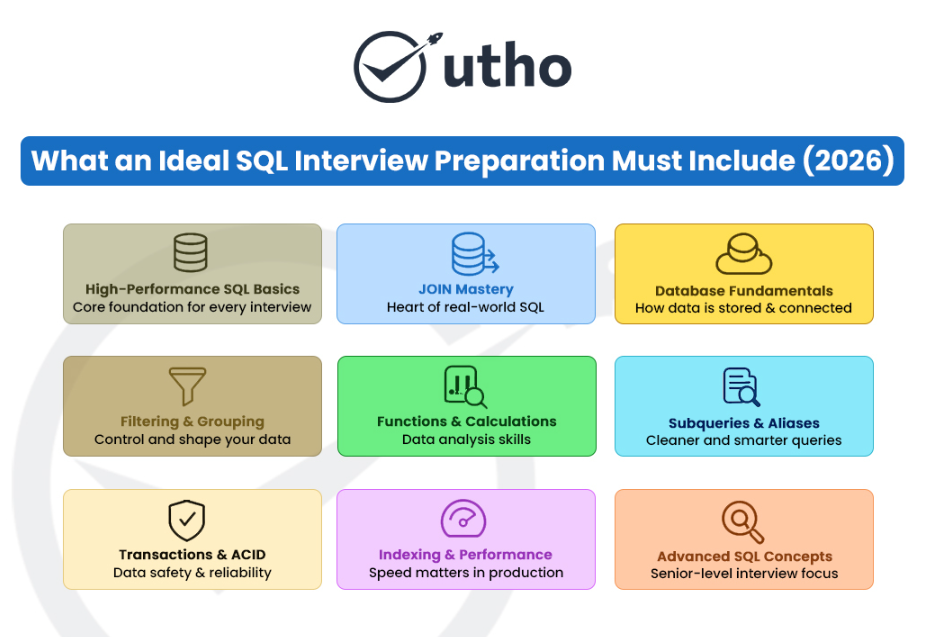
Chapter 1: Introduction to SQL for Interviews
SQL means Structured Query Language. It is a language used to work with databases like MySQL PostgreSQL SQL Server Oracle and MariaDB. In most interviews questions start with basic sql interview questions. These questions check if you understand the basics well. After that interviews move to harder topics like joins indexing transactions and making queries faster.
Companies hiring in 2026 expect candidates to know:
- How to write optimized queries
- How to use JOINs effectively
- How to manage large datasets
- How to tune SQL performance
- How to handle transactions and locking
- How to use SQL functions
This is why understanding both sql interview questions for freshers and sql interview questions for experienced is extremely important.
Chapter 2: Basic SQL Interview Questions (Perfect for Beginners)
These are basic sql interview questions asked in almost every entry-level interview.
1. What is SQL?
SQL is a simple language used to work with data. It helps you store data, see data and change data in a database. People use SQL to manage information easily on computers.
- Create and modify database structures (DDL)
- Insert, update, and delete data (DML)
- Retrieve and filter data using queries (DQL)
- Control access permissions and security (DCL)
- Manage transactions and ensure data integrity (TCL)
SQL works in a simple way. You tell SQL what result you want and SQL finds the best way to get it. You do not need to tell every step. SQL works with data stored in tables.
SQL is used in many database systems like MySQL PostgreSQL Oracle SQL Server and cloud databases. Because of this SQL is very important to learn.
This question is one of the most common sql interview questions and answers. It is asked to check if a person really understands SQL and not just the meaning of the word.
2. What is a Database?
A database is a structured, logically organized collection of data that allows efficient storage, retrieval, management, and manipulation of information. Databases ensure:
- Data consistency
- High availability
- Efficient querying
- Secure access control
- Backup and recovery capabilities
In relational databases (RDBMS), data is stored in tables using rows and columns. Relationships are established using primary keys, foreign keys, and constraints, making data more organized and reliable.
Modern databases support:
- Large-scale enterprise applications
- E-commerce platforms
- Banking systems
- Cloud-based infrastructures
This question is usually included in basic sql interview questions, especially for candidates learning how SQL interacts with stored information.
3. What is a Table?
A table is a place where data is stored in a simple way. It looks like a grid made of rows and columns.
Rows show one full record like details of one person.
Columns show one type of information like name or email.
For example: A users table can store user id name and email. Each row has data of one user.
Tables use simple rules to keep the data clean and correct.
- Data accuracy
- Fast search performance
- Referential integrity
- Efficient query execution
Because tables form the backbone of relational systems, this is a common topic in top sql interview questions.
4. What is a Primary Key?
A Primary Key is a special column—or a combination of columns—used to uniquely identify each record in a table. It ensures that:
- Every row can be distinguished from all others
- No duplicate values are allowed
- No NULL values are permitted
A primary key automatically creates a unique index, which improves search performance and enforces data integrity inside relational databases.
Primary keys are critical for relational design because they:
- Serve as reference points for other tables
- Maintain entity integrity
- Enable fast lookups
- Prevent duplicate data insertion
Example:
- student_id INT PRIMARY KEY
This is one of the most frequent topics in top 50 SQL interview questions, as it forms the foundation of relational database design.
5. What is a Foreign Key?
A Foreign Key is a column in one table that points to the Primary Key of another table. It is used to:
- Establish and maintain relationships between tables
- Ensure referential integrity
- Prevent insertion of invalid or orphaned records
When a foreign key is applied, the database ensures that:
- You cannot insert a value that does not exist in the referenced table
- You cannot delete a referenced row unless cascading rules allow it
- Relationship-based queries become more structured and accurate
Foreign keys are essential in designing normalized relational databases, where multiple tables work together.
Example:
- student_id INT,
- FOREIGN KEY (student_id) REFERENCES students(id)
6. What is a Constraint?
A Constraint is a rule enforced on a table’s column to maintain validity, reliability, accuracy, and consistency of data. Constraints prevent invalid operations and ensure that only correct data gets stored.
Common types of SQL constraints include:
- NOT NULL – Disallows empty values
- UNIQUE – Ensures all values are distinct
- PRIMARY KEY – Unique + Not Null
- FOREIGN KEY – Maintains relationships between tables
- CHECK – Applies a conditional rule
- DEFAULT – Assigns a value when none is provided
Constraints are a central part of data governance in databases and appear in many sql interview questions for freshers and experienced.
7 What is a Join
A Join is used in SQL to connect data from two or more tables. It combines information using a common column. Joins help get useful data when information is stored in many tables.
This is one of the most common sql interview questions. It often appears in practical tests.
Types of SQL Joins
1 INNER JOIN
Shows only the records that match in both tables
2 LEFT JOIN
Shows all records from the left table and matching records from the right table. If there is no match it shows NULL
3 RIGHT JOIN
Shows all records from the right table and matching records from the left table. If there is no match it shows NULL
4 FULL JOIN
Shows all records from both tables. If there is no match it shows NULL
Joins are very important for working with databases. They appear in almost every top sql interview questions list
8. What is Normalization
Normalization is a way to organize data in a database. It removes duplicate data and makes the database more correct and easy to manage.
The main goals of normalization are
Reduce repeated data
Avoid problems when adding changing or deleting data
Keep data consistent across tables
Make the database more organized and ready to grow
Normalization splits a big table into smaller related tables using keys. Each level of normalization has stricter rules to keep data organized
Common Normal Forms
1. First Normal Form 1NF
Makes sure each value is simple and there are no repeated groups in a table.
- Each column holds a single value
- All rows are uniquely identifiable
2. Second Normal Form (2NF)
- Must already satisfy 1NF
- Removes partial dependency on a composite primary key
3. Third Normal Form (3NF)
- Must satisfy 2NF
- Removes transitive dependencies
- No column should depend on another non-key column
Boyce–Codd Normal Form (BCNF)
- A stricter form of 3NF
- Every determinant must be a candidate key
Normalization is a crucial topic and appears in many basic SQL interview questions, sql interview questions for freshers, and even experienced-level technical rounds.
9. What is Denormalization?
Denormalization means adding some repeated data back into a database on purpose. This is done to make reading data faster.
While normalization tries to remove repeated data, denormalization focuses on making the database quicker for queries.
It is commonly used in:
- Reporting systems
- Data warehouses
- Analytics platforms
- High-performance applications
Why Denormalization is Used?
- Reduces the need for complex joins
- Speeds up SELECT queries
- Improves performance in large-scale systems
- Enhances caching efficiency
Examples of Denormalization Techniques:
- Storing pre-calculated totals
- Adding summary tables
- Creating duplicate columns for faster access
- Combining multiple normalized tables into a single table
Denormalization is often asked in sql interview questions for experienced, especially for roles related to performance optimization.
10. What is a View?
A View is a virtual table created using a SQL query. It does not store data physically; instead, it generates results dynamically when accessed. Views are used to:
- Simplify complex queries
- Provide secure access to selective data
- Create abstraction layers
- Improve readability and maintainability of queries
Types of Views:
1. Simple View
- Based on a single table
- Does not use functions, joins, or group operations
2. Complex View
- Created using joins, aggregations, or functions
- Commonly used to simplify heavy reporting queries
Advantages of Views:
- Enhances security by restricting direct table access
- Ensures consistent results for repetitive queries
- Hides sensitive columns
- Reduces query complexity
Example:
CREATE VIEW employee_view AS
SELECT name, department, salary
FROM employees
WHERE status = 'active';
Views are a frequently recurring topic in top sql interview questions and often appear in sql interview questions for freshers because they test understanding of database abstraction.
Top SQL Interview Questions for Freshers
If you are applying for internships or junior roles, you must prepare these sql interview questions for freshers.
11. What is the difference between DELETE, TRUNCATE, and DROP?
The DELETE, TRUNCATE, and DROP commands are used for removing data or database structures, but each works differently.
DELETE
- Type: DML (Data Manipulation Language)
- Purpose: Deletes specific rows from a table based on a condition.
- Can use WHERE clause.
- Logs each deleted row → slower.
- Table structure remains unchanged.
- Auto-increment counters do not reset.
Example:
DELETE FROM employees WHERE department = 'Sales';
TRUNCATE
- Type: DDL (Data Definition Language)
- Purpose: Removes all rows from the table.
- Cannot use WHERE clause.
- Very fast because it does not log individual row deletions.
- Auto-increment counter resets.
- Table structure remains.
Example:
TRUNCATE TABLE employees;
DROP
- Type: DDL
- Purpose: Deletes the entire table including data and structure.
- After DROP, the table cannot be accessed unless recreated.
Example:
DROP TABLE employees;
This is one of the most commonly asked questions in SQL interviews.
12. What is the SQL SELECT statement?
The SELECT statement is the most frequently used SQL command. It retrieves data from one or more tables.
Key features:
- Used to fetch specific or all columns.
- Can include filtering, sorting, joins, and aggregations.
Basic Example:
SELECT * FROM employees;
Selecting specific columns:
SELECT name, salary FROM employees;
13. What is the WHERE clause?
The WHERE clause is used to filter rows based on specific conditions.
Only rows that satisfy the condition are returned.
Supports operators like:
=, >, <, BETWEEN, LIKE, IN
Example:
SELECT * FROM employees
WHERE salary > 50000;
14. What is GROUP BY used for?
The GROUP BY clause groups rows that have similar values in one or more columns.
It is commonly used with aggregate functions like COUNT, SUM, AVG, MAX, MIN.
Example:
SELECT department, COUNT(*)
FROM employees
GROUP BY department;
This is one of the most frequently asked SQL interview questions because grouping is essential for reporting and analytics.
15. What is HAVING?
HAVING is used to filter results after the GROUP BY operation.
It works like a WHERE clause, but for aggregated data.
Example:
SELECT department, COUNT(*) AS total
FROM employees
GROUP BY department
HAVING COUNT(*) > 10;
16. What are Aggregate Functions?
Aggregate functions perform calculations on multiple rows and return a single value.
Common aggregate functions:
- COUNT(): Returns number of rows
- SUM(): Adds numeric values
- AVG(): Returns average
- MAX(): Highest value
- MIN(): Lowest value
Example:
SELECT COUNT(*) FROM employees;
These appear in almost every SQL interview for freshers because they form the foundation of data analysis.
17. What is ORDER BY in SQL?
The ORDER BY clause is used to arrange data in order. It can sort data from small to big or from A to Z. This is called ascending order
It can also sort data from big to small or from Z to A. This is called descending order.
Sorting is useful when making reports or showing data to people. ORDER BY is often used with LIMIT or TOP to show only the top results
Example (Ascending):
SELECT name, salary
FROM employees
ORDER BY salary ASC;
Example (Descending):
SELECT name, salary
FROM employees
ORDER BY salary DESC;
Key Points:
- Multiple columns can be used: ORDER BY department ASC, salary DESC
- Sorting happens after filtering and grouping, not before.
18. What are Wildcards in SQL?
Wildcards are special symbols used in SQL with LIKE. They help find words or data even if you only know part of it.
Common Wildcards:
% : Represents zero or more characters
_ : Represents exactly one character
Examples:
-- Find names starting with 'A'
SELECT * FROM employees
WHERE name LIKE 'A%';
-- Find names with 'a' as the second character
SELECT * FROM employees
WHERE name LIKE '_a%';
Wildcards are frequently asked in basic sql interview questions because they test understanding of flexible string matching.
19. What is a Subquery in SQL?
A subquery, or nested query, is a query embedded inside another SQL query. It allows you to perform intermediate calculations or filtering, which can then be used by the outer query.
Subqueries can appear in:
- SELECT statements
- WHERE conditions
- FROM clauses
Example (Subquery in WHERE):
SELECT name, salary
FROM employees
WHERE salary > (SELECT AVG(salary) FROM employees);
Example (Subquery in FROM):
SELECT department, MAX(salary)
FROM (SELECT * FROM employees) AS emp
GROUP BY department;
Subqueries are common in top sql interview questions because they test problem-solving, logical thinking, and query writing skills.
20. What is an Alias in SQL?
An alias is a temporary name given to a table or column to make queries more readable, improve clarity, or avoid name conflicts. Aliases are widely used in reporting, joins, and subqueries.
Syntax:
- Column Alias: column_name AS alias_name
- Table Alias: table_name AS alias_name
Examples:
Column Alias:
SELECT name AS employee_name, salary AS employee_salary
FROM employees;
Table Alias (Useful in Joins):
SELECT e.name, d.department_name
FROM employees AS e
JOIN departments AS d ON e.department_id = d.department_id;
Key Points:
- Aliases exist only during the execution of the query.
- They improve readability and maintainability.
- Commonly asked in sql interview questions for freshers and experienced because they are essential for real-world query writing.
21. Explain INNER JOIN with Example
An INNER JOIN returns only the records that have matching values in both tables. It is widely used when you want to combine related data from multiple tables but exclude non-matching rows.
Example:
SELECT e.name, d.department_name
FROM employees AS e
INNER JOIN departments AS d
ON e.dept_id = d.id;
Key Points:
- Rows without a match in either table are excluded.
- Useful for combining normalized data in relational databases.
- One of the most asked SQL interview questions, especially in joins and relational database design.
22. Explain LEFT JOIN with Example
A LEFT JOIN (or Left Outer Join) returns all rows from the left table, and the matching rows from the right table. If there is no match, the result contains NULL for the right table columns.
Example:
SELECT e.name, d.department_name
FROM employees AS e
LEFT JOIN departments AS d
ON e.dept_id = d.id;
Key Points:
- Ensures no data is lost from the left table.
- Useful when you want to retrieve all records, even if related data is missing.
- Frequently asked in top SQL interview questions.
23. What is a Self Join?
A Self Join is a join where a table is joined to itself to compare rows within the same table. It is commonly used to find hierarchical relationships or compare rows.
Example:
SELECT e1.name AS Employee, e2.name AS Manager
FROM employees AS e1
LEFT JOIN employees AS e2
ON e1.manager_id = e2.id;
Key Points:
- Requires table aliases for clarity.
- Useful for hierarchical queries or comparing data within the same table.
- Often appears in advanced SQL interview questions.
24. What is a Stored Procedure?
A Stored Procedure is a precompiled, reusable block of SQL code stored in the database. It can accept input parameters, execute queries, and return results.
Advantages:
- Reduces repetitive coding
- Improves performance by avoiding multiple parsing
- Centralizes business logic in the database
Example:
CREATE PROCEDURE GetEmployeesByDept(IN dept_id INT)
BEGIN
SELECT * FROM employees WHERE dept_id = dept_id;
END;
25. What is a Trigger?
A Trigger is a database object that automatically executes a set of SQL statements in response to certain events on a table, such as INSERT, UPDATE, or DELETE.
Example:
CREATE TRIGGER before_employee_insert
BEFORE INSERT ON employees
FOR EACH ROW
SET NEW.created_at = NOW();
Key Points:
- Used for auditing, validation, or enforcing business rules.
- Triggers help automate tasks without modifying application logic.
- Frequently asked in sql interview questions for experienced.
26. What is ACID in Databases?
ACID is a set of properties that guarantee reliable transactions in databases:
- Atomicity: All operations in a transaction are completed or none are.
- Consistency: Database remains in a valid state before and after a transaction.
- Isolation: Transactions are executed independently without interference.
- Durability: Once committed, changes persist even in case of failures.
Why Important:
ACID ensures data integrity in critical systems and is a must-know topic in sql interview questions for experienced.
27. What is a Transaction?
A Transaction is a sequence of one or more SQL operations executed as a single logical unit. Either all operations succeed, or none are applied, maintaining data consistency.
Example:
START TRANSACTION;
UPDATE accounts SET balance = balance - 100 WHERE id = 1;
UPDATE accounts SET balance = balance + 100 WHERE id = 2;
COMMIT;
Key Points:
- Transactions are crucial for banking, e-commerce, and financial applications.
- Testing understanding of transactions is common in top SQL interview questions.
28. What is COMMIT?
The COMMIT command saves all changes permanently in the database that were part of the current transaction.
Example:
COMMIT;
Key Points:
- Marks the successful end of a transaction.
- Ensures that all operations in the transaction are durable.
29. What is ROLLBACK?
The ROLLBACK command undoes all changes made in the current transaction, reverting the database to its previous consistent state.
Example:
ROLLBACK;
Key Points:
- Used when an error occurs during a transaction.
- Ensures database integrity and prevents partial updates.
30. What is an Index?
An Index is a database structure that improves query performance by enabling faster data retrieval. It works like an index in a book.
Types of Indexes:
- Clustered Index: Reorganizes physical storage based on the key.
- Non-Clustered Index: Creates a separate structure pointing to the data.
Example:
CREATE INDEX idx_emp_name ON employees(name);
Key Points:
- Speeds up searches, joins, and aggregations.
- Often asked in performance optimization interview questions.
31. What are Clustered vs Non-Clustered Indexes? (Detailed Explanation)
Indexes improve query performance, but there are two main types:
Clustered Index
- Determines the physical order of data in the table.
- Each table can have only one clustered index.
- Searching, range queries, and sorting are faster because the data is stored in order.
Example:
CREATE CLUSTERED INDEX idx_emp_id ON employees(emp_id);
Non-Clustered Index
- Maintains a separate structure from the table that points to the data.
- A table can have multiple non-clustered indexes.
- Useful for columns frequently used in WHERE, JOIN, or ORDER BY.
Example:
CREATE NONCLUSTERED INDEX idx_emp_name ON employees(name);
Key Points:
- Clustered index = table sorted physically
- Non-clustered index = pointer structure
- Frequently asked in top SQL interview questions for performance optimization.
32. What is SQL Injection? (Detailed Explanation)
SQL Injection is a security vulnerability where attackers inject malicious SQL code to manipulate the database.
Impact:
- Unauthorized data access
- Data modification or deletion
- Bypassing authentication
Prevention Techniques:
- Use prepared statements or parameterized queries
- Validate user input
- Limit database permissions
Example of vulnerable code:
SELECT * FROM users WHERE username = 'admin' AND password = ' ' OR '1'='1';
This is highly asked in SQL interview questions for experienced candidates.
33. What is the difference between UNION and UNION ALL?
- UNION: Combines results of two queries and removes duplicates.
- UNION ALL: Combines results including duplicates.
Examples:
-- UNION (removes duplicates)
SELECT city FROM customers
UNION
SELECT city FROM suppliers;
-- UNION ALL (keeps duplicates)
SELECT city FROM customers
UNION ALL
SELECT city FROM suppliers;
Key Points:
- UNION performs an implicit DISTINCT → slower
- UNION ALL is faster → no duplicate elimination
34. What is DISTINCT in SQL?
DISTINCT removes duplicate rows in query results.
Example:
SELECT DISTINCT department FROM employees;
Key Points:
- Useful in reporting and analytics
- Frequently appears in sql interview questions for freshers
35. What is the BETWEEN Operator?
BETWEEN filters rows within a specific range of values.
Example:
SELECT * FROM employees
WHERE salary BETWEEN 40000 AND 60000;
Key Points:
- Inclusive of boundary values
- Can be used with numbers, dates, or strings
36. What is EXISTS in SQL?
EXISTS checks whether a subquery returns any rows. Returns TRUE if the subquery has results, otherwise FALSE.
Example:
SELECT name
FROM employees e
WHERE EXISTS (
SELECT 1
FROM departments d
WHERE e.dept_id = d.id
);
Key Points:
- Optimized for correlated subqueries
- Frequently tested in advanced SQL interview questions
37. What are ANY and ALL in SQL?
- ANY: Compares a value to any value in a subquery. Returns TRUE if comparison matches at least one row.
- ALL: Compares a value to all values in a subquery. Returns TRUE only if the condition holds for every row.
Example:
-- Salary greater than any in department 1
SELECT * FROM employees
WHERE salary > ANY (SELECT salary FROM employees WHERE dept_id = 1);
-- Salary greater than all in department 1
SELECT * FROM employees
WHERE salary > ALL (SELECT salary FROM employees WHERE dept_id = 1);
38. What are Temporary Tables?
Temporary tables store data temporarily during a session or transaction. They are automatically deleted when the session ends.
Example:
CREATE TEMPORARY TABLE temp_employees AS
SELECT * FROM employees WHERE department = 'Sales';
Key Points:
- Useful for intermediate calculations or staging data
- Reduces impact on main tables
- Common in performance-focused SQL interview questions
39. What is COALESCE in SQL?
COALESCE returns the first non-NULL value in a list of expressions.
Example:
SELECT COALESCE(phone_home, phone_mobile, 'N/A') AS contact_number
FROM employees;
Key Points:
- Useful for handling missing or NULL data
- Frequently appears in sql interview questions for data manipulation
40. What is NULL in SQL?
NULL represents unknown or missing data. It is not the same as 0 or an empty string.
Key Points:
- Special handling required in comparisons: IS NULL or IS NOT NULL
- Aggregate functions often ignore NULL values
- Example:
SELECT * FROM employees WHERE manager_id IS NULL;
Chapter 5: SQL Interview Questions for Experienced Professionals
If you're applying for senior roles, prepare these sql interview questions for experienced.
41. How do you optimize SQL queries? (Deep Explanation)
Optimizing SQL queries is crucial for performance and scalability. Key strategies include:
- Use Indexes: Speed up searches on frequently queried columns.
- Avoid SELECT *: Fetch only required columns to reduce I/O.
- Proper WHERE Conditions: Use filters to limit rows scanned.
- Avoid Subqueries (when possible): Replace with JOINs for better performance.
- Limit Data Fetch: Use LIMIT or TOP when retrieving large datasets.
- Analyze Execution Plans: Check how SQL engine processes queries and identify bottlenecks.
Example:
EXPLAIN SELECT name, salary FROM employees WHERE department_id = 1;
Key Points:
Query optimization is frequently asked in sql interview questions for experienced or performance-focused roles.
42. What is an Execution Plan?
An Execution Plan shows how the SQL engine executes a query internally. It details:
- The sequence of operations
- Join algorithms used
- Index usage
- Estimated vs actual row counts
- Cost of each operation
Example (MySQL):
EXPLAIN SELECT * FROM employees WHERE salary > 50000;
Key Points:
- Helps identify slow queries
- Critical for query tuning and optimization
- Common in advanced SQL interview questions
43. What is Sharding in Databases?
Sharding is a horizontal partitioning technique where a large table is split into smaller, distributed pieces called shards, often stored across multiple servers.
Benefits:
- Improves scalability and performance
- Reduces server load
- Enables distributed processing
Example:
- Users with ID 1–100000 → Shard 1
- Users with ID 100001–200000 → Shard 2
Sharding is commonly asked in system design and SQL interview questions for experienced candidates.
44. What is Partitioning?
Partitioning divides a table or index into smaller, manageable segments within the same server to improve query performance and maintenance.
Types of Partitioning:
- Range Partitioning: Divide based on value ranges (e.g., dates).
- List Partitioning: Divide based on specific values.
- Hash Partitioning: Distribute data evenly using a hash function.
Example:
CREATE TABLE sales (
sale_id INT,
sale_date DATE,
amount DECIMAL(10,2)
)
PARTITION BY RANGE (YEAR(sale_date)) (
PARTITION p2022 VALUES LESS THAN (2023),
PARTITION p2023 VALUES LESS THAN (2024)
);
Key Points:
- Reduces I/O for queries
- Improves performance on large datasets
- Frequently discussed in database optimization questions
45. What is the difference between OLTP and OLAP?
OLTP (Online Transaction Processing):
- Transaction-based systems (insert, update, delete)
- Handles high volume, short, fast operations
- Examples: Banking apps, e-commerce transactions
OLAP (Online Analytical Processing):
- Analytical queries for reporting and business intelligence
- Handles complex aggregations and historical data analysis
- Examples: Data warehouses, dashboards
Key Points:
Understanding OLTP vs OLAP is critical in SQL interview questions for system design and database architecture.
46. What is a CTE (Common Table Expression)?
A CTE is a temporary, named result set used within a query. It improves readability and modularity, especially for complex queries or recursion.
Example:
WITH sales_cte AS (
SELECT * FROM sales WHERE amount > 1000
)
SELECT * FROM sales_cte;
Key Points:
- Improves query organization
- Can be recursive for hierarchical data
- Frequently appears in advanced SQL interview questions
47. What is a Window Function?
Window Functions perform calculations across a set of rows related to the current row, without collapsing results like GROUP BY.
Example:
SELECT name, salary,
RANK() OVER (ORDER BY salary DESC) AS salary_rank
FROM employees;
Key Points:
- Useful for ranking, running totals, moving averages
- Does not reduce rows in result
- Frequently asked in analytical SQL interview questions
48. What is a Deadlock?
A Deadlock occurs when two or more transactions wait indefinitely for resources locked by each other, causing a system halt.
Example Scenario:
- Transaction A locks row 1 and waits for row 2
- Transaction B locks row 2 and waits for row 1
Resolution:
- Database engine automatically kills one transaction to break deadlock
- Proper indexing and transaction ordering can prevent deadlocks
Key Points:
- Important for transaction management in SQL interviews for experienced roles
49. What is Locking in SQL?
Locking ensures data consistency during concurrent transactions.
- Types of locks:
- Shared Lock (S): Read-only access
- Exclusive Lock (X): Write access, prevents others from reading or writing
Example:
SELECT * FROM employees WHERE department_id = 1 FOR UPDATE;
Key Points:
- Prevents race conditions and anomalies
- Fundamental topic in ACID and transactional SQL interviews
50. Explain Normal Forms in Detail
Normal Forms (NFs) are rules to structure relational databases to reduce redundancy and improve integrity:
- 1NF: Atomic columns, unique rows
- 2NF: No partial dependency on a composite key
- 3NF: No transitive dependency
- BCNF: Every determinant is a candidate key
- 4NF & 5NF: Handle multi-valued dependencies and join dependencies
Key Points:
- Helps in system design, relational modeling, and query efficiency
- Frequently asked in sql interview questions for freshers and experienced
Chapter 6: MySQL Interview Questions (Special Section for 2026)
Since MySQL remains one of the most widely used open-source databases, companies ask many mysql interview questions along with standard SQL topics.
Let’s look at the most important mysql interview questions for 2026.
51. What is MySQL Performance Schema?
MySQL Performance Schema is a feature that allows monitoring and analyzing the internal execution of MySQL server. It helps DBAs and developers identify performance bottlenecks, resource usage, and query execution patterns.
Key Features:
- Monitors SQL statements, stages, and wait events
- Provides insights into I/O, locks, and memory usage
- Can track long-running queries and transaction performance
Example:
SELECT *
FROM performance_schema.events_statements_summary_by_digest
ORDER BY SUM_TIMER_WAIT DESC;
Key Points:
- Essential for query optimization and server tuning
- Frequently asked in MySQL interview questions for experienced candidates
52. How does MySQL store data internally?
MySQL uses storage engines to manage how data is stored, indexed, and accessed. Each engine has unique characteristics.
Common Storage Engines:
- InnoDB: Default engine; supports transactions, row-level locking, foreign keys
- MyISAM: Fast for read-heavy workloads, but no transactions or foreign keys
- Memory Engine: Stores data in RAM for ultra-fast access; volatile (data lost on shutdown)
Key Points:
- Choice of storage engine impacts performance, reliability, and scalability
- Understanding engines is essential for MySQL interview questions for experienced candidates
53. What is InnoDB?
InnoDB is the default storage engine in MySQL that provides:
- ACID-compliant transactions
- Row-level locking for high concurrency
- Foreign key constraints for referential integrity
Example:
CREATE TABLE employees (
emp_id INT PRIMARY KEY,
name VARCHAR(50),
dept_id INT,
FOREIGN KEY (dept_id) REFERENCES departments(dept_id)
) ENGINE=InnoDB;
Key Points:
- Best suited for transaction-heavy applications
- Guarantees data integrity and crash recovery
54. How to create a user in MySQL?
In MySQL, users are created with authentication credentials and optional host restrictions.
Syntax:
CREATE USER 'user1'@'localhost' IDENTIFIED BY 'password';
Key Points:
- 'user1'@'localhost' specifies the username and host
- Use strong passwords for security
- Often asked in MySQL interview questions for freshers and DBAs
55. How to grant privileges in MySQL?
Privileges control what operations a user can perform on databases, tables, or columns.
Syntax:
GRANT ALL PRIVILEGES ON db1.* TO 'user1'@'localhost';
Key Points:
- ALL PRIVILEGES grants full access; can also grant specific privileges (SELECT, INSERT)
- Always follow the principle of least privilege for security
- Frequently asked in MySQL interview questions for experienced candidates
56. What is MySQL Query Cache?
MySQL Query Cache stores results of frequently executed queries in memory. Subsequent identical queries can fetch results directly from cache instead of re-executing the SQL, improving performance.
Example:
SET GLOBAL query_cache_size = 1048576; -- 1 MB
SET GLOBAL query_cache_type = 1; -- Enable caching
Key Points:
- Effective for read-heavy applications
- Not recommended for write-intensive tables because updates invalidate cache
- Often asked in MySQL interview questions for performance tuning
Practice These SQL Interview Questions for Guaranteed Success in 2026
Whether you're a beginner or an experienced developer, mastering these sql interview questions, sql interview questions and answers, top sql interview questions, basic sql interview questions, sql interview questions for freshers, sql interview questions for experienced, top 50 sql interview questions, and most asked sql interview questions will significantly increase your confidence and cracking ability.
SQL is not just a query language—it is a core skill that helps you understand data deeply, solve real-world business challenges, and build scalable applications.