
In 2026 technology is growing faster than ever before. One of the biggest changes is happening in cloud computing. Earlier cloud systems were mainly used for storing data running apps and hosting websites. But now cloud computing has become smarter, more automatic and self managing.
This big change is happening because of AI agents in cloud computing. These are smart digital systems that can learn, understand and make decisions without human help. They are changing how cloud systems work completely.
Today companies are using AI cloud infrastructure which is a new type of cloud system powered by artificial intelligence. These systems are not just storage places anymore. They are active, smart and able to improve themselves automatically.
Along with this technologies like autonomous AI systems, intelligent cloud automation and AI powered cloud management are becoming the base of modern cloud computing in 2026.
Understanding the Core Concept of Cloud Computing
Before understanding how AI is changing cloud systems it is important to first know what cloud computing means.
Cloud computing simply means storing, managing and using data over the internet instead of saving it on your own device like a phone or computer. In simple words your files and apps are stored on powerful online systems called cloud servers.
For example:
- Google Drive stores your files online so you can access them from anywhere
- YouTube uses cloud servers to stream videos smoothly without buffering
- Netflix delivers movies and shows using global cloud infrastructure
- Online games run on distributed cloud servers to support millions of players
All these platforms depend on cloud computing to work properly on a very large scale.
Behind the scenes cloud systems use powerful computers called servers. These servers handle huge amounts of data and support millions of users at the same time.
Many servers work together inside large data centers that are located in different parts of the world. This helps websites, apps and online services work smoothly without stopping.
In traditional IT systems, managing all of this required a lot of manual work from engineers, such as:
- Monitoring server performance
- Managing data storage
- Applying security updates
- Balancing user traffic
- Detecting and fixing system errors
However in 2026 this manual way of working is changing very fast. One big reason for this change is AI agents in cloud computing which are making cloud systems smarter, faster and more automatic.
Today many companies are using AI cloud infrastructure to make systems easier to manage, handle more users and reduce manual work in complex cloud environments.
The Rise of AI Agents in Cloud Computing: Digital Minds Inside Cloud Systems
AI agents in cloud computing are intelligent software programs designed to act like automated digital workers inside cloud environments.
These AI agents are not just simple tools—they are capable of making decisions, analyzing data, and taking actions without constant human involvement.
They can:
- Monitor cloud systems in real time
- Detect performance issues instantly
- Fix errors automatically or suggest solutions
- Optimize resource usage (CPU, memory, storage)
- Improve system speed and stability
For example if a website suddenly gets a very large increase in traffic AI agents in cloud computing can quickly detect the overload. They can automatically spread the traffic across many servers so the website does not crash and users can still use it smoothly.
This happens because of intelligent cloud automation which allows systems to manage themselves without human help.
These AI agents work all day and night without stopping which makes cloud systems faster more reliable and more stable.
Because of this modern cloud systems now need less human work and depend more on smart automation.
This change is also creating a new generation of technology called AI cloud infrastructure where cloud systems are not only managed but also improved and controlled by artificial intelligence.
Many companies are now using AI powered cloud management to improve performance reduce downtime and automate big system operations.
In fact advanced systems are now becoming autonomous AI systems where cloud environments can fix themselves, improve themselves and scale automatically without human input.
AI Cloud Infrastructure: The New Intelligent Backbone of Digital Systems
AI cloud infrastructure means modern cloud systems that are powered managed and improved using artificial intelligence.
In simple words it is a smart cloud system that can watch itself make decisions and improve performance without constant human control.
In traditional cloud computing IT teams had to do many tasks manually like:
- Monitoring servers all the time
- Fixing system problems manually
- Handling security threats
- Managing traffic spikes
- Improving performance and resources
This needed large teams more time and higher chances of mistakes.
But in AI cloud infrastructure most of these tasks are done automatically by AI systems in a smarter and faster way.
Modern AI-powered cloud systems can:
- Predict system failures before they happen
- Automatically fix performance issues
- Optimize storage, CPU, and memory usage
- Allocate resources efficiently based on demand
- Strengthen cybersecurity and detect threats early
Because of these capabilities, cloud systems become:
- Faster
- More reliable
- More scalable
- More cost-efficient
This is why AI cloud infrastructure is quickly becoming the backbone of modern digital businesses in 2026.
Many companies are now using AI powered cloud management to reduce manual work and improve system performance in large cloud systems. This shift helps organizations get better automation and more control over their cloud environments at the same time.
Autonomous AI Systems Self Working Intelligence in Cloud
One of the most advanced ideas in cloud technology is autonomous AI systems.
These systems are built to work on their own without needing constant human instructions. The word autonomous means self working or self managing.
In simple words these systems act like smart digital workers inside cloud environments.
Autonomous AI systems can:
Make quick decisions in real time
Find and fix system problems automatically
Protect cloud systems from cyber attacks
Increase or decrease resources based on demand
For example if a cloud application suddenly gets millions of users at the same time autonomous AI systems can instantly add more servers within seconds without waiting for a human to approve it.
This ensures that services remain:
- Fast
- Stable
- Always available
These systems play an important role in AI cloud infrastructure and work closely with AI agents in cloud computing to build a fully smart and self managing cloud system.
Modern companies also depend on AI powered cloud management to make sure all autonomous systems and cloud operations work together smoothly. This makes AI powered cloud management very important for large scale cloud environments.
Intelligent Cloud Automation The Shift from Manual Control to Smart Automation
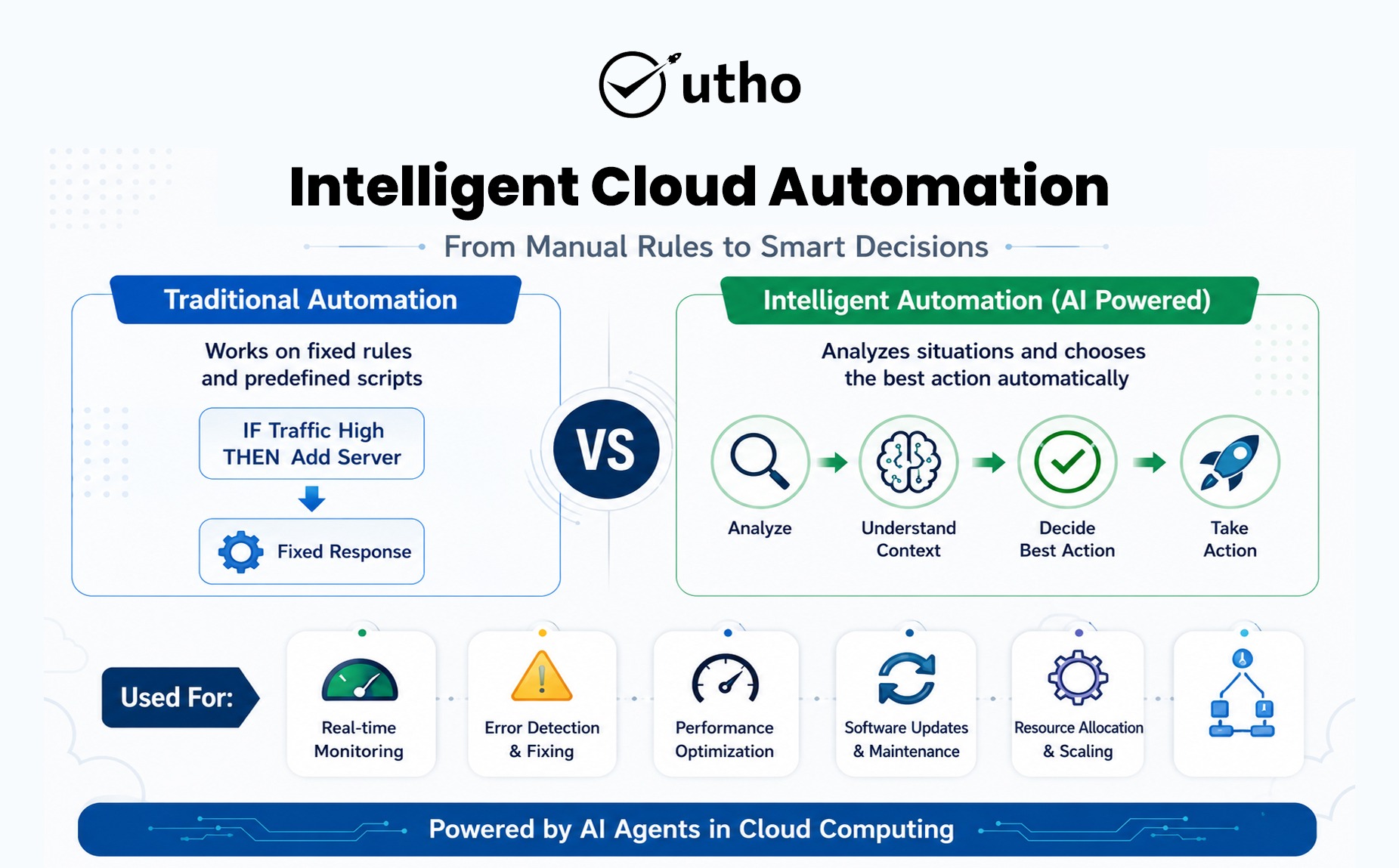
Intelligent cloud automation means cloud systems that can do tasks automatically and also make smart decisions while doing them.
In simple terms, it is not just automation—it is smart automation. The system doesn’t only follow fixed instructions, but also analyzes situations and chooses the best possible action on its own.
Intelligent cloud automation is commonly used for:
- Real-time system monitoring
- Automatic error detection and fixing
- Performance optimization
- Software updates and maintenance
- Resource allocation and scaling
In earlier systems, automation worked only on predefined rules. For example, if traffic increased, the system would follow a fixed script.
But now, with AI integration, automation has become:
- Dynamic
- Adaptive
- Context-aware
- Intelligent
This evolution is driven by AI agents in cloud computing, which act as the decision-making layer behind modern automation systems.
To manage all these intelligent workflows efficiently, organizations depend heavily on AI-powered cloud management, making AI-powered cloud management a core part of modern cloud strategy.
AI-Powered Cloud Management: The Smart Way Companies Control Cloud Systems
In 2026, one of the biggest transformations in cloud technology is the rise of AI-powered cloud management. This approach allows companies to manage entire cloud environments using artificial intelligence instead of depending only on human teams.
In traditional cloud management systems, IT teams had to:
- Monitor servers continuously
- Fix performance issues manually
- Handle updates and maintenance
- Manage security threats
- Control infrastructure costs
This required large teams, constant effort, and a higher chance of delays or human errors.
But with AI-powered cloud management, most of these responsibilities are now automated.
AI systems continuously analyze cloud environments and make smart decisions such as:
- Adjusting server capacity based on traffic
- Detecting and fixing errors before they escalate
- Optimizing storage usage
- Improving system performance and response time
- Reducing unnecessary operational costs
This makes cloud systems:
- More efficient
- More stable
- More scalable
- More cost-effective
Modern AI cloud management works closely with AI agents in cloud computing, which function like digital managers operating inside cloud environments.
How AI is Strengthening Cloud Security in 2026
Security has always been a critical part of cloud computing, but in 2026, cyber threats are becoming more advanced and harder to detect. At the same time, AI is also becoming powerful enough to defend against them in real time.
Modern AI cloud infrastructure includes intelligent security systems that protect data automatically without waiting for human intervention.
With the help of AI agents in cloud computing, cloud systems can:
- Detect suspicious activity instantly
- Block cyber attacks in real time
- Identify unusual login behavior
- Protect sensitive data automatically
- Predict potential security risks before they occur
Earlier security systems mostly reacted after an attack had already happened.
But now AI based systems are smarter and more active. They can often stop problems before any damage happens.
This is possible because of autonomous AI systems that keep watching cloud environments all the time and quickly take action when they find any danger or threat.
Because of this, cloud computing in 2026 is becoming much safer, smarter and more reliable than before.
Real-World Use Cases of AI in Cloud Infrastructure
Today, AI cloud infrastructure is not just a concept—it is actively used by major companies across the world to power large-scale digital platforms.
Let’s look at how different industries are using it:
Streaming Platforms
Video streaming platforms use AI powered cloud systems to handle millions of users at the same time. These systems help videos play smoothly, reduce buffering and keep services working properly even during heavy traffic.
E Commerce Platforms
Online shopping websites use AI agents in cloud computing to manage sudden traffic increases, recommend products based on customer interests and quickly detect fake or suspicious payments.
Banking Systems
Banks use autonomous AI systems to watch transactions find suspicious activity and keep important financial information safe with better speed and accuracy.
Online Gaming
Gaming companies use AI cloud infrastructure to provide smooth gameplay, manage servers around the world and keep games stable even when millions of players are online.
Healthcare Systems
Healthcare platforms use smart cloud systems to safely store patient records and study medical data to help doctors make faster and better decisions.
These examples clearly show that AI has become an important part of modern cloud systems in many industries.
How AI Helps Businesses Save Time and Money
One of the biggest benefits of AI powered cloud management is saving both time and money for businesses.
Earlier, companies relied on large IT teams to manage cloud systems, which included:
- High operational expenses
- 24/7 system monitoring teams
- Manual maintenance work
- Emergency troubleshooting support
Now, most of these tasks are handled automatically by AI agents in cloud computing and intelligent cloud automation.
Key Benefits for Businesses:
- Reduced manual workload
- Lower operational costs
- Fewer system failures and downtime
- Improved efficiency with fewer resources
- Automatic optimization of cloud usage
As a result, businesses can focus more on innovation, product development, and growth instead of routine system maintenance.
Intelligent Cloud Automation in Daily Operations
Intelligent cloud automation plays a crucial role in managing cloud systems in 2026.
It ensures that cloud environments run smoothly without constant human intervention by automating key operations such as:
- Automatic software updates
- Real-time system monitoring
- Load balancing across servers
- Resource allocation and optimization
- Error detection and recovery
Earlier, these tasks required manual effort from engineers. Now, AI handles them in a faster and more efficient way.
Thanks to AI agents in cloud computing, this automation has become more adaptive and intelligent. Instead of following fixed rules, it can analyze situations and improve its decisions over time.
Understanding the Future of AI-Driven Cloud Infrastructure with Utho
As cloud computing becomes more intelligent in 2026, understanding how modern infrastructure works is becoming increasingly important for businesses, developers, and cloud professionals. Technologies like AI agents, intelligent automation, autonomous systems, and AI-powered cloud management are changing how infrastructure is designed, monitored, and optimized.
In this evolving landscape, practical exposure to cloud systems and infrastructure environments plays an important role in helping professionals better understand how modern digital systems operate at scale.
1. Understanding How Intelligent Cloud Systems Work
Modern cloud environments are no longer limited to simple hosting or storage. Today’s systems are increasingly powered by automation and intelligence that help improve performance, reduce downtime, and optimize operations.
A deeper understanding of AI-driven cloud environments often includes learning:
- How cloud workloads are managed at scale
- How automation improves infrastructure efficiency
- How intelligent systems respond to performance issues
- How cloud environments adapt to changing demands
This practical understanding helps professionals better understand how modern infrastructure behaves in real-world scenarios.
2. Exploring Automation in Modern Cloud Infrastructure
One of the biggest changes highlighted in cloud computing today is intelligent automation. Earlier, infrastructure management required continuous manual effort, but AI-powered systems are gradually making cloud operations more efficient.
Key areas often explored include:
- Infrastructure monitoring and optimization
- Automated workload scaling
- Cloud resource management
- Performance and uptime management
Understanding these workflows helps build stronger awareness of how large-scale cloud systems remain stable and responsive.
3. Building Awareness Around Cloud Security and Reliability
As AI becomes deeply integrated into infrastructure, cloud security and reliability are becoming more important than ever. Modern systems increasingly depend on intelligent monitoring and automated threat detection to improve system protection.
Important areas of understanding include:
- Secure cloud configurations
- Access management and permissions
- Infrastructure reliability practices
- Risk reduction through proactive monitoring
This becomes especially important as businesses increasingly depend on cloud systems for critical operations and sensitive data management.
4. Preparing for the Future of AI-Powered Cloud Infrastructure
Cloud technology continues evolving rapidly with advancements in AI agents, autonomous systems, and intelligent cloud automation. Staying familiar with these technologies helps professionals better understand where modern infrastructure is heading.
Keeping up with areas such as:
- AI-powered infrastructure management
- Intelligent cloud automation
- Scalable cloud architecture
- Modern cloud and DevOps practices
can help create a stronger foundation for understanding next-generation infrastructure environments
As AI continues transforming cloud computing in 2026, practical understanding of intelligent cloud systems is becoming increasingly valuable. Learning how automation, scalability, cloud security, and AI-powered operations work together helps build a better understanding of the future of modern cloud infrastructure.
Related: Cloud Computing Trends 2026