


Learning data types is very important for anyone using Python, whether you make small scripts or big applications. Understanding python basics helps developers write clean and correct code. Python’s data types help manage different kinds of information like numbers, text, or more complex data. For modern developers, knowing data types is important to make software that is easy to grow and maintain. Python also has new features like type hints, which make coding easier. This guide explains all main Python data types and covers python basics to help you make better coding choices.
What Are Data Types in Python?
Data types tell Python what kind of value a variable can have and what we can do with it. Everything in Python is data so knowing python basics is very important.
A data type decides if a value is a number text, true or false list dictionary set or something else. Python is smart and gives types to variables by itself. This is called dynamic typing. You do not have to tell Python the type yourself.
For example:
x = 10 # int
y = “Hello” # str
Even though Python gives types automatically developers still need to know data types to write good clean and fast programs. This is very important for working with data machine learning websites APIs and checking code quality. Python has many types built in like numbers, text lists, dictionaries sets true or false and more. You can also make your own types using classes. Python 3 lets you add type hints to make code easier to read and understand and reinforces python basics for all developers.
Understanding data types helps developers:
- Optimize performance
- Avoid type-related bugs
- Improve readability
- Maintain large codebases
- Ensure predictable behavior in functions
This section-along with the rest of the blog-will give you a deep, structured, developer-friendly understanding of Python’s data types, enabling you to choose the right type in every situation.
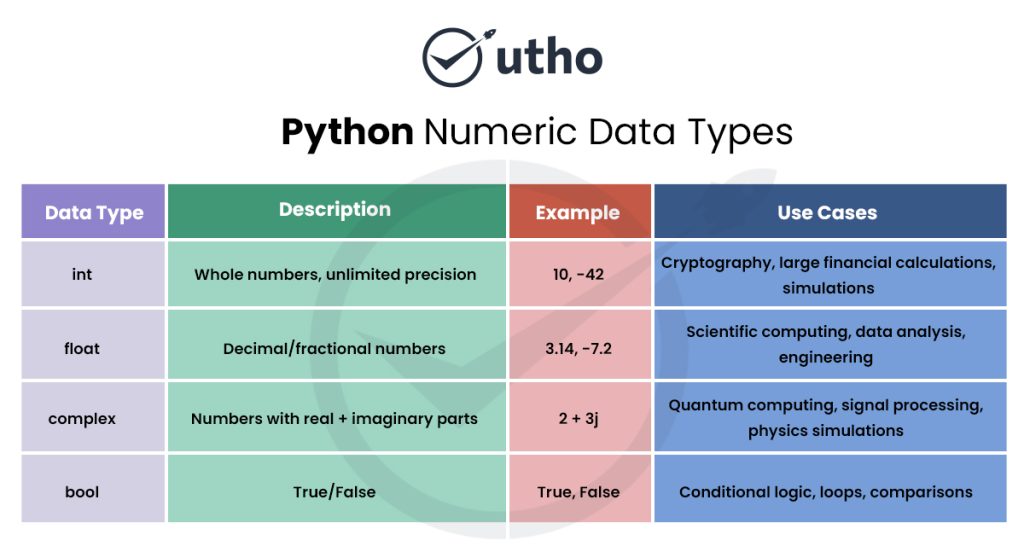
Numeric Data Types of Python
Python has many types of numbers that are easy to use. You can work with whole numbers, decimals , complex numbers and true/false values. Numbers are very important for many programs like money calculations games, machine learning science projects and decision making. Knowing python basics helps beginners and advanced users understand how to use numbers correctly.
Whole numbers are numbers without decimals like 1 2 100 or -5. You can use them for counting items, keeping scores or simple money calculations.
Decimal numbers are numbers with decimals like 3.14 0.5 or -7.2. You can use them when you need exact numbers like in prices, science experiments or measurements.
Complex numbers are special numbers like 2 + 3j used in advanced math and scientific calculations.
Boolean numbers are special numbers that are only True or False. They are used to check conditions or make decisions in programs like if a player has enough points or if a task is complete.
Python makes it simple to use numbers and do math. You can add, subtract, multiply, divide and do more complicated calculations easily. You can also use extra modules to do harder math work with very exact numbers and scientific calculations. These features make Python a great language for beginners and advanced programmers alike and reinforce python basics for anyone learning to work with numbers in games apps websites machine learning projects or science and finance programs.
Below are the primary numeric data types in Python:
1. int (Integer)
Integers represent whole numbers-values without any fractional or decimal component. They can be positive, negative, or zero.
a = 10
b = -42
Python’s handling of integers is one of its major strengths. Unlike languages such as C, C++, or Java that restrict integers to fixed memory sizes (like 32-bit or 64-bit), Python automatically adjusts the memory allocation based on the size of the number. This means Python can handle extremely large integers without overflow issues:
- Great for cryptography
- Ideal for financial calculations involving big numbers
- Useful in scientific simulations requiring high numeric ranges
Python’s unlimited integer precision makes it more robust for applications where numeric overflow would otherwise cause errors or data corruption.
2. float (Floating-Point Numbers)
Floats represent real numbers, which include decimal or fractional values.
pi = 3.14159
Under the hood, Python implements floats using 64-bit double-precision format based on the IEEE-754 standard. This ensures a balance between speed and accuracy, making floats suitable for scientific computing, machine learning algorithms, statistical modeling, engineering simulations, and data analysis.
However, because floats rely on binary fractions, certain decimal values cannot be represented with perfect accuracy. This sometimes results in small precision errors:
0.1 + 0.2
# Output: 0.30000000000000004
While these errors are normal in floating-point arithmetic, understanding them is critical when developing financial applications or systems requiring exact decimal values.
3. complex (Complex Numbers)
Complex numbers consist of a real part and an imaginary part, written in Python using the j notation:
z = 3 + 5j
Python is one of the few programming languages that natively supports complex numbers without requiring external libraries. Developers can perform addition, subtraction, multiplication, division, trigonometric functions, and more with complex numbers.
Use cases include:
- Quantum computing
- Digital signal processing
- Electrical engineering calculations
- Physics simulations
Complex numbers make Python uniquely powerful in domains where advanced mathematics is required.
4. bool (Boolean)
Booleans represent truth values: True and False.
x = True
y = False
Interestingly, Booleans in Python are actually a subtype of integers:
- True is interpreted as 1
- False is interpreted as 0
This allows Booleans to be used in arithmetic expressions:
True + True # Output: 2
False + True # Output: 1
Booleans play a crucial role in conditional logic, loop control, comparisons, and decision-making in almost every Python program.
5. Additional Numeric Modules
Beyond built-in numeric types, Python strengthens its numerical ecosystem with specialized libraries designed for precision, performance, and mathematical depth.
decimal
Used for high-precision decimal arithmetic. Essential for banking, finance, and currency calculations where floating-point errors are unacceptable.
fractions
Represents rational numbers as exact numerator/denominator pairs. Ideal for scenarios requiring exact results rather than approximations.
math
Provides advanced mathematical functions such as trigonometry, logarithms, constants (pi, e), factorials, and more. Highly optimized for performance.
random
Useful for probabilistic models, simulations, testing, and generating pseudo-random numbers.
These modules extend Python’s numeric capabilities far beyond typical number operations, making it a go-to language for scientific research, engineering applications, and data-driven development.
Built-in Data Types in Python
Python has many built-in data types that are easy to use. These data types help developers store, organize and work with data easily. They are used in every Python program from small scripts to big projects like machine learning.
Python groups its data types into categories based on how they work and how data is stored. Knowing these categories is important for writing code that is faster, cleaner and easier to understand.
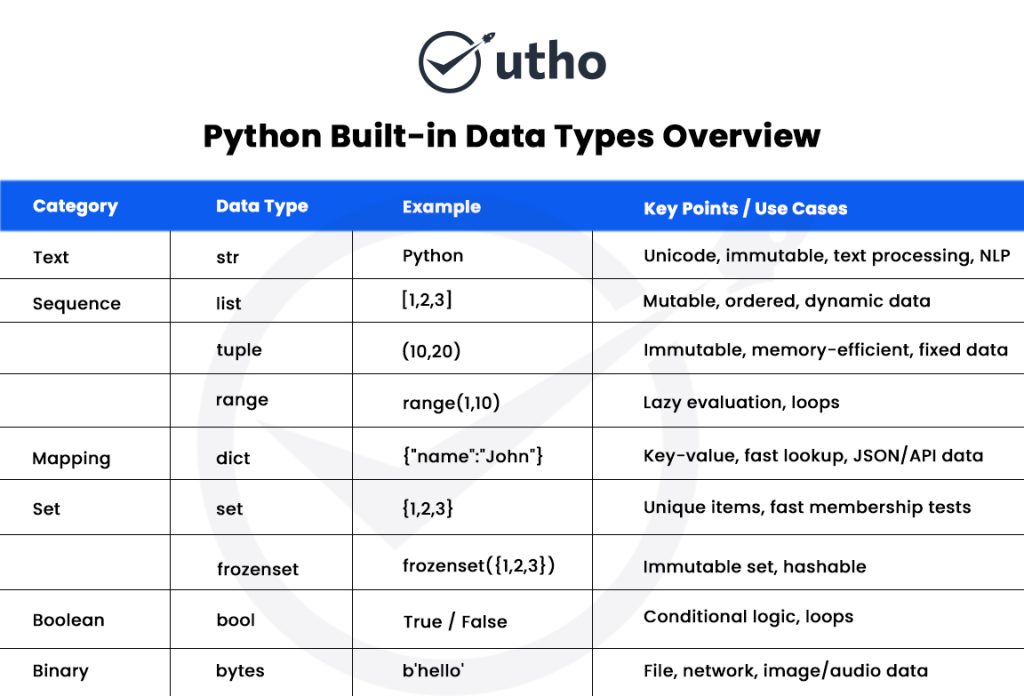
Below is a deep dive into each category:
1. Text Type
str (String)
A string represents a sequence of Unicode characters. It is one of the most frequently used data types in Python.
name = “Python”
Key characteristics of Python strings:
- Immutable: Once created, a string cannot be changed. Any modification results in a new string object.
- Unicode support: Python strings fully support international characters (Hindi, Chinese, Emojis, special symbols, etc.).
- Rich functionality: Strings allow slicing, concatenation, formatting, searching, and transformation using built-in methods.
Use cases include:
- Text processing
- User input
- Log messages
- Configuration files
- NLP (Natural Language Processing)
2. Sequence Types
These data types store ordered collections of items.
list
A list is a mutable sequence that can store heterogeneous data types-integers, strings, objects, or even other lists.
nums = [1, 2, 3]
Core properties:
- Mutable: Items can be added, removed, or changed.
- Dynamic resizing: Grows/shrinks automatically as elements are added or deleted.
- Heterogeneous: Supports storing mixed data types.
- Index-based access: Retrieval is fast using list[index].
Lists are useful for:
- Managing datasets
- Building dynamic collections
- Storing results from loops
- Data transformation pipelines
tuple
A tuple is an immutable, ordered collection of items.
coords = (10, 20)
Core properties:
- Immutable: Once created, elements cannot be modified.
- Lightweight: Faster and more memory-efficient than lists.
- Used for fixed data: Ideal for values that must not change, such as coordinates, configurations, and metadata.
Tuples are commonly used in:
- Function returns (multiple values)
- Database records
- Hashable types for dictionary keys
range
range represents a sequence of numbers, often used in loops:
r = range(1, 10)
Range objects:
- Do not generate numbers immediately (lazy evaluation)
- Are memory-efficient
- Provide fast iteration
Perfect for:
- Loop counters
- Generating sequences
- Mathematical series
3. Mapping Type
dict (Dictionary)
A dictionary stores data in key-value pairs and is one of the most powerful and widely used Python data structures.
student = {“name”: “John”, “age”: 22}
Key characteristics:
- Fast lookup: Dictionaries use hashing, making searches extremely quick.
- Mutable: Keys and values can be added, removed, or modified.
- Flexible: Keys must be unique and hashable; values can be anything.
Use cases:
- Storing JSON-like data
- API responses
- Caching
- User profiles
- Configurations and environment variables
Dictionaries are crucial in modern Python apps, especially in web, ML, and data engineering workflows.
4. Set Types
A set is an unordered collection of unique items. Useful when you want to avoid duplicate values.
set
s = {1, 2, 3}
Key properties:
- No duplicates allowed
- Mutable and dynamic
- Extremely fast for membership checks (in, not in)
Great for:
- Removing duplicates
- Mathematical operations (union, intersection, difference)
- Fast membership testing
frozenset
An immutable version of a set.
Key uses:
- When a set needs to be hashable
- When storing inside dictionaries or other sets
- For fixed, read-only sets of unique data
5. Boolean Type
Already covered under numeric types, but essential to mention here:
- Represents truth values: True and False
- Frequently used in:
- Conditional statements
- Loops
- Comparisons
- Logical operations
Booleans form the foundation of program flow control.
6. Binary Types
Designed for handling raw binary data, bytes, and memory-efficient operations.
Includes:
bytes
Immutable sequences of bytes (0–255).
Used in:
- File handling
- Image/audio data
- Compression
bytearray
Mutable version of bytes.
Used when binary data must be modified.
memoryview
Provides a view into binary data without copying it-very efficient for large data blocks.
Important in:
- Network communication
- Buffer handling
- High-performance applications
Why Built-in Data Types Matter
Python’s built-in data types are optimized for:
- Speed
- Flexibility
- Memory efficiency
- Real-world application needs
They form the foundation for:
- Algorithms
- APIs and backend systems
- Machine learning pipelines
- Enterprise-grade applications
- Data analysis workflows
Mastering these types ensures better performance, cleaner code, and improved problem-solving as a Python developer.
Choosing the Right Data Type
The ability to choose the correct data type determines:
- Application performance
- Memory usage
- Code readability
- Bug prevention
When to use which data type?
| Purpose | Best Data Type |
| Store structured key-value data | dict |
| Maintain order + indexing | list |
| Protect data from modification | tuple |
| Fast membership tests | set |
| Real numbers or decimal precision | float / decimal |
| Store raw binary data | bytes |
| Use simple yes/no values | bool |
Choosing based on mutability
- Use tuples instead of lists when immutability is required.
- Use frozenset instead of set when modifying is not allowed.
Choosing based on operation speed
- Dictionaries and sets are faster for lookups.
- Lists are better for ordered data and slicing.
Choosing the right type ensures your code remains efficient and clear.
Type Hints and Annotations (Python 3.5+)
Type hinting revolutionized Python by adding static typing capabilities.
Example:
def add(a: int, b: int) -> int:
return a + b
Benefits:
- Better IDE support
- Fewer bugs
- Cleaner documentation
- Helps large teams maintain code
Python supports:
- Basic types (int, str, float)
- Generic types (list[int], dict[str, int])
- Optional types (Optional[str])
- Union types (int | str)
- Custom classes as types
Type hints bridge the gap between Python’s dynamic nature and modern development practices requiring consistency and clarity.
Advanced and Custom Data Types
Python allows creating custom classes to serve as new data types.
class Vehicle:
def __init__(self, model: str, speed: int):
self.model = model
self.speed = speed
Additionally, advanced data structures include:
- NamedTuple
- dataclasses
- Enum
- TypedDict
- User-defined classes
These provide flexibility to structure data optimally for complex projects.
Common Mistakes and Tips
- Confusing mutable vs immutable types
- Using lists where sets are needed
- Misusing floats in financial calculations
- Failing to use type hints
- Unintentionally modifying shared data structures
- Overusing dictionaries where classes are better
- Avoiding built-ins like enumerate, zip, map
Tips for developers:
- Always choose the smallest effective data type
- Use type hints in all modern codebases
- Prefer immutable types for safety
- Use standard libraries before reinventing structures
Conclusion
Python data types are very important for every program script and system made with Python. They help you work with numbers, text lists and other data easily. Knowing data types is important to write clean, easy to understand and fast code.
As Python grows and improves learning, built in types, type hints and custom data structures will help you make modern professional and bigger programs.
FAQs
1. Why are data types important in Python?
They determine how data behaves and what operations are allowed.
2. Does Python support static typing?
Yes, through type hints introduced in Python 3.5+.
3. Are lists or tuples faster?
Tuples are faster because they are immutable.
4. What type should I use for financial calculations?
Use the decimal module for precision.
5. What is the most commonly used data type in Python?
Lists and dictionaries are the most widely used.