
Python is still one of the most popular programming languages in 2026 It is widely used in software development, artificial intelligence cloud computing automation and backend systems.
Earlier interviews mostly focused on basic syntax and simple coding But now Python interviews have changed. Companies expect developers to understand real world systems performance optimization concurrency async programming and cloud systems.
In 2026 Python is widely used in
- AI and machine learning systems
- FastAPI backend development
- Cloud native and microservices systems
- Data engineering pipelines
- Automation and DevOps workflows
Because of this change Python interviews now test how well a person can think about large scalable systems, not just write simple code.
This guide includes 53 important Python interview questions and answers updated for 2026 hiring needs Each question helps you understand concepts deeply and connect them with real industry use cases like AI systems distributed computing and backend development.
Whether you are preparing for big tech interviews, startup jobs or cloud engineering roles, this guide will help you understand Python in a simple and strong way for 2026.
Q1. What is Python and why is it still popular in 2026?
Python is a high-level interpreted programming language.
In 2026 Python has grown from a simple beginner friendly language into a powerful production level language used in modern software systems.
Today Python is widely used in areas like.
- Artificial Intelligence and Machine Learning
- Web development and backend systems
- Cloud automation and DevOps workflows
- Data science and analytics
- Cybersecurity testing
- Distributed systems and event driven architectures
Python is powerful not just because it is easy to use but because it works well with modern technologies like AI systems, cloud platforms and large scale distributed systems.
Why Python Still Dominates in 2026
Python is still a top language because it has evolved with industry needs
1. Easy and Readable Syntax
Python code is simple and easy to understand This helps large teams work together on complex AI and cloud systems.
2. Large Ecosystem
Python has a very large ecosystem with libraries, frameworks and tools available for almost every field.
3. AI First Language
Python has become the main language for AI development because it integrates easily with.
Large Language Models like OpenAI Claude and Gemini APIs
Vector databases like Pinecone Weaviate and FAISS.
4. Strong Backend Framework Support
Modern production systems heavily rely on frameworks like:
- FastAPI (dominant in 2026 for async APIs)
- Django (for enterprise applications)
These frameworks allow developers to build scalable systems quickly.
5. Enterprise-Level Adoption
Python is no longer limited to startups or research—it is widely used in large-scale enterprise systems, especially in:
- Cloud platforms
- Financial systems
- AI-driven automation pipelines
Q2. What are Python’s key features in 2026?
Python has significantly evolved, and its feature set in 2026 reflects modern software demands.
1. Interpreted but highly optimized execution
Python is still an interpreted language but modern versions like 3.12 and above have improved performance a lot such as:
- Advanced bytecode optimizations
- Faster execution pipelines
- Improved memory handling
- Reduced runtime overhead
This makes Python much faster than earlier versions, especially in backend and AI workloads.
2. Multi-Paradigm Programming Support
Python is not limited to one way of writing code In 2026 it supports
- Object oriented programming OOP
- Functional programming
- Asynchronous programming
- Event driven systems
This flexibility makes Python useful for both small scripts and large distributed systems
3. Massive and Mature Ecosystem
Python’s ecosystem is one of its strongest advantages.
Key categories include:
Data Science & Analytics
- NumPy
- Pandas
AI / Machine Learning
- PyTorch
- TensorFlow
Backend Development
- FastAPI
- Django
Background Processing
- Celery
Data Validation & Structuring
- Pydantic v2+
These tools allow Python to support end-to-end system development—from data processing to production deployment.
4. Native Async Support (Modern Standard)
One of the biggest evolutions in Python is its strong support for asynchronous programming.
Modern Python heavily uses:
- asyncio
- async/await syntax
- Event loop-based execution
This is essential in 2026 because modern applications are:
- API-driven
- Real-time
- Cloud-native
- Highly concurrent
Async programming allows Python applications to handle thousands of simultaneous requests efficiently.
Q3. What is PEP 8 and why is it still important?
PEP 8 is the official Python style guide that defines how Python code should be written in a clean, readable, and consistent way. It includes rules for:
- Code indentation
- Naming conventions (variables, functions, classes)
- Line spacing and structure
- Import organization
- Code readability standards
In simple words PEP 8 makes Python code look clean and easy to read even when different developers write it.
In 2026 PEP 8 is very important because Python is used in big systems like.
- AI apps
- Cloud microservices
- Large backend systems
- Enterprise automation tools
In these systems many developers work together so code must stay the same and easy to understand.
2026 Update: How PEP 8 is Enforced Today
Instead of manually following style rules, modern teams rely on automated tools:
1. Black (Code Formatter)
Black automatically formats Python code into a consistent style. Developers no longer debate formatting—it is enforced automatically.
2. Ruff (Modern Linter)
Ruff has replaced many traditional tools like flake8 in modern systems because it is:
- Extremely fast
- Highly efficient
- Capable of handling large codebases
3. Pre-commit Hooks
These make sure code is checked before it is added to repositories like GitHub or GitLab.
Why PEP 8 Still Matters in 2026
It makes code easy to read for all team members
It keeps enterprise level code consistent
It reduces bugs and debugging time
It helps maintain large systems easily
In modern Python development clean code is not optional it is required.
Q4 Difference between List and Tuple
Lists and Tuples both store multiple items in Python but they are different in how they work.
In 2026 interviews this question is not just about definitions it is about understanding performance and real system usage.
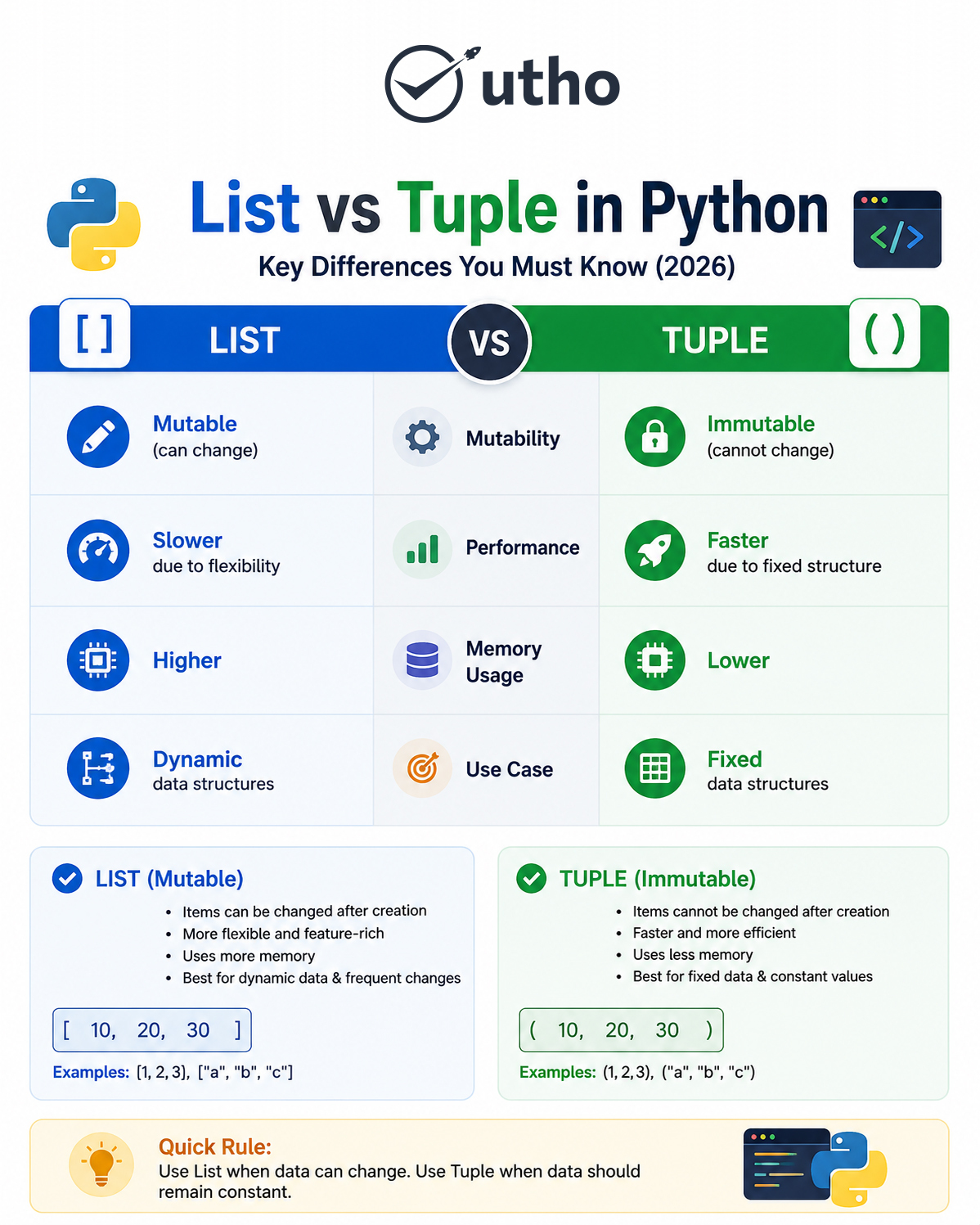
Lists
Lists are used when data needs to change frequently, such as:
- User input collections
- Dynamic API responses
- Runtime-modified datasets
Because lists are mutable, they allow:
- Adding elements
- Removing elements
- Modifying values
However, this flexibility comes at a cost of slightly lower performance.
Tuples
Tuples are used when data should remain constant.
Common use cases:
- Configuration values
- Fixed datasets
- Function return structures
Because tuples are immutable:
- They are faster in execution
- They consume less memory
- They are safer in concurrent environments
Q5. What is a Dictionary in Python?
A dictionary in Python is a hash-based key-value data structure that stores data in pairs:
- Key → Value mapping
It allows fast lookup, insertion, and modification.
2026 Modern Usage of Dictionaries
Dictionaries are now heavily used in real-world systems such as:
1. JSON APIs
Most modern APIs return data in JSON format, which directly maps to Python dictionaries.
2. NoSQL-like Data Structures
Dictionaries behave similarly to document-based databases like:
- MongoDB
- Firestore
3. AI Metadata Storage
In AI systems, dictionaries are used to store:
- Model parameters
- Configuration settings
- Prompt metadata
- Training data attributes
4. Configuration Systems
Modern applications use dictionaries for:
- Environment configurations
- Feature toggles
- System settings
Why Dictionaries are Important in 2026
Dictionaries are essential because they provide:
- Fast data retrieval (O(1) average complexity)
- Flexible structure for dynamic data
- Native compatibility with APIs and AI systems
They are one of the most critical data structures in modern Python development.
Q6. What are Python Variables?
Python variables are not fixed memory containers—they are dynamic references to objects in memory.
This means a variable does not directly store a value; instead, it points to an object.
2026 Interview Focus Areas
Modern interviews no longer ask only basic definitions. They focus on deeper understanding such as:
1. Memory Model Understanding
Candidates are expected to know:
- How Python stores objects in memory
- How variables reference those objects
- What happens during assignment
2. Reference Behavior
Multiple variables can point to the same object, which can lead to unexpected behavior if not understood properly.
3. Mutability Issues in Concurrency
In modern systems with:
- Async programming
- Multi-threading
- Distributed processing
Understanding how variables behave is critical to avoid data corruption or unexpected side effects.
Why This Matters in 2026
Python is widely used in:
- Cloud systems
- AI pipelines
- Microservices
So variable behavior directly impacts:
- System stability
- Performance optimization
- Bug prevention
Q7. What are Python Modules and Packages?
Python modules and packages are the building blocks of scalable applications.
Basic Definition
- Module → A single .py file containing Python code
- Package → A collection of multiple modules organized together
2026 Modern Usage
In 2026, modules and packages are no longer just code organization tools—they are part of modern architecture design.
1. Microservice-Based Modules
Each module can represent a microservice component such as:
- Authentication service
- Payment service
- Notification service
2. Plugin-Based Architectures
Modern systems are built using modular plugins that can be:
- Added dynamically
- Updated independently
- Removed without affecting core systems
3. AI Tool Modules (Agent-Based Systems)
In AI-driven systems, modules now represent:
- AI agents
- Tool integrations
- LLM-based components
- Workflow automation units
Q8. What is the Python indentation rule?
Python indentation is a very important rule in the language unlike many other programming languages that use curly brackets. Python uses spaces at the start of a line to define blocks of code.
In simple words spacing in Python is not optional it controls how the code works.
For example:
- Indentation defines loops
- Indentation defines functions
- Indentation defines conditions (if/else blocks)
If indentation is incorrect, Python will immediately throw an error.
Why Indentation Matters in Python
Python uses indentation to enforce readability and structure at the same time. This makes the code:
- Clean and visually organized
- Easy to read for teams
- Less prone to structural confusion
Because of this design, Python is often called a “readable language by design.”
2026 Modern Enforcement of Indentation Rules
In 2026, indentation is no longer something developers manually worry about most of the time because it is enforced automatically through modern tools:
1. IDE Auto-Formatting
Modern IDEs like VS Code and PyCharm automatically fix indentation as you write code.
2. CI Pipeline Validation
In production systems, CI/CD pipelines check indentation rules before code is merged or deployed.
3. Pre-Commit Hooks
Before code is pushed to repositories, hooks automatically validate formatting consistency.
Why This is Important in 2026
In large-scale systems like:
- AI applications
- Cloud-native microservices
- Distributed backend systems
Even small formatting inconsistencies can lead to:
- Code review delays
- Deployment failures
- Collaboration issues
So indentation is now part of automated quality assurance, not just syntax rules.
Q9. What are namespaces?
A namespace in Python is a system that maps names (variables, functions, objects) to their corresponding values or memory locations.
In simple terms, a namespace is like a container that ensures every name in a program is unique and properly organized.
Types of Namespaces in Python
Python typically uses:
- Built-in namespace (functions like print())
- Global namespace (module-level variables)
- Local namespace (inside functions)
2026 Relevance of Namespaces
Namespaces have become extremely important in modern systems because Python is now widely used in:
- Large-scale distributed systems
- AI-driven applications
- Multi-module backend architectures
- Microservices-based platforms
Why Namespaces Matter in 2026
1. Large-Scale System Organization
In complex systems, multiple modules may define similar names. Namespaces prevent conflicts.
2. AI and Multi-Agent Applications
Modern AI systems often include multiple components such as:
- Data processors
- Model handlers
- API wrappers
Namespaces ensure each component works independently without interference.
3. Microservices Debugging
In distributed systems, debugging becomes easier because namespaces clearly separate:
- Service-level variables
- Module-level data
- Runtime objects
Key Idea
Namespaces help Python keep code clean structured and separated in large applications.
Q10. Explain args and kwargs
args and kwargs are used in Python to allow functions to take any number of inputs.
They make functions more flexible.
- args Non keyword arguments
args lets a function accept multiple values without fixing the number of inputs.
It is useful when you do not know how many values will be passed.
2. kwargs Keyword arguments
kwargs lets a function accept named key value inputs
It is useful when
- You need flexible settings
- You are passing dynamic data
- You are building reusable functions
Q11. What is Type Casting
Type casting means converting one data type into another
Example
- string to int
- int to float
Modern 2026 update
Type casting is now used with
- Pydantic validation systems
- Static type checkers like mypy and pyright
- API validation tools
Importance
It keeps data correct and avoids errors in complex systems
Q12. Difference between remove pop and del
All three are used to delete items from a list but they work differently
In 2026 interviews this is tested for
- Performance impact
- Memory usage
- Large data handling
Key idea
Each method is useful in different situations and choosing the right one improves performance
Q13 What is a Lambda Function in Python
A lambda function is a small anonymous function in Python with no name.
It is used for simple single line operations.
It is mainly used when a function is required for a short duration and does not need full definition using def.
Common use cases:
- Quick data transformations
- Sorting and filtering operations
- Functional programming patterns
- AI and data preprocessing pipelines
- Event-driven callbacks
2026 usage in real systems:
- Data engineering pipelines
- AI feature engineering workflows
- Serverless and event-driven architectures
Why it is important:
- Reduces boilerplate code
- Useful for inline logic in pipelines
- Improves readability for simple operations (when not overused)
Q14. What is the difference between append() and extend() in Python lists?
Both append() and extend() are used to add elements to a list, but they behave differently.
append():
- Adds a single element to the end of the list
- The element is added as it is (even if it is a list)
extend():
- Adds multiple elements from an iterable (like list, tuple, set)
- Expands the original list with each element separately
Key difference:
- append() → adds one object
- extend() → merges multiple items into the list
2026 interview focus:
Candidates are expected to understand:
- How memory is handled internally
- Difference between object insertion vs iterable expansion
- Performance impact in large-scale data systems
Why it matters:
- Frequently used in data pipelines
- Important in AI preprocessing and ETL workflows
- Helps avoid logical bugs in production systems
Q15. What is List Comprehension in Python?
List comprehension is a concise and efficient way to create lists using a single line of code.
It is a shortcut for creating lists using loops and conditions.
Example use cases:
- Data transformation
- Filtering datasets
- Feature engineering in AI pipelines
- Cleaning and preprocessing large datasets
2026 usage in modern systems:
- Widely used in data engineering workflows
- Common in AI preprocessing pipelines
- Used in fast transformation-heavy operations
Important update in 2026:
Although list comprehensions are powerful, in enterprise systems:
Readability is more important than extreme compactness
So:
- Simple comprehensions are preferred
- Overly complex nested comprehensions are avoided
Why it is important:
- Improves code efficiency
- Reduces lines of code
- But must be used carefully for maintainability
Q16. What is Slicing in Python?
Slicing is a technique used to extract a part (subset) of a list, string, or any sequence using index ranges.
It allows you to access multiple elements at once instead of accessing them one by one.
Example use:
- Extracting part of a string
- Working with specific rows in a dataset
- Handling subsets of large lists efficiently
2026 usage in real systems:
- Time-series data processing (finance, IoT, analytics)
- AI dataset manipulation and feature extraction
- Large-scale data preprocessing in ML pipelines
Why it is important:
- Very fast and memory-efficient operation
- Reduces complexity in data handling
- Frequently used in data engineering and AI workflows
Q17. What is __init__ in Python?
__init__ is a special constructor method in Python classes that automatically runs when a new object is created.
It is mainly used to initialize object properties.
Example usage:
- Setting initial values for variables
- Configuring objects before use
- Preparing class instances for execution
2026 trend in modern Python:
Traditional constructors are now often replaced or enhanced with:
- Pydantic models (for validation + structured data)
- Dataclasses (for cleaner and shorter code)
- Dependency Injection frameworks (for scalable architecture)
Why this evolution happened:
- Reduces boilerplate code
- Adds strong validation layers
- Improves scalability in enterprise applications
- Supports modern API and microservice architecture
Q18. What is GIL in Python?
GIL (Global Interpreter Lock) is a mechanism in CPython that allows only one thread to execute Python bytecode at a time, even on multi-core processors.
Simple meaning:
Even if multiple threads exist, only one runs Python code at a time due to GIL.
Impact:
- Limits true parallel execution in CPU-heavy tasks
- Affects performance in multithreaded applications
2026 update:
Python is actively improving this limitation through:
- Experimental free-threaded builds (ongoing PEP evolution)
- Better multiprocessing support as default in many frameworks
- Increased adoption of async-based architectures
Why it matters:
- Critical for system design decisions
- Important in AI, ML, and cloud-based high-performance systems
- Directly impacts scalability and performance tuning
Q19. Multithreading vs Multiprocessing
Multithreading and multiprocessing are both concurrency techniques, but they work differently in how they use system resources.
| Feature | Multithreading | Multiprocessing |
| GIL | Affected (limited execution) | Not affected |
| Execution | Same process, multiple threads | Multiple independent processes |
| Memory Usage | Low (shared memory) | High (separate memory) |
| Best For | I/O-bound tasks | CPU-bound tasks |
Key understanding:
- Multithreading is best when tasks wait on external operations (API calls, file I/O)
- Multiprocessing is best for heavy computations like ML training or data processing
2026 perspective:
Modern systems often combine both with async programming for maximum efficiency.
Q20. What are Closures in Python?
A closure is a function that remembers and retains variables from its outer scope even after the outer function has finished execution.
Simple meaning:
A function that “remembers its environment”.
Example usage:
- Functions inside decorators
- Functional programming pipelines
- AI data transformation flows
- Dynamic behavior injection in frameworks
2026 usage in real systems:
- AI pipelines where state needs to be preserved
- Event-driven architectures
- Advanced backend frameworks with dynamic logic
Why it is important:
- Enables modular and reusable code design
- Supports advanced functional programming patterns
- Widely used in scalable backend systems
Q21. What are Decorators in Python?
Decorators are functions that modify or enhance the behavior of another function without changing its actual code.
Simple explanation:
They act like a “wrapper layer” around functions.
Real-world usage:
- Authentication systems
- Logging and monitoring
- API rate limiting
- Middleware in backend frameworks
- AI function wrappers in modern systems
2026 trend:
Decorators are now heavily used in:
- FastAPI-based architectures
- Microservices frameworks
- AI-powered backend systems
Why important:
- Keeps code clean and reusable
- Avoids duplication of logic
- Essential for scalable enterprise applications
Q22. What are Async and Await in Python?
async and await are keywords used to write asynchronous (non-blocking) code in Python.
Simple meaning:
They allow multiple tasks to run concurrently without waiting for each other.
Used in:
- Real-time chat applications
- FastAPI backend systems
- Streaming APIs (especially AI responses)
- High-performance microservices
2026 importance:
Async programming is now a must-have skill for backend and cloud developers.
Key benefit:
- Improves performance
- Handles high traffic efficiently
- Reduces system waiting time
Q23. What are Context Managers in Python?
Context managers are used to manage resources efficiently by automatically handling setup and cleanup operations.
They are used with the with statement.
Example use cases:
- File handling
- Database connections
- API sessions
- Network resource management
2026 usage in modern systems:
- Cloud-based resource handling
- Distributed system cleanup operations
- Transaction safety in microservices
Why it is important:
- Prevents memory/resource leaks
- Ensures safe execution of critical operations
- Essential for production-level backend systems
Q24. How do you reverse a string in Python, and what are the common approaches asked in interviews?
Reversing a string is a basic coding question used to test logic and understanding of string manipulation.
In interviews, it is usually asked in different ways:
- Using slicing ([::-1])
- Using loops
- Using recursion (sometimes with constraints like no built-in methods)
Key idea:
Interviewers check how well you can handle constraints, not just the final output.
Q25. How do you check if a number is a prime number, and how is the problem optimized in modern interviews?
A prime number check is used to test basic loops and mathematical thinking.
In advanced interviews, it is extended to:
- Optimized checking up to √n
- Handling large input values efficiently
- Sometimes discussing performance improvements
Key idea:
Focus is on optimization, not just basic logic.
Q26. How is the Fibonacci series implemented, and why is recursion not preferred in modern interviews?
Fibonacci series tests recursion and problem-solving skills.
But in 2026 interviews, candidates are expected to use:
- Dynamic programming
- Memoization
- Iterative approach
Key idea:
Avoiding repeated calculations is more important than simple recursion.
Q27. How do you remove duplicates from a list in Python, and what are the efficient ways to do it?
Removing duplicates is a common data structure question.
Expected approaches include:
- Using sets for O(n) solution
- Maintaining order using loops or ordered structures
Key idea:
Efficiency and preserving order both matter.
Q28. How do you check if two strings are anagrams, and what complexities are added in real-world scenarios?
Anagram checking tests string processing skills.
Modern interviews may include:
- Unicode character handling
- Large input optimization
- Frequency map or hashing approach
Key idea:
Scalability and real-world data handling.
Q29. How would you design an LRU Cache, and why is it considered a system design question?
LRU Cache is a popular system design problem.
Expected design includes:
- O(1) operations
- Hash map + doubly linked list
Key idea:
Testing data structure knowledge and design thinking.
Q30. How do you design a REST API in Python for production systems?
REST API design is a key backend interview topic.
Modern expectations:
- Use FastAPI or similar frameworks
- Async support
- JWT authentication
- Proper error handling and scalability
Key idea:
Production-ready design matters more than basic endpoints.
Q31. How do you implement a custom map() function in Python?
This question tests understanding of functional programming.
Expected concepts:
- Iterators
- Functions as first-class objects
- Lazy evaluation
Key idea:
Understanding internal behavior of built-in functions.
Q32. How does binary search work, and where is it used beyond simple arrays?
Binary search is a classic algorithm question.
Modern variations include:
- Rotated arrays
- Large-scale or distributed data systems
Key idea:
Applying algorithm knowledge in real-world scenarios.
Q33. What are context managers in Python, and why are they important?
Context managers handle resource management using the with statement.
Common uses:
- File handling
- Database connections
- API sessions
Key idea:
Automatic cleanup and safe resource handling.
Q34. What is duck typing in Python?
Duck typing means Python checks behavior, not type.
Simple idea:
“If it behaves like a type, it is treated as that type.”
Used in:
- Flexible system design
- Plugin-based architectures
Q35. What is pickling in Python, and why is it less preferred in modern systems?
Pickling is used for object serialization.
But modern systems often prefer:
- JSON
- Protobuf
- Message-based formats
Key idea:
Interoperability and security concerns.
Q36. Why are virtual environments important in Python?
Virtual environments isolate project dependencies.
Tools used:
- venv
- poetry
Key idea:
Avoid dependency conflicts between projects.
Q37. What are REST APIs in Python?
REST APIs allow communication between systems over HTTP.
Modern usage includes:
- FastAPI
- Async endpoints
- Microservices architecture
Key idea:
Scalable and fast backend communication.
Q38. How are Python microservices used in modern systems?
Python microservices are used in distributed applications.
Common setup:
- Kubernetes-based deployment
- Event-driven systems
- Cloud-native architecture
Key idea:
Scalable and modular system design.
Q39. What is the difference between deep copy and shallow copy?
Shallow Copy
Shallow copy creates a new object, but inner objects are still referenced.
Deep Copy
Deep copy creates a completely independent object including nested objects.
Example (2026 usage context)
import copy
original = [[1, 2], [3, 4]]
shallow = copy.copy(original)
deep = copy.deepcopy(original)
Key Difference:
- Shallow copy → shared nested memory
- Deep copy → fully independent
Why asked in 2026 interviews?
Because it tests:
- memory model understanding
- mutability in large systems
- bug prevention in concurrent apps
Q40. What is a Context Manager in Python?
A context manager is a Python construct that automatically handles setup and cleanup operations for resources.
It is commonly used with the with statement to ensure proper resource management.
Example:
with open(“file.txt”) as f:
data = f.read()
How it works:
- __enter__() → sets up the resource
- __exit__() → cleans up the resource (even if errors occur)
2026 usage in real systems:
- Database transaction management
- API session handling
- Cloud resource lifecycle management
Why it is important:
- Prevents resource leaks
- Ensures safe execution
- Widely used in production-grade backend systems
Q41. What is Duck Typing in Python?
Duck typing is a concept where Python focuses on an object’s behavior rather than its actual type.
Simple meaning:
“If it behaves like the required object, it is treated as that type.”
Example:
class Bird:
def sound(self):
print(“Chirp”)
class Dog:
def sound(self):
print(“Bark”)
def make_sound(obj):
obj.sound()
2026 relevance:
- Used in dynamic plugin systems
- AI agent-based architectures
- Flexible API design systems
Why it is important:
- Enables flexible and loosely coupled systems
- Reduces dependency on strict type definitions
- Widely used in modern AI-driven frameworks
Q42. What is Pickling in Python?
Pickling is the process of converting Python objects into a byte stream so they can be stored or transferred.
Example:
import pickle
data = {“name”: “Alex”}
pickle.dump(data, open(“data.pkl”, “wb”))
Use cases:
- Saving trained ML models
- Caching data
- Transferring objects between systems
2026 update:
Pickling is now often compared or replaced with:
- JSON APIs (for web systems)
- Protobuf (for high-performance communication)
- Message queues like Kafka and RabbitMQ
Why it matters:
- Enables data persistence
- Important in distributed systems and AI workflows
Q43. What is a Virtual Environment in Python?
A virtual environment is an isolated workspace that allows Python projects to have their own dependencies.
It prevents conflicts between different project libraries.
Common tools in 2026:
- venv (standard built-in tool)
- poetry (most widely used modern tool)
- uv (new fast dependency manager trend)
Why it is important:
- Prevents dependency conflicts
- Ensures reproducible builds
- Essential for CI/CD and deployment pipelines
Q44. What is a REST API in Python?
REST API is a standard way of communication between client and server using HTTP protocols.
Key characteristics:
- Stateless communication
- JSON-based data exchange
- Uses HTTP methods like GET, POST, PUT, DELETE
Popular Python frameworks in 2026:
- FastAPI (most widely used)
- Django REST Framework
- Flask (lightweight services)
Why it is important:
- Backbone of modern web applications
- Used in microservices and cloud systems
- Essential for backend development
Q45. What is Microservices Architecture in Python?
Microservices architecture breaks a large application into smaller independent services.
Each service:
- Runs independently
- Handles a specific function
- Communicates via APIs
Python usage:
- FastAPI services
- Background workers (Celery)
- Docker-based deployments
Benefits:
- High scalability
- Independent deployment
- Fault isolation (one service failure doesn’t break system)
Why it is important:
- Standard architecture in cloud-native systems
- Widely used in SaaS, fintech, and AI platforms
Q46. What is GIL (Global Interpreter Lock)?
GIL is a mechanism in CPython that allows only one thread to execute Python bytecode at a time.
Simple meaning:
Even in multithreading, only one thread runs Python code at a time.
Impact:
- Limits CPU-bound parallel execution
- Affects performance in heavy computation tasks
2026 update:
Python is evolving with:
- Experimental free-threaded builds
- Better async-first architectures
- Multiprocessing as default recommendation for CPU tasks
Why it is important:
- Critical for system performance design
- Important in AI, ML, and backend scalability
Q47. Difference Between Threading and Multiprocessing in Python
| Feature | Threading | Multiprocessing |
| GIL | Affected | Not affected |
| Memory | Shared memory | Separate memory |
| Execution | Same process | Multiple processes |
| Best For | I/O-bound tasks | CPU-bound tasks |
Modern usage:
- Threading → API calls, network operations
- Multiprocessing → AI, ML, heavy computation
Why it matters:
- Helps choose correct architecture for performance optimization
Q48. What are Descriptors in Python?
Descriptors are objects that control how attributes are accessed, modified, or deleted in a class.
They are used to manage attribute behavior dynamically.
Example:
class Value:
def __get__(self, obj, objtype):
return obj._x
def __set__(self, obj, value):
obj._x = value
2026 usage:
- ORM frameworks (Django, SQLAlchemy)
- Data validation layers
- Schema-based systems
Why it is important:
- Enables powerful abstraction in Python internals
- Used in enterprise-grade frameworks
Q49. What are Metaclasses in Python?
Metaclasses define how classes themselves behave in Python.
Simple meaning:
“A class that creates classes.”
Example:
class Meta(type):
def __new__(cls, name, bases, attrs):
print(“Creating class:”, name)
return super().__new__(cls, name, bases, attrs)
2026 usage:
- Django ORM internals
- Automatic class registration
- Schema generation systems
Why it is important:
- Enables advanced framework design
- Used in large-scale backend architectures
Q50. What is Monkey Patching in Python?
Monkey patching means modifying or extending code behavior at runtime without changing original source code.
Example:
import math
math.sqrt = lambda x: “patched”
Use cases:
- Testing and mocking
- Temporary bug fixes
- Dynamic behavior modification
2026 caution:
- Useful in testing environments
- Strongly discouraged in production systems due to unpredictability
Why it is important:
- Shows flexibility of Python
- But must be used carefully in real-world applications
Q51. What is Memoization in Python?
Memoization is an optimization technique where the results of expensive function calls are stored (cached) so that repeated calls with the same inputs return instantly instead of recalculating.
Simple meaning:
“Once calculated, reuse the result instead of computing again.”
Example:
from functools import lru_cache
@lru_cache(maxsize=None)
def fib(n):
if n < 2:
return n
return fib(n-1) + fib(n-2)
How it works:
- First call → function computes result
- Next call → cached result is returned instantly
2026 usage in real systems:
- AI model inference optimization
- Backend caching systems
- High-performance API response optimization
Why it is important:
- Reduces computation time significantly
- Improves scalability of recursive and heavy functions
- Widely used in AI and distributed systems
Q52. What is Async and Await in Python?
async and await are keywords used to write asynchronous (non-blocking) programs in Python.
Simple meaning:
They allow multiple tasks to run concurrently without waiting for each other to finish.
Example:
import asyncio
async def task():
await asyncio.sleep(1)
print(“Done”)
asyncio.run(task())
Key idea:
- async → defines an asynchronous function
- await → pauses execution until a task completes
2026 importance:
Async programming is now essential in modern backend development.
Used in:
- FastAPI-based backend systems
- Real-time chat applications
- Streaming AI responses (LLM systems)
- High-performance microservices
Why it is important:
- Improves system responsiveness
- Handles large number of concurrent requests
- Reduces blocking in I/O-heavy operations
Q53. What is a Generator in Python?
A generator is a special type of iterator that yields values one at a time instead of storing the entire dataset in memory.
It uses the yield keyword instead of return.
Example:
def gen():
for i in range(5):
yield i
How it works:
- Generates values on demand
- Does not store full data in memory
- Produces results lazily (one by one)
2026 usage in real systems:
- Large-scale dataset processing
- AI and ML data pipelines
- Streaming data systems
- Memory-efficient APIs
Why it is important:
- Saves memory in large applications
- Improves performance for big data processing
- Essential in modern data engineering and AI workflows
Python Interview Mastery 2026: Complete Guide to Python Interview Questions and Job Preparation
Python has grown from a simple programming language into a core technology powering AI systems, cloud platforms, automation, and large-scale distributed applications in 2026. Today, mastering python interview questions is no longer optional for developers—it has become a fundamental requirement for cracking modern tech roles. Similarly, understanding python job questions is equally important because companies now evaluate candidates based on real-world problem solving rather than just syntax.
It is now widely used across:
- Artificial Intelligence & Machine Learning
- Cloud-native backend systems
- DevOps and automation pipelines
- Data engineering and analytics platforms
In all these domains, interviewers frequently design python interview questions around real production scenarios. At the same time, recruiters also focus on python job questions that test how well a candidate can apply Python in real business environments. Because of this shift, both python interview questions and python job questions have become deeply connected with modern hiring standards.
Key Skills Required in 2026 Python Interviews
Modern Python interviews are no longer limited to syntax or basic coding. Candidates are expected to understand real-world system design concepts such as:
- Async programming and concurrency models
- Scalable backend architecture
- Performance optimization techniques
- Microservices and distributed systems
- AI and data processing workflows
Most companies now design advanced python interview questions to evaluate these skills. These python interview questions often simulate production-level problems where candidates must think like system engineers. On the other hand, python job questions focus more on practical application, such as debugging, optimization, and building scalable APIs. Many organizations even mix python interview questions and python job questions in the same interview round to evaluate both theoretical and practical knowledge.
What This 53 Questions Guide Covers
This guide includes a complete set of 53 Python interview questions (2026 updated) covering:
- Basic Python fundamentals
- Advanced programming concepts
- Real-world development scenarios
- System design and architecture topics
- AI and cloud-based Python usage
Each section is carefully designed around modern python interview questions patterns used by top companies. You will also find scenarios inspired by python job questions that reflect real industry challenges. The combination of python interview questions and python job questions helps candidates prepare for both technical interviews and job screening rounds.
In 2026, recruiters heavily rely on python interview questions to filter skilled developers. At the same time, python job questions help them identify candidates who can actually work on production systems rather than just theoretical coding problems. That is why repeated exposure to python interview questions and python job questions is essential for interview success.
Real-World Interview Trends
Companies are no longer asking only textbook problems. Instead, they focus on scenario-based python interview questions that test decision-making, architecture thinking, and optimization skills. These python interview questions often include debugging live systems or designing scalable APIs.
Similarly, python job questions are increasingly based on daily development tasks such as:
Handling API failures
Optimizing database queries
Improving application performance
Managing cloud deployments
Because of this, candidates who regularly practice python job questions alongside python interview questions tend to perform significantly better in technical hiring processes.
Final Takeaway
In 2026, Python is not just about writing code—it is about building intelligent, scalable, and production-ready systems.
Mastering python interview questions will help you crack modern technical interviews, while understanding python job questions will prepare you for real-world engineering challenges. In fact, success in today’s tech industry depends heavily on how well you balance both python interview questions and python job questions during preparation.
By consistently practicing python interview questions and solving real-world python job questions, you can easily become industry-ready for high-level engineering roles and advanced Python-based system development.