
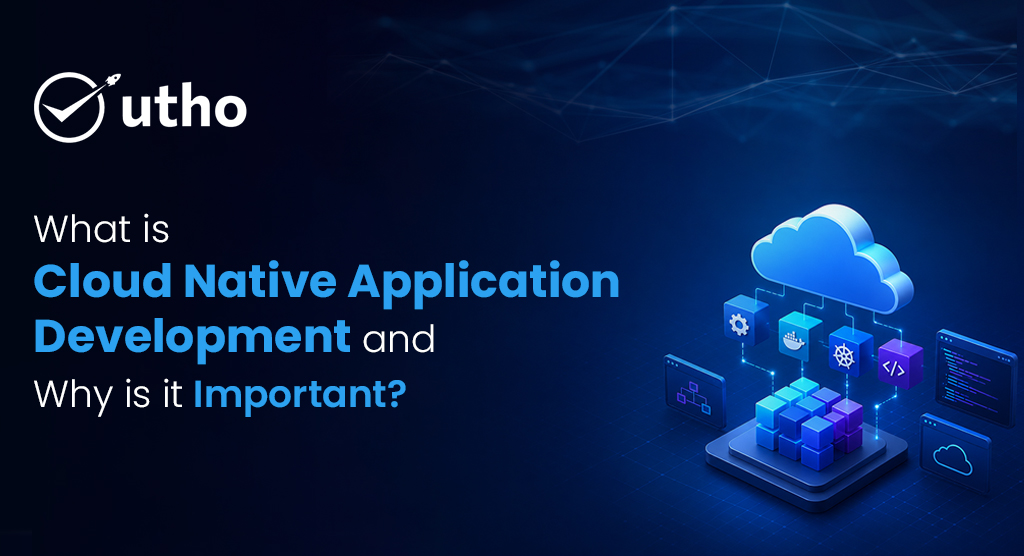
Cloud native application development is now the base of modern software systems. In 2026 almost every big application like SaaS platforms, AI apps, fintech systems and e-commerce websites is built using cloud native ideas.
Cloud native is not just a method anymore. It is now the main way to build modern applications. Companies design apps directly for cloud systems so they can grow faster, work better and handle many users without stopping.
This method helps companies move away from old monolithic systems. Instead they build apps that are flexible, split into parts and more stable.
This guide explains cloud native development in very simple words and how it works in today’s world with technologies like serverless AI systems and edge computing.
Introduction
Cloud computing has changed how software is built and used. But just putting apps on the cloud is not enough now.
Modern apps must handle many things like:
- High traffic without slowing down
- Users from all over the world
- Fast updates and new features
- Automatic system management
- No downtime and quick recovery
Cloud native development helps achieve all this by building apps directly for cloud systems.
Instead of changing old apps for the cloud companies now build apps in a cloud ready way from the beginning. This makes them faster, easier and more reliable.
What is Cloud Native Application Development
Cloud native application development means building apps in a way that fully uses cloud power.
These apps do not depend on one server. They run across many systems and services.
Cloud native apps are:
- Spread across many services
- Easy to scale when needed
- Able to recover automatically if something fails
- Connected through APIs
- Easy to deploy and manage
In simple words cloud native means building apps for the cloud from day one.
This makes apps faster, more stable and easier to manage.
In 2026 cloud native systems also use advanced technologies like:
- Serverless computing for event based tasks
- Edge computing for fast response
- AI systems for automation and monitoring
- Containers for better management
- Event based systems for real time actions
All these together make cloud native the main base of modern software systems.
Core Principles of Cloud-Native Development
Cloud native applications are built on some clear rules that decide how they are designed, built , deployed and managed in modern cloud systems. These rules help applications stay scalable, stable and fast even when there is heavy load.
1. Microservices Architecture
Cloud native applications are broken into small independent parts instead of one big system.
For example a modern application can have:
- User login service
- Payment service
- Notification service
- Analytics service
Each microservice:
- Runs on its own without affecting others
- Can be updated separately
- Can scale based on need
This makes the system more flexible and if one service fails the whole app does not stop. It also helps teams work faster because different teams can work on different services.
2. Containerization
Most cloud native applications run inside containers which give a same and portable environment.
Containers include everything needed like:
- Application code
- Dependencies
- Libraries
- Runtime
This makes sure the app works the same in development testing and production.
In 2026 tools like Kubernetes are used to manage many containers. They help with scaling and keeping systems always available.
3. API First Design
Cloud native systems use APIs so different services can talk to each other.
Common methods include:
- REST APIs
- GraphQL APIs
- Event based messaging
This helps services stay separate but still connected. It also makes systems easier to scale and connect with other tools.
4. Automation CI CD
Automation is very important in cloud native systems.
It includes:
- Continuous Integration CI
- Continuous Deployment CD
- Automated testing
- Infrastructure as Code IaC
In 2026 many systems also use AI automation to make deployments faster and reduce mistakes.
5. DevOps and Observability
Cloud native systems need monitoring to stay healthy.
This includes:
- Logs
- Metrics
- Traces
- Dashboards
DevOps teams use this data to find problems quickly and fix them fast. This helps keep systems stable and reliable.
Why Cloud Native Development is Important
Cloud native development is now very important for building modern apps that are fast stable and ready for future growth
- Scalability on Demand
Cloud native apps can automatically grow or reduce based on traffic
In 2026 scalability is even better with
- AI based scaling prediction
- Multi region load handling
- Edge based request processing
This keeps apps fast even when many users come at the same time
- High Availability and Reliability
Cloud native systems are built to keep running even if something fails
They use
- Multiple region setup
- Automatic failover
- Backup systems
- Self fixing infrastructure
Even if one part stops working the system still runs smoothly
- Cost Efficiency
Cloud native systems help save money
They do this by
- Pay only for what you use model
- No wasted idle resources
- Automatic scaling up and down
- Use of managed cloud services
This makes it good for both small and big companies
- Faster Development and Deployment
Cloud native makes software delivery faster
It allows
- Small and frequent updates
- Quick bug fixing
- Separate service deployment
- Automated CI CD pipelines
This helps companies launch features faster in the market
- Flexibility and Technology Freedom
Cloud native systems do not depend on one platform
They support
- Multi cloud usage
- Open source tools
- Portable containers
- Hybrid cloud setups
This gives companies more control and freedom
Cloud Native Architecture 2026 Modern Stack
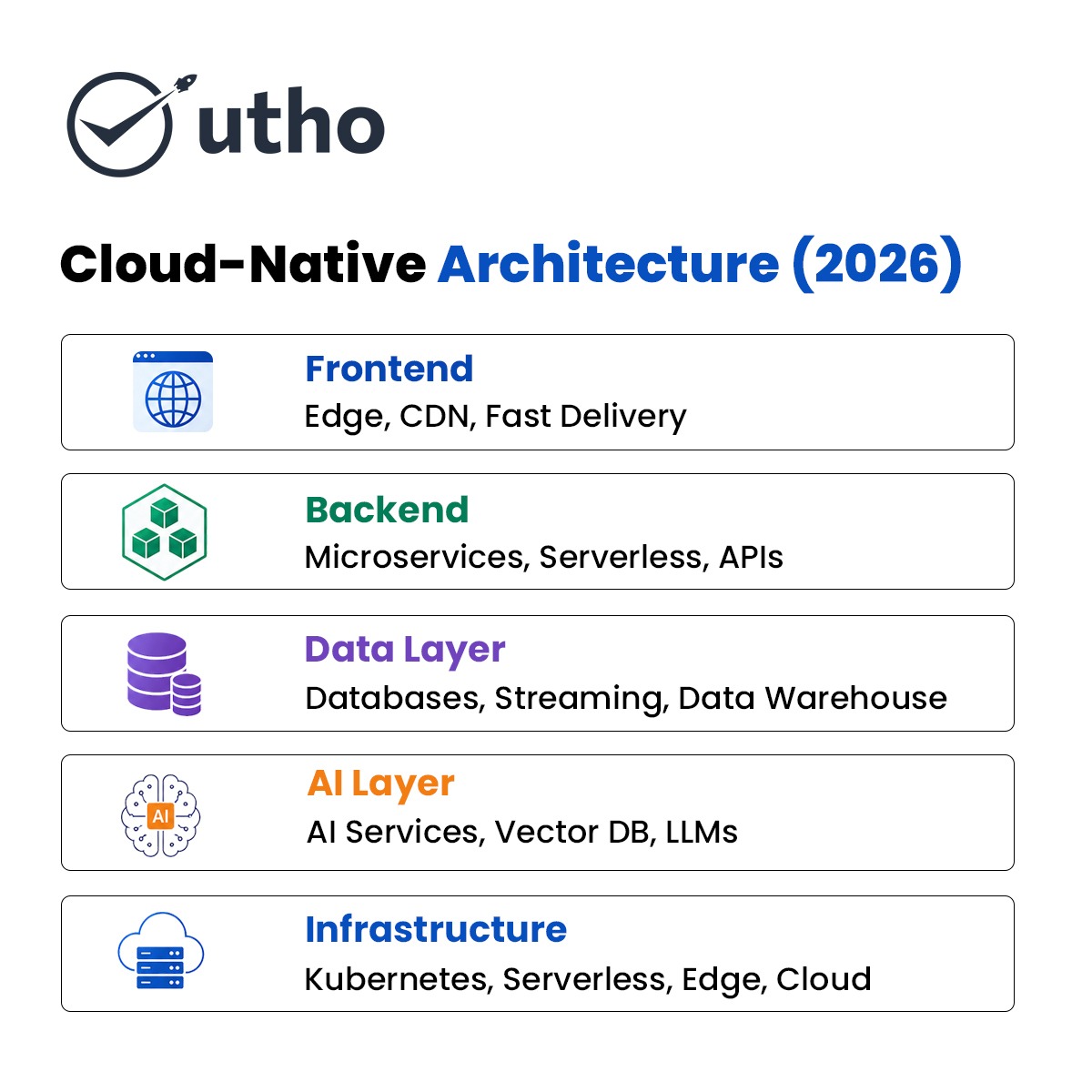
Modern cloud native systems in 2026 are not simple systems anymore. They are advanced setups that combine cloud edge and AI technologies
They are built to be scalable, stable and intelligent for modern applications.
A typical cloud-native architecture today is structured into several key layers:
Frontend Layer
The frontend layer focuses on how users interact with applications.
It includes:
- Edge-hosted web applications for faster global access
- CDN-based delivery systems to reduce latency
- Server side rendering at the edge helps pages load faster and improves SEO
Cloud native application development makes sure backend systems can grow automatically when needed and stay flexible and easy to manage. This helps modern applications become faster and more stable.
Backend Layer
The backend layer handles the core application logic and processing.
It is typically built using:
- Microservices architecture for modular development
- Serverless functions for event-driven workloads
- Containerized APIs for scalable service communication
Cloud native application development ensures that backend systems can scale dynamically while remaining highly flexible and maintainable. This makes modern applications faster and more resilient.
Data Layer
The data layer manages storage, processing, and real-time data flow.
It includes:
- Distributed databases for high availability and scalability
- Real-time streaming systems for live data processing
- Cloud data warehouses for large-scale analytics
Cloud native application development helps optimize how data is processed and managed across distributed systems, ensuring high performance even at large scale.
AI Layer
In 2026, AI has become a core component of cloud-native systems.
This layer includes:
- AI inference services for real-time predictions
- Vector databases for semantic search and embeddings
- LLM-based applications for intelligent automation and user interaction
- Smart automation systems help make decisions and improve performance automatically
Cloud native application development allows AI systems to easily connect with modern cloud systems and makes applications more smart and able to adjust on their own
Infrastructure Layer
The infrastructure layer is the base of cloud native systems. It provides everything needed to run applications.
It includes:
Kubernetes clusters for managing containers
Serverless platforms for event based tasks
Edge computing nodes for fast processing
Managed cloud services to reduce system work
This layer helps systems stay scalable, reliable and available across the world.
Evolution of Cloud Native
Cloud native systems have changed a lot in recent years. Earlier they were mainly based on microservices. Now they have become more advanced and intelligent.
From Microservices to Full Distributed Systems
In the past cloud native systems focused on splitting apps into microservices.
In 2026 they also include:
Event based systems for real time actions
Global distribution across many regions
Edge computing for faster response
AI based system control and automation
This change has made cloud native systems more powerful scalable and self managed than before.
Rise of Serverless Cloud-Native
Serverless computing has become a core pillar of modern cloud-native architecture.
Platforms like:
- Amazon Web Services
- Microsoft Azure
- Google Cloud Platform
now support fully managed, event-driven application models that eliminate the need for manual infrastructure management.
This allows developers to focus entirely on application logic while the cloud handles scaling and execution automatically.
Platform Engineering Revolution
In 2026, many organizations have adopted platform engineering practices.
Companies now build internal developer platforms that provide:
- Standardized deployment tools
- Self-service infrastructure provisioning
- Automated CI/CD pipelines
- Unified development environments
This significantly reduces DevOps complexity and improves developer productivity.
AI Integration in Cloud-Native Systems
Artificial intelligence is now deeply integrated into cloud-native environments.
AI systems are used for:
- Predicting system failures before they occur
- Optimizing performance in real time
- Automatically scaling infrastructure based on demand
- Detecting anomalies and security threats
As a result, cloud-native systems are becoming increasingly self-managing and autonomous.
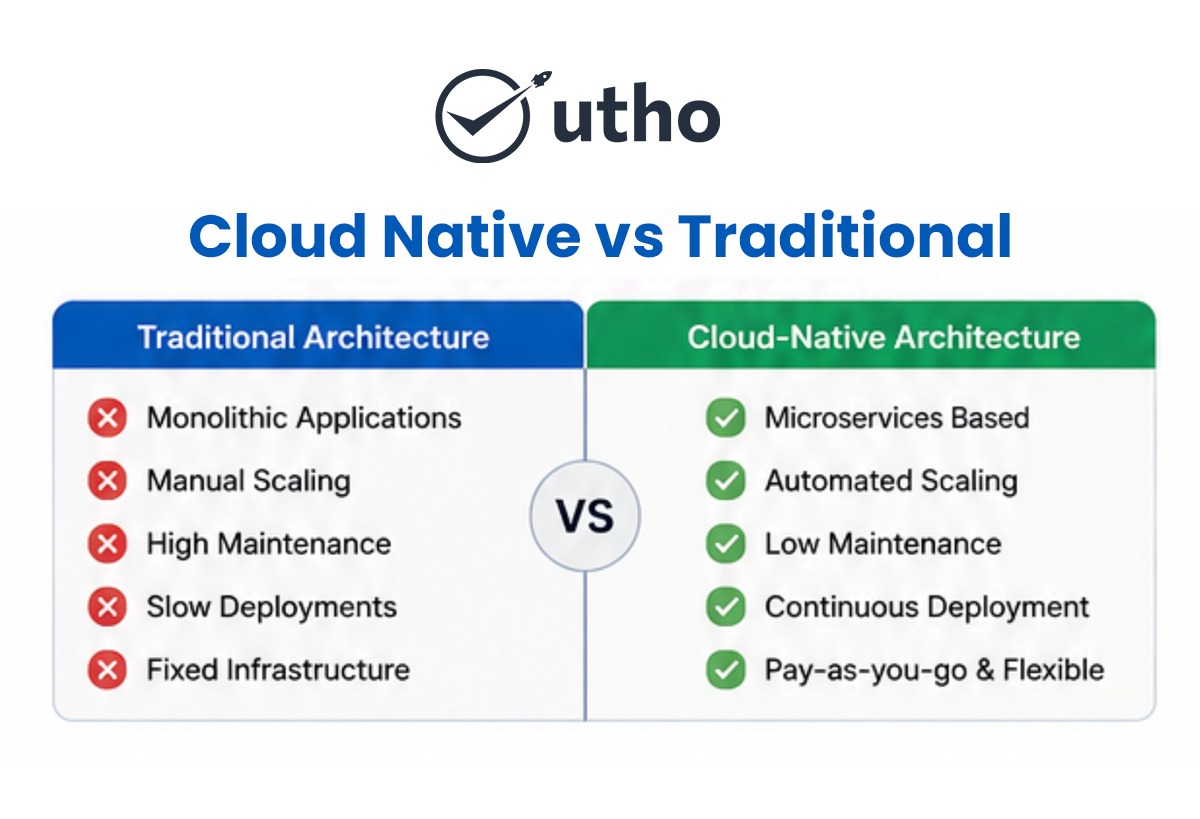
Cloud-Native vs Traditional Architecture
Best Practices for Cloud-Native Development
Cloud-native development in 2026 is not just about using modern tools—it is about building systems that are stable, scalable, secure, and automation-driven from the ground up. Following best practices ensures that applications perform efficiently even in large-scale distributed environments.
1. Design for Failure
In cloud-native systems, failure is not an exception—it is expected.
Instead of trying to prevent all failures, systems are designed to handle them automatically.
This includes:
- Automatic failover mechanisms
- Redundant services across regions
- Self-healing infrastructure
By designing for failure, applications remain available even when parts of the system go down.
2. Use Microservices Wisely
Microservices improve flexibility, but they also increase system complexity.
Best practice is to:
- Break applications only where needed
- Avoid over-segmentation of services
- Maintain clear service boundaries
Proper use of microservices ensures better scalability without unnecessary complexity.
3. Automate Everything
Automation is the backbone of cloud-native systems.
Modern applications automate:
- Deployment processes
- Testing workflows
- Scaling decisions
- Monitoring and alerting
This reduces human error, improves speed, and ensures consistent system behavior across environments.
4. Focus on Observability
Observability helps teams understand what is happening inside complex systems.
It includes:
- Logs for tracking events
- Metrics for performance analysis
- Tracing for request flow visibility
Strong observability ensures faster debugging and better system reliability in distributed environments.
5. Implement Strong Security
Security is very important in cloud native development
- Modern security practices include
- Zero trust architecture never trust always verify
- Identity based access control IAM
- Automatic vulnerability scanning
- Full encrypted communication
These methods help protect applications from new cyber threats in 2026
Challenges of Cloud Native Development
Even though cloud native systems are very powerful they still have some challenges that teams need to handle carefully
1. Complexity
Distributed systems are inherently complex because they consist of multiple services working together.
Managing dependencies and communication between services can be challenging.
2. Debugging Difficulty
Finding the root cause of issues in cloud-native systems is harder because:
- Services are distributed
- Requests pass through multiple layers
- Failures may occur in different components
This makes debugging more time-consuming without proper observability tools.
3. Cost Management
Poor planning of resources can lead to high cloud costs
- Challenges include
- Extra resources that are not needed
- Unused services running in background
- Poor scaling decisions
Cost control is always needed in cloud native systems
4. Skill Requirements
Cloud native development needs strong technical skills in
- Cloud platforms AWS Azure GCP
- Containers and orchestration tools
- DevOps practices
- Distributed system design
This makes it harder for beginners compared to traditional development
Role of AI in Cloud Native
Artificial Intelligence is now a big part of cloud native systems and makes them smarter faster and more efficient
AI Operations AIOps
AI is now widely used to manage systems
It helps to
- Predict failures before they happen
- Automatically scale systems
- Improve performance in real time
This reduces manual work and makes systems more stable
AI-Assisted Development
AI is also transforming how developers build applications.
It supports:
- Automated code generation
- Deployment recommendations
- Intelligent debugging assistance
This significantly speeds up development cycles.
AI Optimization
AI continuously improves system efficiency by:
- Reducing operational costs
- Balancing workloads
- Predicting traffic patterns
- Optimizing resource usage
As a result, cloud-native systems are becoming more intelligent and cost-efficient.
Edge Computing + Cloud-Native Integration
In 2026, cloud-native applications are no longer limited to centralized cloud regions.
They now run across:
- Cloud data centers
- Edge computing nodes
- Hybrid environments
This distributed model reduces latency and improves performance, especially for real-time applications like gaming, streaming, and AI services.
Future of Cloud-Native Development
Cloud-native development is evolving rapidly toward more autonomous and intelligent systems.
1. Fully Autonomous Infrastructure
Future systems will be capable of:
- Self-healing
- Self-optimization
- Self-scaling without human input
2. AI-Native Applications
Applications will be built with AI at their core, not just as an added feature.
3. Unified Cloud + Edge Platforms
Cloud and edge environments will merge into a single global execution layer for seamless performance.
4. Zero-DevOps Future
Infrastructure management will become fully automated, reducing the need for manual DevOps operations.
Conclusion
Cloud native application development in 2026 has become the foundation of modern software engineering.
It enables organizations to build systems that are:
- Highly scalable
- Fast and efficient
- Globally available
- Fault-tolerant
- AI-optimized
What started as a container-based architecture has now evolved into a fully distributed, intelligent, and automated cloud ecosystem.
Companies that adopt cloud-native principles are better prepared for future technological demands, global-scale applications, and AI-driven digital transformation.