

Cloud-native applications have changed the way businesses build and use software. Today companies want to launch applications quickly, handle more users and keep their services running without problems. Because of this container technology has become very important.
Two technologies that many people hear about are Kubernetes and Docker. Many people think they are the same because both are used for containers. But they are different and each has its own job. Understanding Kubernetes vs Docker helps people know how modern applications work.
The topic of Kubernetes vs Docker is still important in 2026 because many companies use both technologies every day. Docker helps developers create containers and run applications easily. Kubernetes helps manage those containers and keep everything working properly.
In simple words Docker helps create containers and Kubernetes helps manage containers.
In this guide we will learn Kubernetes vs Docker in very simple words, understand what they do, compare their features and see how companies use them to run applications easily.
What is Kubernetes?
Kubernetes, also called K8s, is a tool that helps manage containers. It was first made by Google. Later it became an open source project that anyone can use.
As companies started using more containers it became difficult to manage them manually. Some companies use many containers. Managing them by hand is not easy and takes a lot of time.
Kubernetes was made to solve this problem. It helps manage containers automatically and keeps applications running on different servers.
Today many companies use Kubernetes to manage containers easily. Small companies large businesses and cloud providers use it to run applications more easily and efficiently.
Kubernetes helps automate many tasks such as:
- Container deployment
- Scaling applications
- Load balancing
- Resource management
- Service discovery
- Monitoring
- Fixing failures
Because of these features Kubernetes has become one of the most popular tools for managing applications in modern cloud environments.
Key Features of Kubernetes
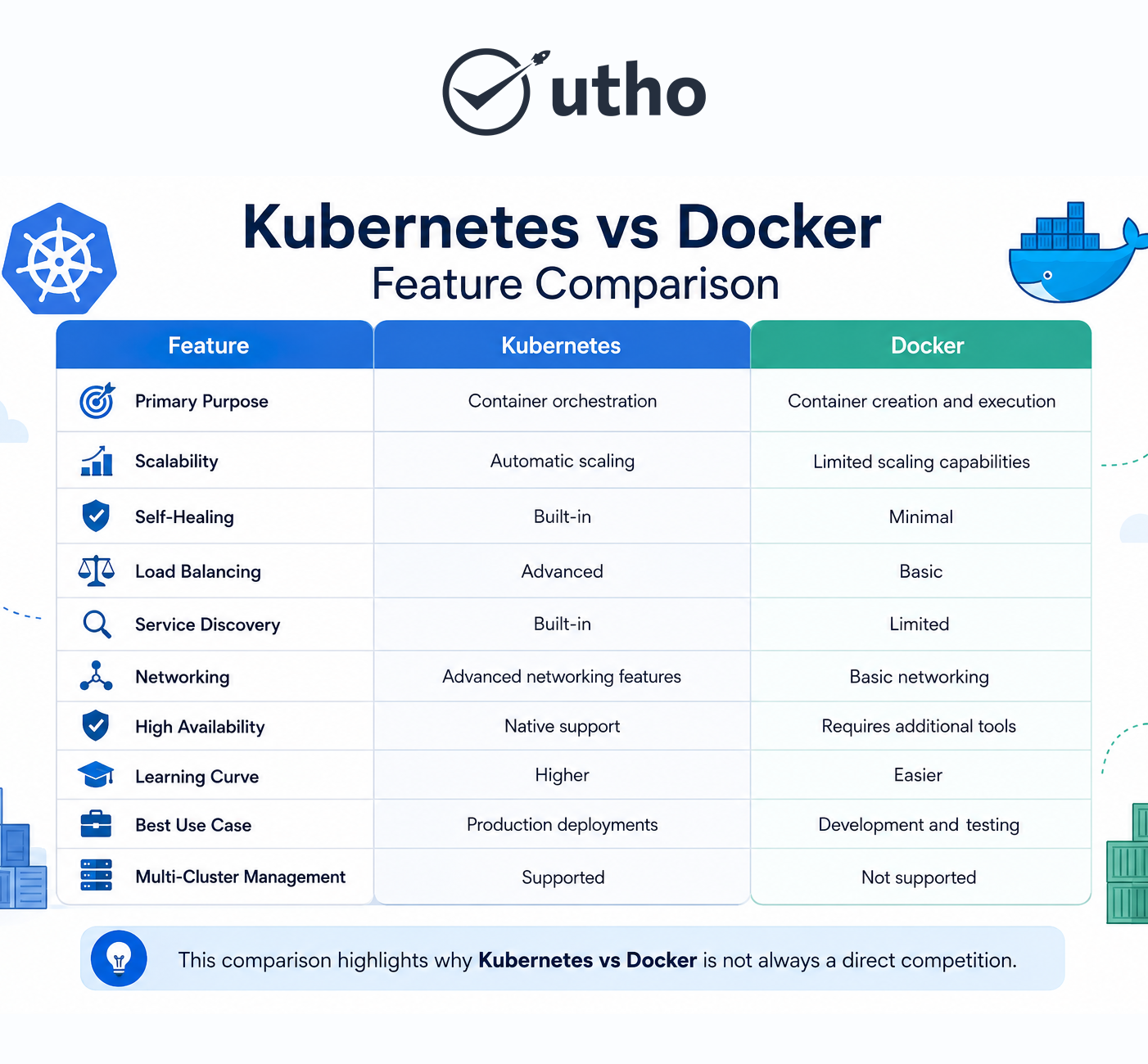
1. Scalability
One of the biggest benefits of Kubernetes is automatic scaling.
Sometimes a website or app gets more visitors and sometimes fewer visitors. Kubernetes can automatically increase or decrease resources based on demand.
This helps applications run smoothly and also saves money.
2. Self-Healing
Kubernetes keeps checking whether applications are working properly.
If a container stops working Kubernetes can restart it automatically. If a server fails Kubernetes can move the application to another healthy server.
This helps reduce downtime and keeps applications running.
3. Service Discovery and Load Balancing
Many applications have different parts that need to work together.
Kubernetes helps these parts find each other and communicate properly. It also shares traffic across containers so that no single container gets overloaded.
This helps improve speed and performance.
4. Automatic Updates and Rollbacks
When companies update their software problems can sometimes happen.
Kubernetes allows updates to happen step by step. If something goes wrong Kubernetes can quickly go back to the previous working version.
This makes updates safer and easier.
5. Better Resource Usage
Kubernetes uses servers and resources in a smart way.
It helps companies use what they have properly and avoid wasting resources.
This can also help save money.
6. Works Across Different Clouds
Many businesses use more than one cloud platform.
Kubernetes can work on public clouds, private clouds and hybrid clouds.
This gives businesses more flexibility and helps them run and manage applications more easily across different cloud platforms.
What Is Docker?
Docker is a tool that helps developers put applications into containers. It makes it easier to build, run and share applications on different systems.
A Docker container includes everything an application needs to work properly such as:
- Application code
- Runtime environment
- Libraries
- Dependencies
- Configuration files
Because everything is packed together inside a container the application works the same way everywhere.
Before Docker developers often faced a common problem:
“It works on my computer but not on another computer.”
Docker helps solve this problem by creating the same environment for everyone.
Many people compare Kubernetes vs Docker but Docker is mainly used for creating and running containers. It is not designed to manage large numbers of containers across many servers.
Key Features of Docker
1. Containerization
Docker puts applications into separate containers.
Each container has everything needed to run the application without depending on the system around it.
2. Portability
Docker containers can run on any computer or cloud platform where Docker is installed.
This makes it very easy to move and use the same application in different places without changing much.
3. Better Efficiency
Docker containers use fewer resources than traditional virtual machines.
Because of this businesses can run more applications on the same hardware.
4. Faster Development
Docker helps developers create testing and development environments quickly.
This makes building testing and deploying applications much faster.
5. Large Ecosystem
Docker has a large community and many useful tools.
Developers can use ready made container images from Docker Hub to save time and build applications faster.
Kubernetes vs Docker Main Difference
When people talk about Kubernetes vs Docker it is important to know that both do different jobs.
Docker helps create and run containers.
Kubernetes helps manage containers on many servers.
The easiest way to understand it is:
- Docker creates containers.
- Kubernetes manages containers.
This is the main reason why many companies use both tools together. Docker creates the containers and Kubernetes helps manage them when applications grow and need more resources.
Why Kubernetes Has Become So Popular
In the last few years more companies have started using Kubernetes.
This growth has happened because of several reasons.
Standardization
Kubernetes provides a consistent way to deploy applications across environments.
Vendor Neutrality
Organizations are not locked into a single cloud provider.
Automation
Many infrastructure management tasks become automated.
Scalability
Applications can handle increasing workloads without significant manual effort.
Reliability
Self-healing mechanisms improve application uptime.
These benefits explain why Kubernetes is now the default orchestration platform for cloud-native applications.
Why Docker Remains Important in 2026
Despite changes in container runtimes, Docker continues to be widely used.
Docker remains valuable because it simplifies:
- Application packaging
- Development environments
- Local testing
- CI/CD workflows
- Container image creation
Even in modern Kubernetes environments, developers frequently use Docker to build images before deploying them to production.
This is one reason the conversation around Kubernetes vs Docker remains relevant.
Can Kubernetes and Docker Work Together?
Yes.
Many people think they must choose between Kubernetes vs Docker but that is not true.
In reality both tools often work together and help each other.
Step 1: Create Containers with Docker
Developers first use Docker to create containers for their applications.
Each container includes everything the application needs to run properly.
Step 2: Store Container Images
After creating containers the images are stored in places such as:
- Docker Hub
- Private registries
- Cloud registries
Step 3: Deploy with Kubernetes
Kubernetes takes these container images and runs them across servers and clusters.
Step 4: Manage and Scale
After deployment Kubernetes handles many tasks such as:
- Scaling applications
- Monitoring containers
- Scheduling workloads
- Managing networking
- Recovering from failures
This shows that Kubernetes vs Docker is not about choosing one over the other. Many businesses use Docker to create containers and Kubernetes to manage them.
Kubernetes Runtime Changes in 2026
An important change in the Kubernetes vs Docker discussion is related to container runtimes.
Today Kubernetes does not use Docker Engine as its main runtime.
Most modern Kubernetes clusters now use:
containers
containerd is a lightweight container runtime designed for running containers efficiently.
It is fast, simple and widely used in Kubernetes environments.
CRI-O
CRI-O is another container runtime made especially for Kubernetes.
It is designed to be secure, simple and suitable for production environments.
Even though Kubernetes now uses containerd and CRI-O Docker is still very important because developers continue to use it for building container images and development work.
Kubernetes Providers in the Market
Many cloud companies offer managed Kubernetes services that make deployment easier.
Amazon EKS
Amazon Elastic Kubernetes Service is a managed Kubernetes service from Amazon Web Services.
Benefits:
- Easy AWS integration
- Managed control plane
- High availability
Challenge:
- Costs can become high as usage grows
Google Kubernetes Engine
Google Kubernetes Engine is a Kubernetes service from Google Cloud.
Benefits:
- Automatic updates
- Strong automation
- Excellent scalability
Challenge:
- Requires knowledge of Google Cloud
Microsoft AKS
Azure Kubernetes Service is a managed Kubernetes platform from Microsoft Azure.
Benefits:
- Works well with Azure services
- Managed infrastructure
- Good pricing options
Challenge:
- Best for companies already using Azure
These services make it easier for businesses to use Kubernetes without managing everything themselves.
How Utho simplifies Kubernetes for users.
Many businesses think Kubernetes is difficult because it needs to set up security updates and regular management. These tasks can take a lot of time.
Utho makes Kubernetes easier to use. It provides a managed Kubernetes platform so businesses do not have to do most of the difficult work themselves.
With Utho Kubernetes users can quickly create clusters, manage applications easily and run workloads without spending too much time on setup and maintenance.
Benefits of Utho Kubernetes
Lower Costs
Many businesses choose Utho because it helps save money.
- Lower cloud costs
- Better use of resources
- Less waste of infrastructure
- Easy and clear pricing
This helps businesses control their spending while still getting good performance.
Reliable Performance
Applications need to keep running without problems.
Utho Kubernetes helps by:
- Restarting failed workloads automatically
- Reducing downtime
- Keeping applications available
- Improving reliability
This helps businesses provide a better experience to their users.
Easy Scaling
As more users visit an application, more resources may be needed.
Utho Kubernetes makes scaling simple.
- Add resources when traffic increases
- Support growing applications
- Handle traffic spikes easily
- Work well with modern applications
This allows businesses to grow without worrying about infrastructure problems.
Simple Management
Managing Kubernetes can be confusing for many teams.
Utho makes it easier by providing:
- Ready-to-use clusters
- Easy setup
- Simple monitoring
- Clear resource management
- Easier day-to-day operations
This saves time and reduces complexity.
Better for Developers
Developers want to spend more time building applications and less time managing servers.
Utho helps by offering:
- Faster deployments
- Easier workflows
- Consistent environments
- Less infrastructure work
- Better development experience
This helps teams work faster and more efficiently.
When Should You Choose Kubernetes?
Kubernetes is a good choice if:
- You use many containers
- Your application is growing
- You need automatic scaling
- High availability is important
- You use microservices
- You want more automation
Kubernetes is best for applications that need to grow and handle many users.
When Should You Choose Docker?
Docker is a good choice if:
- You want to create containers
- You are building applications
- You need a testing environment
- You want applications to work the same everywhere
- You use only a few containers
Docker is simple and very useful for developers.
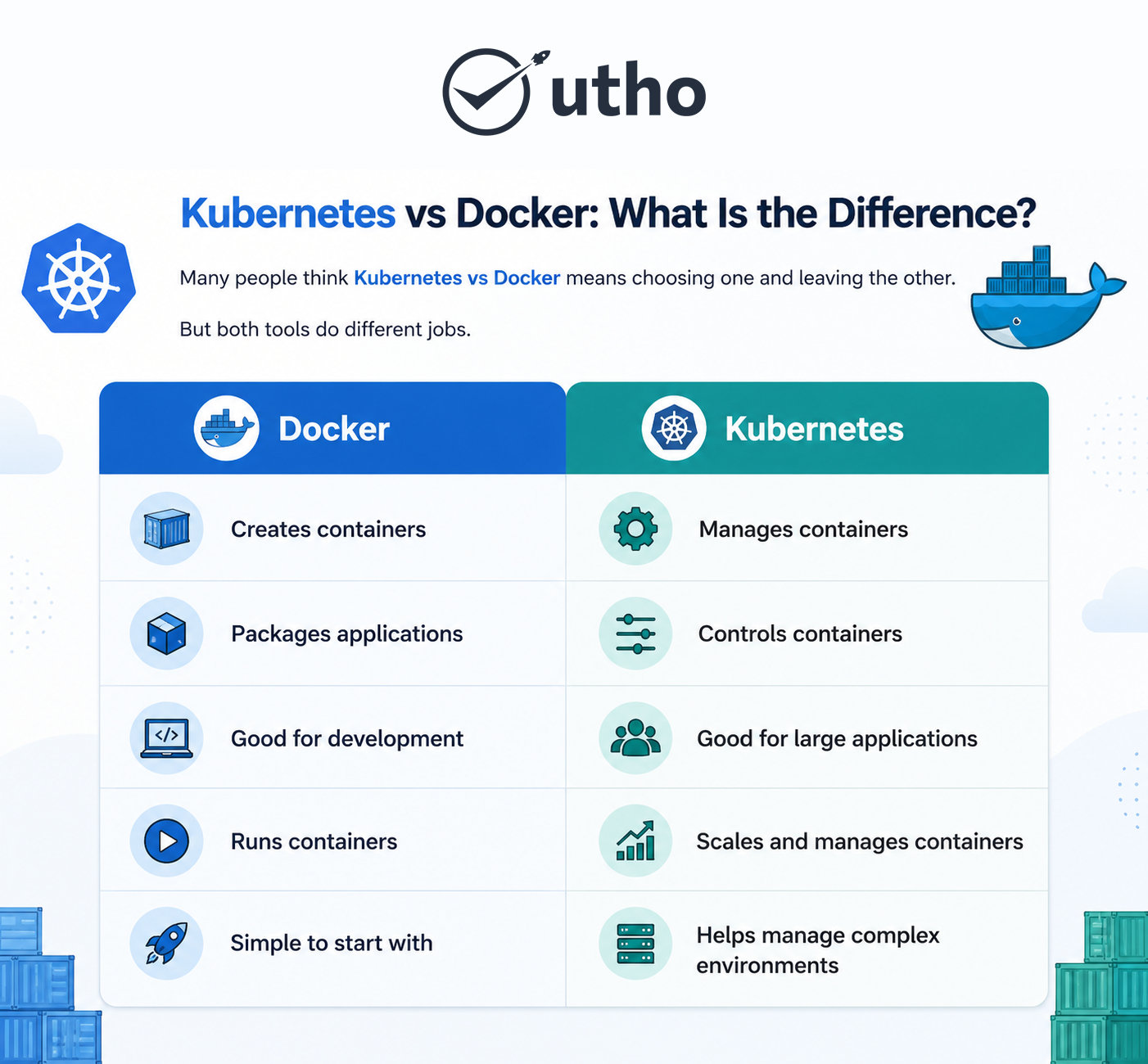
The easiest way to understand it is:
- Docker makes containers.
- Kubernetes manages containers.
That is why many companies use both together.
Why Businesses Choose Utho for Kubernetes
Many businesses want the benefits of Kubernetes without dealing with its complexity.
Utho helps by providing:
- Fast Kubernetes setup
- Lower cloud costs
- Managed Kubernetes service
- Easy scaling
- Simple monitoring
- Ready-to-use infrastructure
This helps teams spend more time building applications and less time managing Kubernetes.
Final Thoughts
Both Kubernetes and Docker are important tools in cloud computing.
When people compare Kubernetes vs Docker they should remember that both tools do different jobs.
Docker helps create containers.
Kubernetes helps manage containers.
For small projects Docker may be enough.
For larger applications that need automatic scaling and easier management Kubernetes is usually a better choice.
For businesses that want to use Kubernetes in a simple way Utho provides an easy, affordable and user-friendly solution.