


In modern software development speed stability and automation are very important. Companies now release new features, security updates and bug fixes very quickly sometimes many times in a day.
To do this safely and without breaking systems companies use CI CD pipelines.
CI CD means Continuous Integration and Continuous Delivery or Deployment and in 2026 it has become a very important part of DevOps cloud native systems and AI based development.
This guide explains CI CD pipelines in simple words how they work and how they have changed with AI cloud systems and modern DevOps.
What is CI CD
CI CD is a modern software method that automates the full process of building testing and delivering software.
It helps teams release updates faster, more safely and with fewer mistakes.
In traditional development, developers had to manually:
- Combine code changes
- Test applications
- Build software versions
- Deploy updates to servers
This manual process was slow and often caused mistakes, bugs and deployment failures.
CI CD solves this problem by automating everything using a structured pipeline.
In simple words CI CD makes sure every code change is automatically checked, tested and prepared for deployment without manual work. This is what people mean when they ask what is ci cd pipeline because it shows how software moves from development to production in an automatic way.
CI/CD is divided into two main parts:
CI (Continuous Integration)
Continuous Integration is the process of regularly merging code changes into a shared repository.
Every time a developer adds new code:
- It is automatically integrated with the main codebase
- Automated tests are executed
- Errors or conflicts are detected early
This ensures that the software is always in a stable and working state.
CI helps teams avoid “integration problems” that usually happen when multiple developers work on the same project.
This entire workflow is often described when explaining ci/cd pipeline meaning, because CI is the first and most important stage of any CI/CD system.
CD (Continuous Delivery / Deployment)
CD focuses on delivering or deploying the tested code to production environments.
There are two forms:
Continuous Delivery
- Code is automatically built and tested
- It is then prepared for release
- Manual approval may still be required before deployment
Continuous Deployment
- Everything is fully automated
- Once code passes tests, it is directly deployed to production
- No manual intervention is needed
This helps companies release updates fast and in a steady way
Modern engineering teams often use what is ci cd pipeline practices to understand how automation works in real systems while ci cd pipeline meaning explains the full flow from code to production
Why CI/CD Matters in 2026
In 2026, CI/CD is not just a development practice—it is a foundation of modern software delivery.
It supports:
- Faster release cycles
- Improved software quality
- Reduced human errors
- Better collaboration between teams
- Scalable deployment systems
This is why understanding what is ci cd pipeline and ci cd pipeline meaning has become very important for every developer, DevOps engineer and tech company working in modern cloud systems.
Continuous Delivery vs Continuous Deployment
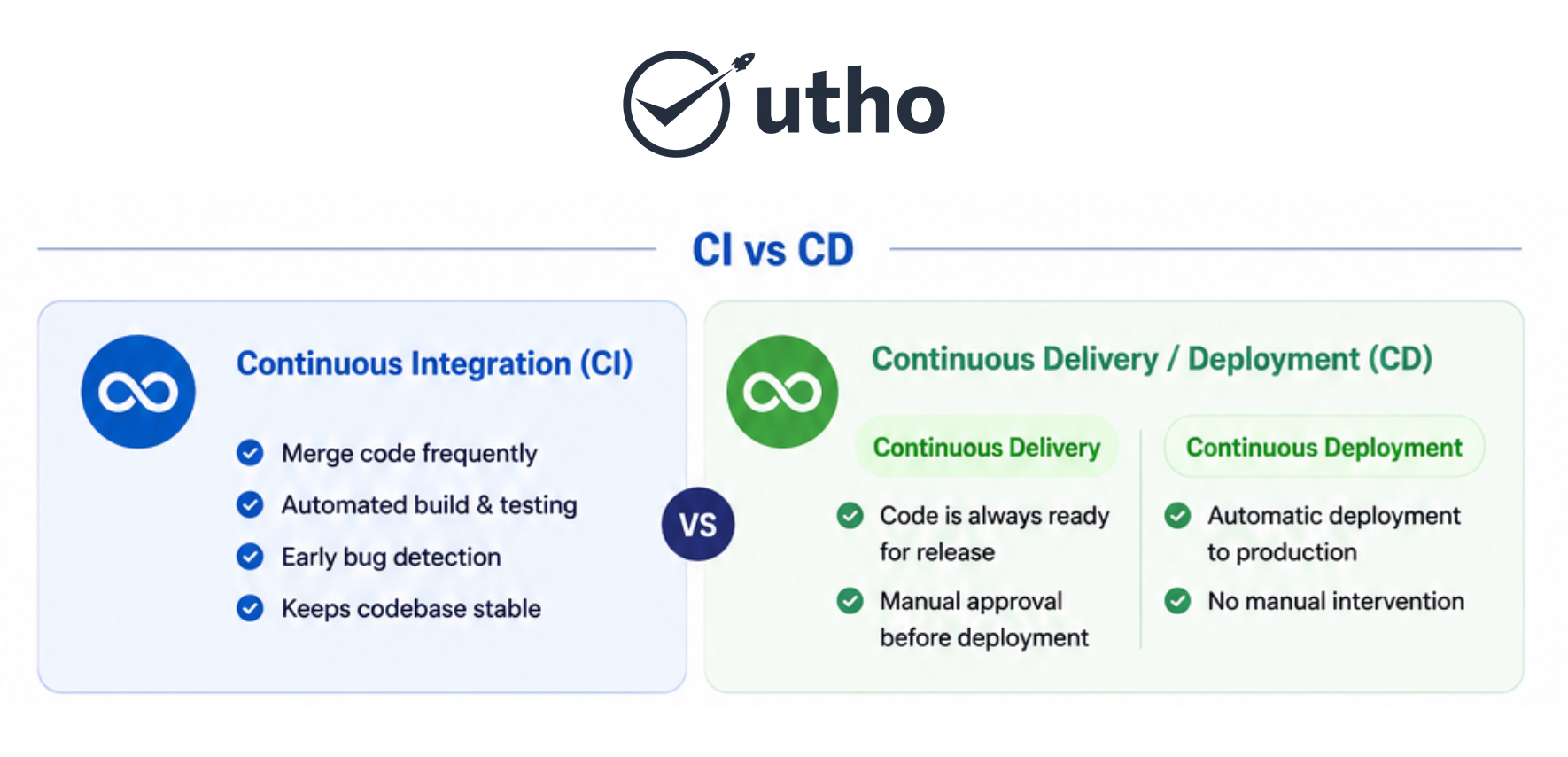
These two terms are often mixed but they are different. Even though both are part of CI CD pipelines and both help automate software release the main difference is how code goes to production and who controls the final step. This distinction is often explained when understanding what is ci/cd pipeline, because both models define different ways a CI/CD system behaves in real production environments.
Continuous Delivery
- Code is automatically tested through CI pipelines after every commit
- Every change goes through a structured build process
- Automated testing checks for bugs, errors, and integration issues
- Code is always kept in a production-ready state
The system makes sure the application is always safe to deploy at any time.
This means developers do not need to manually prepare the app for release every time. The pipeline keeps checking the code and makes sure everything is stable before it is ready for production.
However the most important part is
Deployment is triggered manually.
Even if all tests pass and the system confirms everything is stable the code does not go live automatically. A person like a DevOps engineer or developer decides when to send the changes to production.
This gives organizations more control over releases, allowing them to:
- Choose optimal deployment timing
- Avoid releasing during peak traffic hours
- Coordinate with business or marketing teams
- Reduce risk in critical systems
Think of it as:
“Ready anytime, deploy when needed.”
This model is often referenced when explaining ci/cd pipeline meaning, because it clearly shows how controlled deployment works inside a CI/CD pipeline.
Continuous Deployment
In Continuous Deployment:
- Code is automatically tested using CI pipelines.
- After all tests pass successfully, the code is automatically released to production.
- There is no manual approval step before deployment.
- Every validated change goes live instantly.
This method focuses on full automation where the system itself checks quality using tests and if everything is stable it directly sends the update to users.
This means developers do not wait for release schedules or manual approvals The pipeline itself decides when to deploy.
Think of it like this
If it works release it immediately
Modern DevOps teams often study what is ci cd pipeline to understand how Continuous Deployment fully automates software release inside a CI CD pipeline while ci cd pipeline meaning explains the full flow from code to production.
What is a CI CD Pipeline
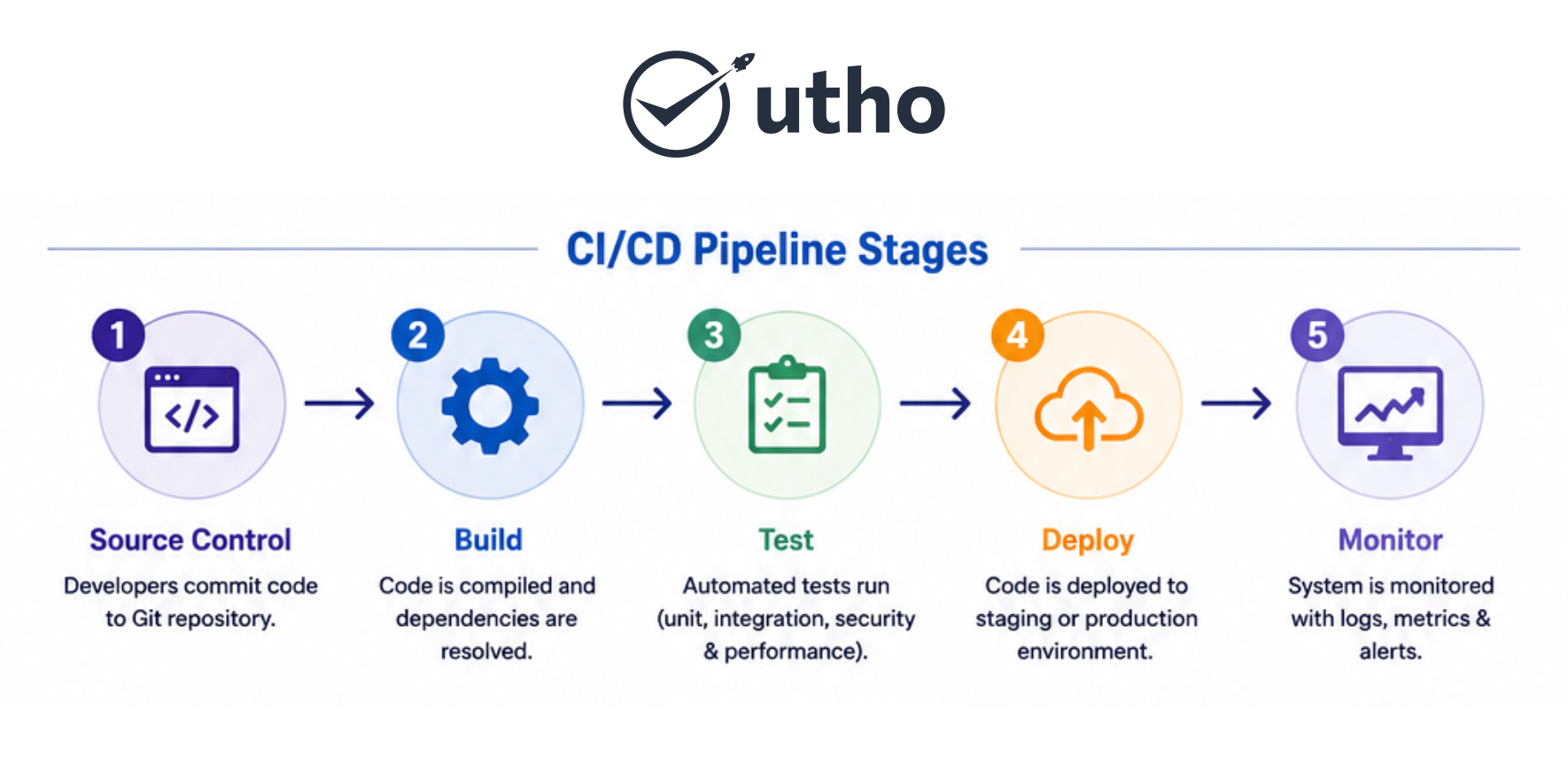
A CI CD pipeline is a simple automated workflow that takes code from development and moves it to production.
It makes sure every code change is built, tested and delivered in a proper and reliable way without manual work.
A normal CI CD pipeline has different steps.
1. Source Control
This is the starting point of the pipeline. Developers write and store their code in version control systems such as:
- Git repositories
- GitHub
- GitLab
- Bitbucket
Whenever a developer pushes new code, it automatically triggers the CI/CD pipeline. This ensures that every change is tracked, versioned, and processed through the same workflow.
2. Build Stage
In this stage, the system prepares the application for testing and deployment. It typically includes:
- Compiling source code
- Resolving dependencies and libraries
- Packaging the application into build artifacts
- Preparing runtime-compatible output
This step ensures that the code is technically correct and can be executed in a controlled environment.
3. Testing Stage
This is one of the most important parts of the pipeline. Automated tests are executed to ensure code quality and stability, such as:
- Unit tests (testing individual components)
- Integration tests (testing combined modules)
- End-to-end tests (testing full application flow)
- Security tests (checking vulnerabilities and risks)
In 2026, CI/CD pipelines are further enhanced with AI-powered testing tools that help identify:
- Edge-case failures
- Performance bottlenecks
- Security vulnerabilities
- Unexpected system behavior
This makes the testing process smarter, faster, and more reliable.
4. Deployment Stage
This is the final stage where the application is delivered to users or environments. The tested code is deployed to:
- Staging environments (for final validation)
- Production environments (live user systems)
- Cloud infrastructure platforms
Modern CI/CD systems often use advanced deployment strategies like:
- Blue-green deployments (switching between two environments)
- Canary releases (releasing to a small user group first)
- Rolling updates (gradual system-wide deployment)
These methods help reduce downtime and minimize risk during releases.
In real world CI CD systems, understanding what is ci cd pipeline and ci cd pipeline meaning is very important because both explain how automation testing and deployment work together in modern software delivery.
How CI CD Works in Modern Systems 2026
CI CD has changed a lot in recent years Earlier it was only an automation process but now it has become a smart AI based system that improves software quality speed and reliability
Modern engineering teams first understand what is ci cd pipeline before building any delivery system because this concept is the base of modern software development
In 2026 CI CD pipelines are not just simple scripts that run builds and tests. They are now smart systems that can check code, find risks and improve deployments automatically. This evolution is also closely connected to the growing understanding of ci/cd pipeline meaning in modern DevOps environments. The idea of ci/cd pipeline meaning helps teams define structured automation in software delivery.
Modern CI/CD Flow
A typical modern CI/CD pipeline works in the following sequence:
- Developer commits code to a repository (Git-based systems)
- AI based pre-checks analyze the code for quality issues, performance risks and security problems.
- The CI CD pipeline is automatically triggered when code is committed or merged.
- Multiple tests run at the same time in parallel to save time and improve speed.
- Security scanning tools check for vulnerabilities in dependencies and code structure in real time.
- A build is generated after successful validation of code.
- Deployment is executed either automatically or with controlled approval (depending on system design)
This entire flow ensures that software moves from development to production in a fast, safe, and predictable way. It is a practical implementation of what is ci/cd pipeline, where the system is built around what is ci/cd pipeline principles.
Key Benefits of CI/CD Pipelines
1. Faster Software Delivery
CI/CD removes manual steps from the development lifecycle, allowing teams to release software much faster.
Instead of waiting for long release cycles, teams can now push updates in real time:
- Daily feature updates
- Weekly improvements and enhancements
- Emergency bug fixes within minutes
This speed is especially important in 2026, where users expect instant updates and continuous improvements. Organizations also rely on ci/cd pipeline meaning to optimize their release strategies. Many organizations study ci/cd pipeline meaning to optimize delivery speed and workflow efficiency.
2. Improved Code Quality
One of the biggest advantages of CI/CD is consistent code quality through automation.
Automated testing ensures:
- Bugs are detected early in development
- Regression issues are avoided before production release
- Only stable and verified builds move forward in the pipeline
This reduces production failures and improves overall software reliability. A clear understanding of what is ci/cd pipeline helps teams build better quality systems. The concept of what is ci/cd pipeline is central to modern DevOps workflows.
3. Reduced Human Error
Manual deployments often lead to mistakes such as:
- Incorrect configuration settings.
- Missing deployment steps.
- The environment mismatches between development and production.
CI CD removes these risks by making the whole process standard through automation so every deployment follows the same safe and tested steps.
This is directly related to ci cd pipeline meaning where ci cd pipeline meaning explains a structured and error free delivery process.
4. Better Collaboration
CI CD helps improve teamwork between all people involved in software development It creates one shared workflow for.
- Developers who write and commit code.
- QA engineers who test and check the system.
- DevOps teams who handle deployment and infrastructure.
Since everything is automated and visible in pipelines teams can easily track changes, find problems and work together in a better way.
This teamwork model is based on what is ci cd pipeline where what is ci cd pipeline gives shared visibility and automation.
5 Scalability
Modern CI CD systems are built to handle large and complex applications easily They support:
- Big enterprise applications.
- Microservices based systems.
- Multi cloud environments like AWS Azure and GCP.
This makes CI CD very important for companies that want to grow their applications globally without performance problems.
The concept of ci/cd pipeline meaning becomes especially important when scaling systems across distributed environments.
CI/CD Tools in 2026
Today, many advanced tools are used to build and manage CI/CD pipelines. Some of the most widely used tools include:
- GitHub Actions
- GitLab CI/CD
- Jenkins
- CircleCI
- Argo CD
These tools help automate every stage of software delivery, from code integration to production deployment, making modern DevOps systems faster and more reliable.
CI/CD in Cloud-Native Environments
CI CD is closely connected with cloud native development In modern systems applications are not deployed as one single block Instead they are built using distributed systems that need continuous and automatic delivery.
Today cloud native environments depend on.
- Containers that package applications with all needed files.
- Microservices that split applications into small independent parts.
- Kubernetes that manages and scales containers.
- Serverless functions that run code without managing servers.
In these systems CI CD pipelines are directly connected with cloud platforms. After code is tested and verified it is automatically deployed into environments managed by Kubernetes. This helps applications scale, recover and update smoothly in the cloud.
AI Revolution in CI CD Major 2026 Update
One of the biggest changes in CI CD is the use of Artificial Intelligence In 2026. CI/CD is not only simple automation it has become smart and predictive automation.
1. AI Code Review
AI-powered tools now assist developers by analyzing code before traditional testing even begins.
These tools can:
- Detecting potential bugs in early development stages.
- Suggest performance improvements and optimizations.
- Identify security vulnerabilities and risky code patterns.
This reduces development errors and improves code quality before the pipeline even starts testing.
2. Predictive Testing
AI has also improved the testing phase significantly by introducing predictive analysis.
Modern systems can:
- Predict which test cases are most likely to fail.
- Identify high-risk areas in code changes.
- Evaluate whether a change is safe to deploy.
This makes testing faster and more efficient by focusing resources on critical areas instead of running every test blindly.
3. Intelligent Deployment
AI is now actively involved in deployment decisions.
It can automatically determine:
- When the best time to deploy is.
- Where the deployment should be executed (region. or environment)
- How to scale services based on expected demand.
This ensures smoother releases with minimal downtime and optimal performance.
4. Auto Rollback Systems
One of the most powerful features in modern CI/CD is automatic rollback powered by AI.
If the system detects:
- Errors in production
- Sudden performance degradation
- Security threats or unusual behavior
It can automatically roll back the deployment to the previous stable version without waiting for human intervention.
This significantly reduces risk and improves system reliability.
CI/CD Pipeline Architecture (Modern View)
A modern CI/CD pipeline in 2026 is structured into multiple intelligent layers, each responsible for a specific part of the delivery process:
1. Developer Layer
This is where everything begins:
- Writing code
- Running local tests
- Committing changes to Git repositories
2. Automation Layer
This layer handles core CI/CD execution:
- Triggering pipelines on code changes
- Building applications
- Running automated test suites
3. Security Layer
Security is deeply integrated into the pipeline:
- Static code analysis
- Dependency vulnerability scanning
- AI-based threat detection and anomaly analysis
4. Deployment Layer
This layer handles delivery to production environments:
- Cloud deployments
- Container orchestration using Kubernetes
- Serverless function deployment
5. Monitoring Layer
After deployment, systems are continuously observed:
- Real-time logs
- Performance metrics
- Alerts and notifications
- AI-based anomaly detection and system health tracking
This layered architecture ensures that CI/CD in 2026 is not just about automation, but about building self-aware, secure, and highly scalable software delivery systems.
Best Practices for CI/CD (2026)
In modern software development, following proper CI/CD practices is essential to ensure systems remain fast, reliable, and secure. As pipelines become more complex in 2026, these best practices help maintain stability and efficiency.
1. Automate Everything Possible
Automation is the core foundation of CI/CD.
Teams should automate:
- Builds
- Testing processes
- Deployment workflows
- Security scanning and checks
This reduces manual effort and ensures consistency across all stages of the pipeline. The more automation is implemented, the fewer chances there are for human error.
2. Shift Left Testing
“Shift left” means moving testing earlier in the development lifecycle.
Instead of testing at the end, teams now:
- Run tests during development
- Catch bugs before code reaches the main branch
- Validate changes continuously
This approach helps reduce costly fixes later in production and improves overall code quality from the beginning.
3. Use Small, Frequent Deployments
Modern CI/CD encourages breaking large updates into smaller releases.
Benefits include:
- Easier debugging
- Faster rollback if something fails
- Reduced system risk
- More stable production environments
Small deployments are easier to manage and allow teams to release features more confidently and frequently.
4. Implement Strong Security (DevSecOps)
Security is now integrated directly into CI/CD pipelines, a practice known as DevSecOps.
This includes:
- Automated vulnerability scanning
- Secret detection (API keys, passwords, tokens)
- Compliance and policy checks
By integrating security early in the pipeline, teams can prevent vulnerabilities before they reach production environments.
5. Use Observability Tools
Modern CI/CD systems rely heavily on observability to maintain performance and reliability.
Key components include:
- Distributed tracing (tracking requests across services)
- Log analysis (identifying errors and patterns)
- Real-time dashboards (monitoring system health)
These tools help teams quickly detect issues and understand system behavior in real time.
Challenges in CI/CD
Even in 2026, CI/CD systems come with several challenges that organizations must manage carefully.
1. Pipeline Complexity
As systems grow, pipelines become more complex and harder to manage, especially in microservices-based architectures.
2. Debugging Failures
When pipelines fail, identifying the exact cause can be difficult due to multiple interconnected stages.
3. Tool Overload
Using too many tools in the CI/CD ecosystem can create confusion, integration issues, and reduced productivity.
4. Cost Management
Cloud-based CI/CD pipelines can become expensive, especially when running large-scale builds and tests frequently.
5. Security Risks
Improperly configured pipelines can become a target for attackers, making pipeline security extremely important.
CI/CD vs Traditional Deployment
| Feature | Traditional Deployment | CI/CD Pipeline |
| Speed | Slow | Fast |
| Testing | Manual | Automated |
| Deployment | Manual | Automated |
| Errors | High risk | Low risk |
| Scalability | Limited | High |
CI/CD and DevOps Relationship
CI/CD is a core technical foundation of DevOps.
While DevOps focuses on:
- Collaboration between teams
- Automation of processes
- Continuous improvement
CI/CD provides the automation engine that makes these DevOps principles possible in real systems.
CI/CD in Real-World Use Cases
1. SaaS Applications
Used for frequent feature updates and continuous improvements.
2. E-commerce Platforms
Supports:
- Flash sale updates
- Inventory changes
- Payment system fixes
3. Fintech Systems
Ensures high-security deployments with strict validation and testing.
4. AI Applications
Used for:
- Model deployment pipelines
- LLM updates
- Data processing workflows
Future of CI/CD (Beyond 2026)
CI/CD is evolving rapidly toward fully autonomous systems.
Future trends include:
1. AI-Driven DevOps
AI will manage entire pipelines automatically.
2. Zero-Touch Deployment
No human involvement will be required for deployment decisions.
3. Self-Healing Pipelines
Systems will automatically detect and fix failures.
4. Fully Autonomous Software Delivery
From code creation to production deployment—everything will be automated.
Conclusion
CI/CD pipelines have transformed software development from a slow, manual process into a fast, automated, and highly reliable system.
In 2026, CI/CD is no longer just a DevOps practice—it has become the foundation of modern software engineering.
It enables:
- Faster releases
- Higher code quality
- Reduced human errors
- Strong security integration
- Highly scalable systems
Organizations that implement CI/CD effectively are able to innovate faster, release software confidently, and stay competitive in the rapidly evolving digital world.