
Artificial Intelligence has entered a new era where model sizes are increasing rapidly and inference workloads have become significantly more demanding than they were just a few years ago. Modern AI applications are no longer limited to simple chatbots or image classification models. Today, organizations are deploying large language models (LLMs), AI agents, Retrieval-Augmented Generation (RAG), multimodal AI, recommendation systems, enterprise search, document intelligence, and real-time generative AI services at production scale.
As these applications grow in complexity, GPU hardware has become one of the most important components of AI infrastructure. While traditional enterprise GPUs were designed primarily for graphics acceleration or general-purpose computing, today’s AI workloads require significantly higher memory capacity, faster memory bandwidth, lower inference latency, and the ability to efficiently serve thousands of concurrent requests. Businesses evaluating an Enterprise AI GPU Cloud India solution often consider whether deploying NVIDIA’s latest enterprise GPUs can improve AI performance while keeping infrastructure scalable.
This is where NVIDIA H200 SXM5 enters the picture.
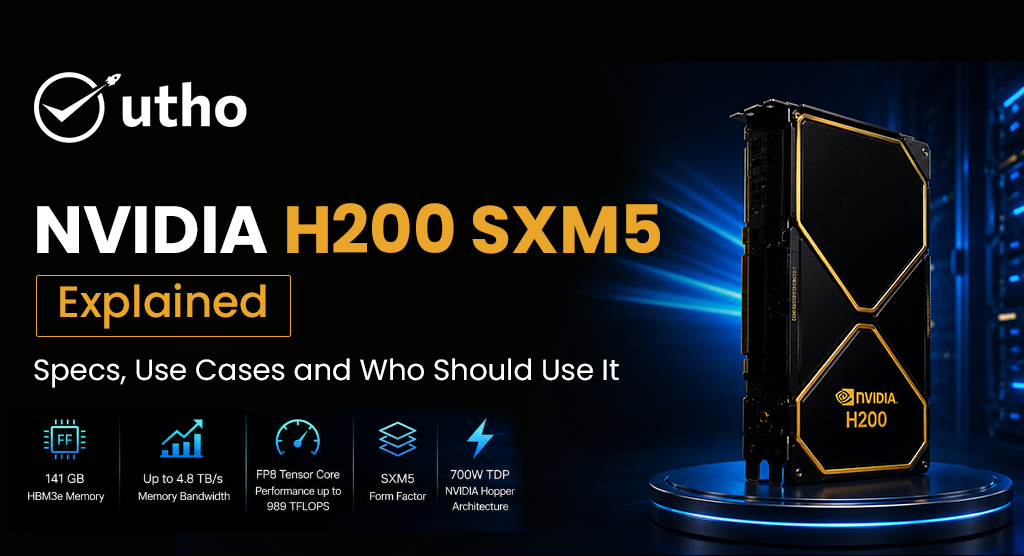
Built on NVIDIA’s Hopper architecture, the NVIDIA H200 SXM5 is designed specifically for enterprise AI inference, large-scale language models, and high-performance computing (HPC). Rather than focusing solely on raw compute performance, NVIDIA engineered the H200 SXM5 to address one of the biggest bottlenecks in modern AI systems—memory.
With 141 GB of HBM3e memory, extremely high memory bandwidth, and NVLink-powered multi-GPU communication, the NVIDIA H200 SXM5 enables organizations to deploy larger AI models, support longer context windows, and achieve higher inference throughput than previous Hopper-based GPUs. This makes it an ideal H200 GPU for LLM Inference, especially for enterprises serving large language models with demanding production workloads.
However, despite being one of NVIDIA’s most powerful AI accelerators, the H200 SXM5 is not the right choice for every workload.
Many startups and growing AI companies may achieve better infrastructure efficiency using GPUs such as the RTX PRO 6000 Blackwell or NVIDIA L4, depending on the size of their models and deployment requirements.
Understanding where the H200 SXM5 excels—and where it may be unnecessary—is essential before making infrastructure decisions.
In this guide, we’ll explain everything you need to know about the NVIDIA H200 SXM5, including its specifications, architecture, memory technology, enterprise use cases, infrastructure requirements, and the types of organizations that can benefit the most from deploying it. Organizations comparing the NVIDIA H200 GPU Price India before making an investment often use this information to decide whether enterprise deployment is the right choice.
What is NVIDIA H200 SXM5?
The NVIDIA H200 SXM5 is NVIDIA’s flagship Hopper-generation GPU designed for enterprise AI inference, scientific computing, and high-performance AI infrastructure.
Unlike consumer graphics cards or workstation GPUs, the H200 SXM5 is purpose-built for data centers where reliability, scalability, memory bandwidth, and multi-GPU communication are critical requirements.
Instead of using traditional GDDR memory found in most workstation GPUs, the H200 SXM5 uses HBM3e (High Bandwidth Memory), allowing AI models to access data much faster while significantly reducing memory bottlenecks during inference.
Another defining characteristic of the H200 SXM5 is its SXM5 form factor.
Unlike PCIe GPUs that can be installed into standard servers, SXM5 GPUs are integrated into NVIDIA HGX platforms and communicate with each other using NVLink, enabling multiple GPUs to function as a unified AI cluster. Organizations looking for a reliable NVIDIA H200 Cloud Provider India often prioritize platforms that support HGX infrastructure for enterprise-scale AI deployments.
This architecture makes the H200 particularly well-suited for workloads that require extremely large models or continuous communication across multiple GPUs.
Some examples include:
- Large Language Models (LLMs)
- AI reasoning systems
- Enterprise AI assistants
- Scientific simulations
- Financial modeling
- Genomics
- Climate research
- High-concurrency inference platforms
Rather than serving individual users, these deployments often support thousands—or even millions—of AI requests every day, making scalability and memory bandwidth just as important as raw compute performance.
Why Did NVIDIA Introduce the H200 SXM5?
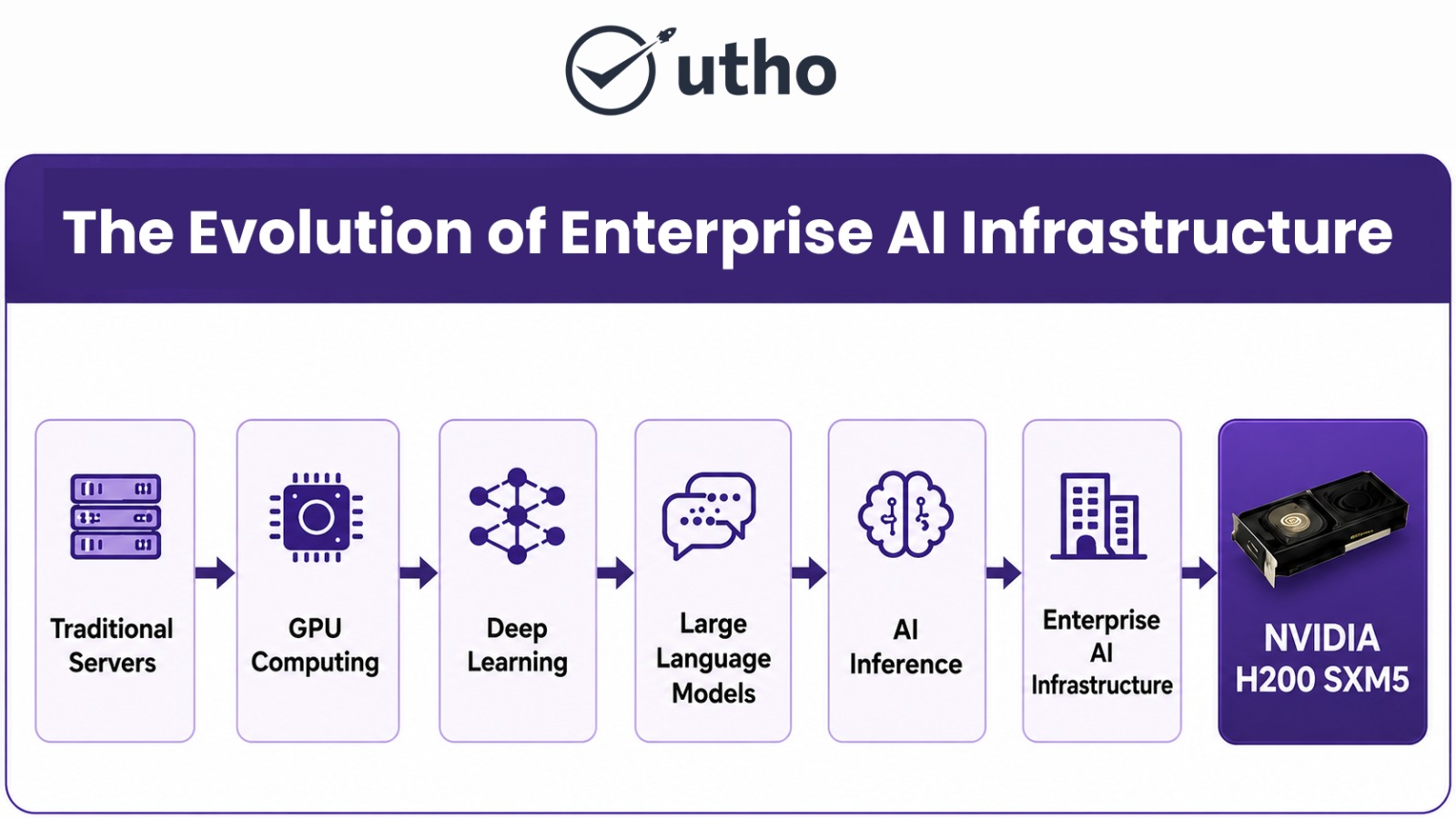
The NVIDIA H100 represented a major advancement in AI computing, but as AI models continued to evolve, organizations began encountering new infrastructure challenges.
Over the past two years, several industry trends have reshaped enterprise AI requirements:
- Large language models have grown from billions to hundreds of billions of parameters.
- Context windows have expanded dramatically, requiring substantially more GPU memory.
- AI inference has become a larger operational expense than model training for many organizations.
- AI agents now execute multiple reasoning steps, increasing memory and compute demands.
- Enterprises require lower latency while serving thousands of simultaneous users.
Although the H100 remained highly capable, many production workloads became increasingly memory-bound rather than compute-bound.
Recognizing this shift, NVIDIA developed the H200 SXM5 with a clear objective: deliver significantly higher memory capacity and memory bandwidth while maintaining compatibility with the Hopper ecosystem. Many organizations planning to Rent NVIDIA H200 GPU India or exploring NVIDIA H200 SXM5 rent services are doing so specifically to overcome these memory limitations without investing in dedicated hardware.
The most notable upgrade is the transition from HBM3 to HBM3e memory, increasing total memory capacity to 141 GB and providing substantially higher bandwidth for memory-intensive AI workloads.
This enhancement allows organizations to:
- Deploy larger AI models without aggressive quantization.
- Support longer context windows for conversational AI.
- Improve throughput for inference-heavy applications.
- Reduce memory bottlenecks in enterprise deployments.
- Serve more concurrent inference requests with greater efficiency.
Rather than replacing the H100’s compute architecture, the H200 focuses on improving the areas that most directly impact production AI performance.
NVIDIA H200 SXM5 Specifications
At first glance, the H200 SXM5 may appear similar to the H100 because both are built on NVIDIA’s Hopper architecture. However, the differences become significant when examining memory capacity, bandwidth, and enterprise deployment capabilities. Organizations evaluating NVIDIA H200 GPU Price India often find that these hardware improvements justify the investment for enterprise-scale AI deployments.
| Specification | NVIDIA H200 SXM5 |
| Architecture | Hopper |
| Form Factor | SXM5 |
| GPU Memory | 141 GB HBM3e |
| Memory Type | HBM3e |
| Memory Bandwidth | 4.8 TB/s |
| Tensor Cores | 4th Generation |
| CUDA Cores | 16,896 |
| NVLink Support | Yes |
| Multi-GPU Scaling | Excellent |
| Typical Deployment | NVIDIA HGX Systems |
| Primary Focus | Enterprise AI & HPC |
| Best For | LLM Inference, AI Agents, HPC, Scientific Computing |
One of the standout specifications is the 4.8 TB/s memory bandwidth, which allows AI models to move data between memory and compute units far more efficiently than GPUs using conventional GDDR memory. For workloads where massive datasets and long-context language models are common, this can have a significant impact on inference speed and overall system efficiency. Businesses planning Rent NVIDIA H200 GPU India deployments often prioritize this high-bandwidth architecture to maximize AI performance while preparing for future scalability.
NVIDIA H200 SXM5 Architecture Explained
The NVIDIA H200 SXM5 is fundamentally different from workstation-class GPUs or PCIe accelerators. Rather than being designed as a standalone graphics processor, it is built to function as part of an integrated AI infrastructure capable of supporting the largest inference and high-performance computing workloads. Many organizations deploy it through an Enterprise AI GPU Cloud India platform to avoid investing in expensive on-premises infrastructure.
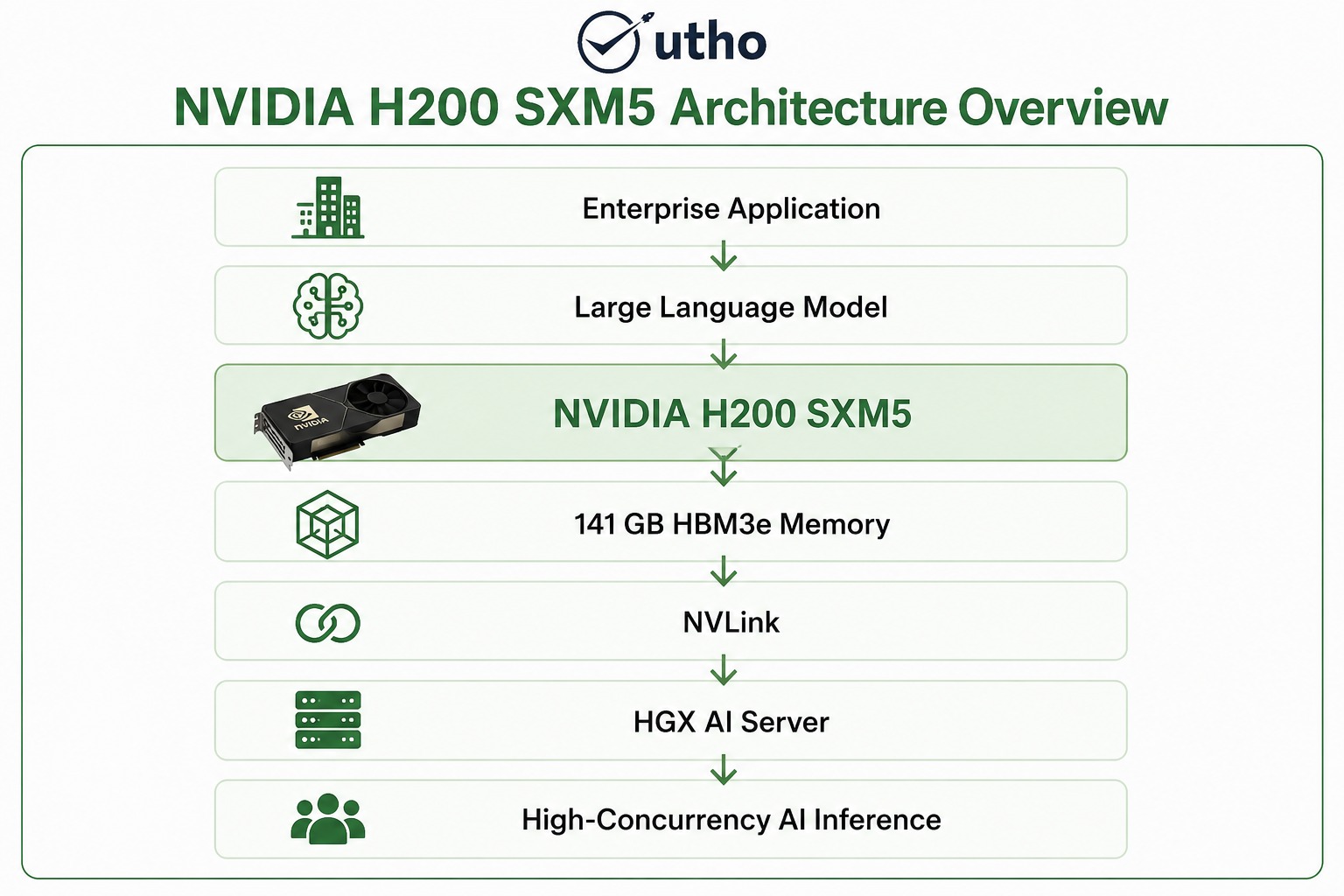
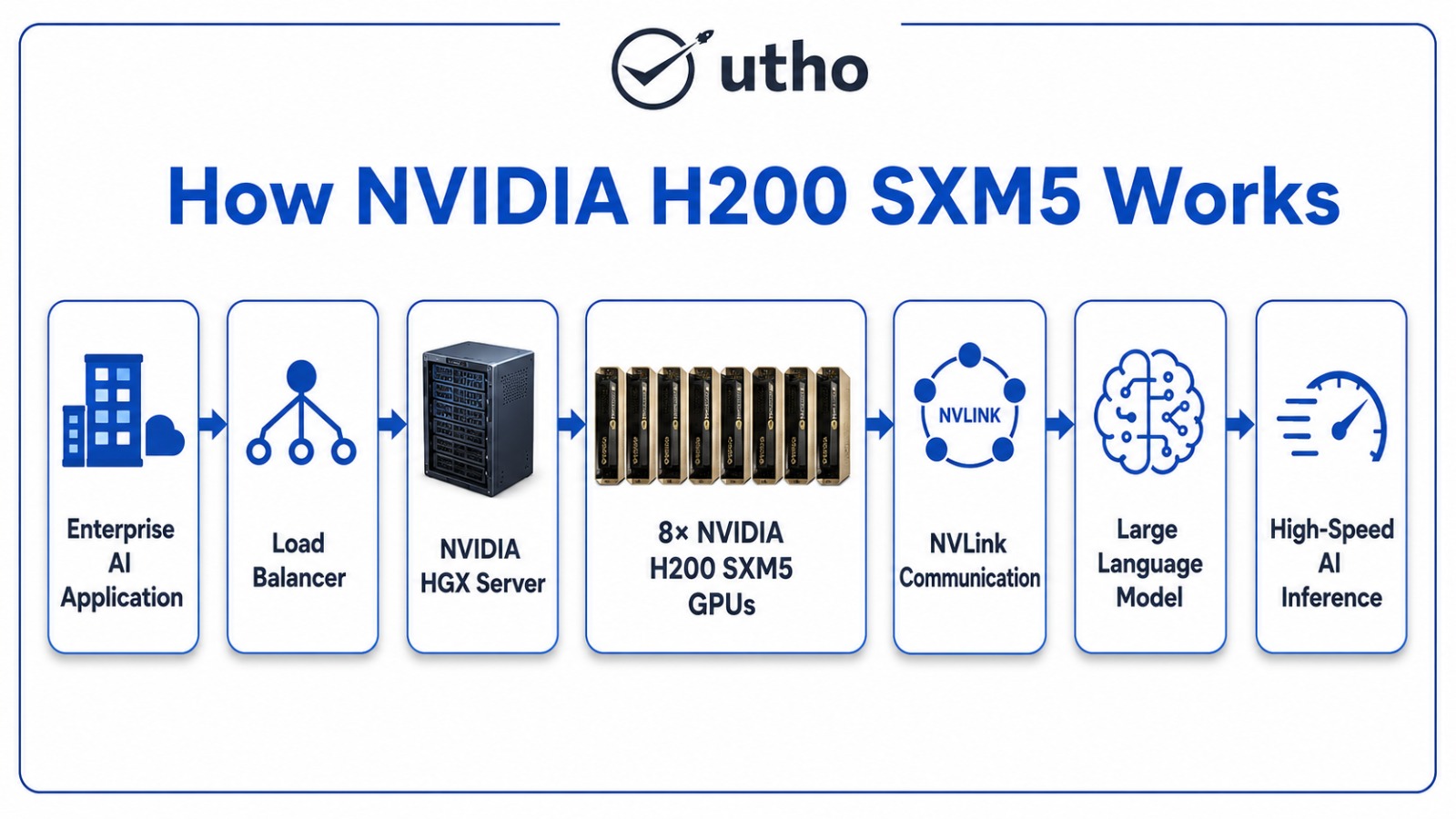
Unlike GPUs that are installed into standard PCIe servers, the NVIDIA H200 SXM5 is deployed inside NVIDIA HGX systems, where multiple GPUs are interconnected through NVLink. This architecture enables GPUs to exchange data at extremely high speeds, minimizing communication bottlenecks that typically occur when very large AI models are distributed across several GPUs.
Instead of relying on slower PCIe communication, the H200 SXM5 uses dedicated GPU-to-GPU links that dramatically improve scalability for enterprise AI workloads. Organizations working with a trusted NVIDIA H200 Cloud Provider India can leverage this architecture without managing complex HGX hardware themselves.
This architecture is particularly important because today’s production AI applications rarely run on a single GPU. Large language models, multimodal AI systems, recommendation engines, and enterprise AI agents often require multiple GPUs working together as one unified compute platform.
The combination of Hopper architecture, HBM3e memory, and NVLink communication allows the H200 SXM5 to efficiently handle these demanding deployments while maintaining high throughput and low latency. This is one of the primary reasons it is widely recognized as an ideal H200 GPU for LLM Inference in enterprise environments.
Understanding HBM3e Memory
When people compare GPUs, they often focus on CUDA cores or Tensor Core performance. While these specifications are important, one of the biggest reasons the NVIDIA H200 SXM5 delivers exceptional AI performance is its memory subsystem. Organizations researching NVIDIA H200 SXM5 rent services frequently prioritize memory bandwidth because it directly impacts production inference performance.
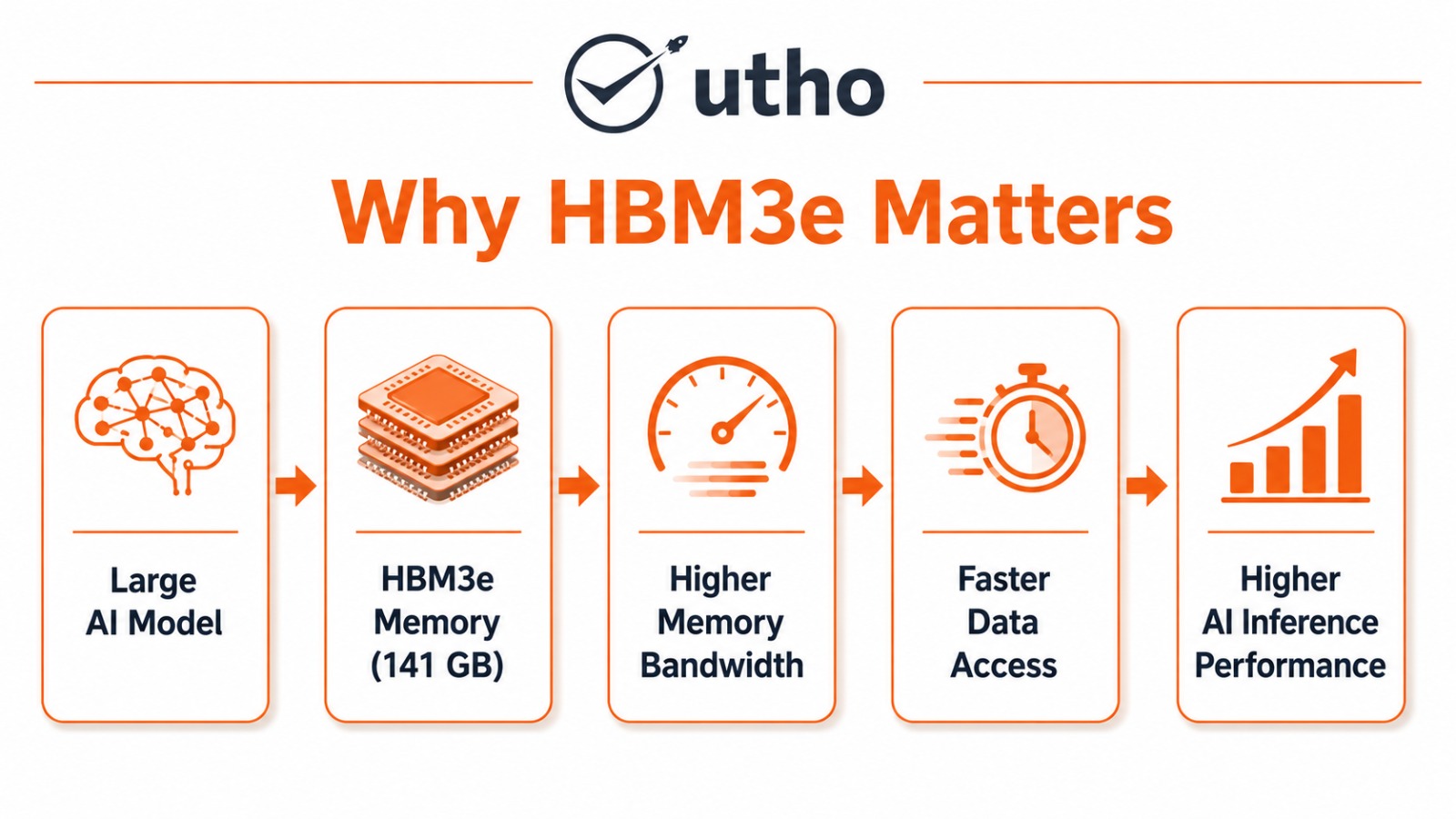
The H200 features 141 GB of HBM3e (High Bandwidth Memory), representing one of the largest memory capacities available on a production AI GPU.
Traditional workstation GPUs generally use GDDR memory, which is highly effective for graphics rendering and many AI workloads. However, enterprise-scale AI models place much greater pressure on memory bandwidth and latency.
HBM3e is physically stacked close to the GPU die, allowing significantly higher bandwidth while consuming less power per unit of data transferred.
This design offers several advantages:
- Faster access to model parameters.
- Improved inference throughput.
- Reduced memory bottlenecks.
- Better handling of large context windows.
- Improved efficiency for large language models.
As foundation models continue to grow, memory bandwidth is becoming just as important as raw compute performance. In many real-world deployments, GPUs spend more time waiting for data than performing calculations. By dramatically increasing memory bandwidth, the NVIDIA H200 SXM5 helps reduce these delays and improves overall inference efficiency. Businesses comparing NVIDIA H200 GPU Server India options or evaluating an Enterprise AI GPU Cloud India solution often consider HBM3e memory a key differentiator.
For organizations planning large-scale AI deployments, choosing the right infrastructure partner is equally important. Whether you’re looking for NVIDIA H200 SXM5 rent, comparing NVIDIA H200 GPU Price India, searching for a reliable NVIDIA H200 Cloud Provider India, evaluating Rent NVIDIA H200 GPU India services, deploying on a NVIDIA H200 GPU Server India, or selecting an H200 GPU for LLM Inference, HBM3e memory provides the bandwidth and scalability required for modern enterprise AI workloads.
Why NVLink Makes Such a Big Difference
One of the defining features of the NVIDIA H200 SXM5 is NVLink, NVIDIA’s high-speed interconnect technology. Organizations evaluating NVIDIA H200 SXM5 rent services often consider NVLink one of the biggest reasons to choose the H200 platform for enterprise AI deployments.
When an AI model is too large to fit on a single GPU, it must be distributed across multiple GPUs. During inference, these GPUs constantly exchange activations, attention states, and intermediate outputs.
If communication between GPUs is slow, the entire system slows down regardless of how powerful each GPU is individually.
This is where NVLink provides a major advantage.
Rather than relying on PCIe bandwidth, NVLink enables significantly faster GPU-to-GPU communication, allowing multiple H200 GPUs to behave almost like one extremely large accelerator.
This becomes increasingly important for:
- 70B+ parameter language models
- 400B+ parameter foundation models
- Long-context inference
- AI reasoning systems
- Multi-agent AI
- High-concurrency enterprise APIs
For organizations deploying enterprise AI services, NVLink often becomes one of the most valuable architectural advantages of the H200 platform. This is one reason why businesses looking to Rent NVIDIA H200 GPU India prioritize HGX-based deployments over standard PCIe infrastructure.
SXM5 vs PCIe: What’s the Difference?
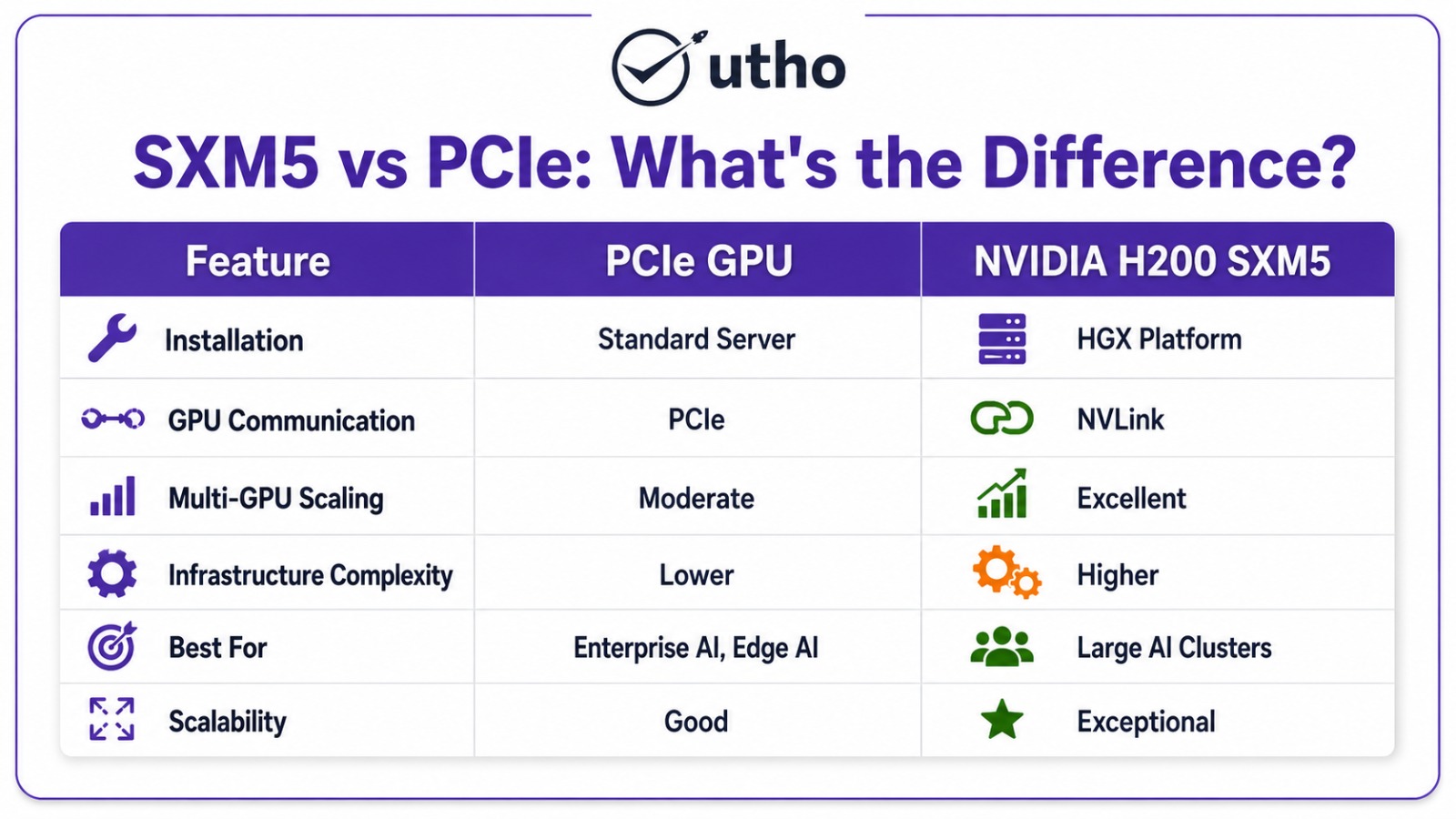
One of the most common questions organizations ask is whether they should choose an SXM-based GPU such as the H200 or a PCIe GPU like the RTX PRO 6000 Blackwell.
The answer depends entirely on the workload.
PCIe GPUs are designed for flexibility. They can be installed into standard enterprise servers, making deployment simpler and more cost-effective for many AI applications.
SXM5 GPUs, on the other hand, prioritize maximum performance. They require specialized HGX systems but provide significantly higher inter-GPU bandwidth through NVLink, making them ideal for large-scale AI infrastructure. Many organizations rely on an experienced NVIDIA H200 Cloud Provider India to access this enterprise-grade architecture without investing in expensive on-premises infrastructure.
Neither approach is universally better.
For workloads that fit comfortably on one or two GPUs, PCIe solutions often provide an excellent balance of flexibility and performance.
For massive language models spanning multiple GPUs, the architecture of the NVIDIA H200 SXM5 provides a clear advantage. Businesses evaluating a NVIDIA H200 GPU Server India solution often choose SXM5 because of its superior scalability for large AI workloads.
Why Memory Bandwidth Matters More Than CUDA Cores
Many buyers assume that a GPU with more CUDA cores will automatically deliver better AI performance.
In practice, inference performance depends on several factors working together.
These include:
- GPU memory capacity
- Memory bandwidth
- Tensor Core performance
- GPU communication
- Software optimization
- Batch size
- Model architecture
- Context window length
For example, if a language model spends most of its time waiting for data to move from memory into the GPU, adding more CUDA cores provides little benefit.
This is why enterprise AI infrastructure increasingly emphasizes memory bandwidth alongside compute performance. Organizations comparing NVIDIA H200 GPU Price India often discover that higher memory bandwidth delivers greater long-term value than compute specifications alone.
The NVIDIA H200 SXM5 combines high Tensor Core performance with 4.8 TB/s memory bandwidth, allowing large AI models to access data far more efficiently than conventional GPU architectures.
As organizations deploy increasingly complex AI applications, memory architecture has become one of the primary factors influencing real-world inference performance. This is why the H200 is widely regarded as the preferred H200 GPU for LLM Inference and is increasingly offered through Enterprise AI GPU Cloud India platforms for production-scale AI deployments.
Comparison Table: Why H200 Performs Well in AI Inference
| Infrastructure Component | Impact on AI Performance |
| HBM3e Memory | Supports larger AI models with faster memory access. |
| 141 GB VRAM | Enables long-context LLMs and larger batch sizes. |
| NVLink | Reduces communication bottlenecks across multiple GPUs. |
| Hopper Tensor Cores | Accelerates FP8 and transformer-based inference workloads. |
| HGX Architecture | Optimized for enterprise-scale AI deployments. |
| High Memory Bandwidth | Improves throughput for memory-intensive inference tasks. |
Key Takeaway
The NVIDIA H200 SXM5 is not simply a faster version of the H100. Its biggest strengths lie in its memory architecture, NVLink connectivity, and ability to scale efficiently across multi-GPU deployments. These capabilities make it particularly valuable for organizations serving large language models, AI agents, and enterprise inference workloads where consistent throughput and low latency are critical.
For businesses evaluating NVIDIA H200 GPU Price India, the real value of the H200 lies not only in its hardware specifications but also in its ability to support enterprise AI workloads with exceptional scalability. Organizations exploring NVIDIA H200 SXM5 rent options often choose this platform because it reduces infrastructure bottlenecks while preparing them for future AI growth.
Real-World Use Cases of NVIDIA H200 SXM5
The NVIDIA H200 SXM5 was designed for organizations running AI at production scale. Unlike GPUs that primarily serve individual developers or small inference workloads, the H200 is built to power enterprise AI services where thousands—or even millions—of inference requests must be processed every day with consistent performance.
As Large Language Models (LLMs), multimodal AI, and AI agents become central to business operations, organizations need infrastructure that can scale efficiently without introducing latency or bottlenecks. This is where the NVIDIA H200 SXM5 stands out.
Its combination of 141 GB HBM3e memory, NVLink connectivity, and Hopper Tensor Cores enables enterprises to serve larger AI models, support higher user concurrency, and deliver faster response times.
Organizations looking to Rent NVIDIA H200 GPU India increasingly choose enterprise cloud platforms because they provide access to HGX infrastructure without requiring significant upfront investment. Working with a trusted NVIDIA H200 Cloud Provider India also allows businesses to deploy advanced AI workloads faster while reducing operational complexity.
For companies building large-scale AI applications, choosing the right NVIDIA H200 GPU Server India solution is essential to achieving consistent inference performance. Whether you’re deploying foundation models or searching for the ideal H200 GPU for LLM Inference, the H200 delivers the memory bandwidth and multi-GPU scalability required for production AI environments.
As AI adoption continues to accelerate, many enterprises are also moving toward Enterprise AI GPU Cloud India platforms to gain flexible access to NVIDIA H200 infrastructure, enabling them to scale AI services efficiently without managing dedicated hardware.
Where NVIDIA H200 SXM5 Is Used
NVIDIA H200 SXM5
│
▼
Large Language Models
│
▼
Enterprise AI Agents
│
▼
Multimodal AI
│
▼
Healthcare AI
│
▼
Financial AI
│
▼
Scientific Computing
│
▼
High-Concurrency AI APIs
Large Language Model (LLM) Inference
One of the primary reasons organizations invest in the NVIDIA H200 SXM5 is to deploy and serve large language models efficiently. Businesses evaluating H200 GPU for LLM Inference often choose this platform because it combines massive memory capacity with enterprise-grade scalability.
Modern LLMs have grown dramatically in size. Models such as Llama, Qwen, DeepSeek, GLM, and other enterprise-grade foundation models require substantial GPU memory and bandwidth to deliver fast responses.
For production deployments, businesses expect:
- Low response latency
- High request throughput
- Large context windows
- Stable performance under heavy traffic
- Efficient multi-GPU scaling
The NVIDIA H200 SXM5 is specifically engineered for these requirements.
Its 141 GB HBM3e memory allows many larger models to fit with less aggressive quantization, while NVLink enables efficient communication when models span multiple GPUs. This results in higher throughput and a smoother inference experience.
Industries using LLM inference include:
- Customer support automation
- Enterprise knowledge assistants
- Internal copilots
- Legal document analysis
- Healthcare documentation
- Financial research
- Code generation
- AI-powered search
Organizations looking to Rent NVIDIA H200 GPU India frequently deploy these workloads on enterprise cloud infrastructure to achieve better scalability without investing in expensive on-premises hardware.
Enterprise AI Agents
AI agents are becoming significantly more sophisticated than traditional chatbots.
Instead of answering a single prompt, they can:
- Reason through complex tasks
- Use external tools and APIs
- Access databases
- Retrieve documents
- Execute workflows
- Generate reports
- Collaborate with other AI agents
These capabilities require much more compute and memory than conventional conversational AI.
Because AI agents maintain larger working contexts and perform multiple inference steps, they benefit from GPUs that can process long prompts and large intermediate states efficiently.
The NVIDIA H200 SXM5 provides the compute resources necessary for these demanding enterprise workloads. Organizations searching for a reliable NVIDIA H200 Cloud Provider India often prefer H200-powered infrastructure to support AI agents at production scale.
High-Concurrency AI APIs
Many organizations expose AI capabilities through APIs rather than consumer chat interfaces.
Examples include:
- Translation APIs
- OCR APIs
- AI search services
- Voice AI platforms
- Enterprise copilots
- Financial analytics platforms
- Healthcare AI systems
Unlike a single-user application, these services may receive thousands of concurrent requests.
The NVIDIA H200 SXM5 is designed to maintain high throughput under these conditions, ensuring consistent latency even as traffic grows.
Its architecture allows businesses to scale AI services without sacrificing reliability or user experience. Companies evaluating Enterprise AI GPU Cloud India solutions often choose the H200 because it delivers consistent performance for high-volume enterprise APIs.
Scientific Computing and High-Performance Computing (HPC)
Although much attention is focused on generative AI, the NVIDIA H200 SXM5 is also widely used in traditional HPC environments.
Common applications include:
- Drug discovery
- Molecular dynamics simulations
- Climate modeling
- Weather forecasting
- Computational chemistry
- Genomics
- Physics simulations
- Engineering analysis
These workloads process massive datasets and often require GPUs with high memory bandwidth to accelerate calculations efficiently.
The H200’s HBM3e memory and Hopper architecture make it well-suited for these compute-intensive tasks. Organizations comparing NVIDIA H200 GPU Price India or planning a NVIDIA H200 GPU Server India deployment often select the H200 for HPC workloads because of its exceptional memory bandwidth and scalability. Businesses exploring NVIDIA H200 SXM5 rent services can also leverage these capabilities through enterprise cloud platforms without making significant upfront infrastructure investments.
Industry-Wise Adoption of NVIDIA H200 SXM5
The H200 is increasingly being adopted across sectors where AI has become a strategic capability rather than an experimental technology.
| Industry | Typical AI Workloads | Why H200 SXM5 Fits |
| Healthcare | Medical imaging, clinical assistants, genomics | Large memory supports advanced AI models and high-speed inference. |
| Banking & Finance | Fraud detection, risk analysis, financial copilots | Handles real-time inference with high throughput and reliability. |
| Manufacturing | Predictive maintenance, quality inspection | Processes large volumes of sensor and vision data efficiently. |
| Retail & E-commerce | Personalized recommendations, AI search | Scales to support millions of customer interactions. |
| Government | Secure AI applications, multilingual services | Supports enterprise-grade deployments with strong scalability. |
| Research Institutions | Scientific simulations, AI research | Delivers high-performance compute for demanding research workloads. |
Enterprise AI Deployment Using H200 SXM5
Enterprise Applications
│
▼
AI API Gateway
│
▼
Load Balancer
│
▼
HGX Server
│
▼
8× NVIDIA H200 SXM5
│
▼
Large Language Model
│
▼
Thousands of Concurrent Users
Infrastructure Requirements for NVIDIA H200 SXM5
While the NVIDIA H200 SXM5 delivers exceptional AI performance, it also requires a more advanced infrastructure than standard PCIe GPUs. Organizations planning NVIDIA H200 SXM5 rent deployments should carefully evaluate whether their existing infrastructure can support enterprise-scale AI workloads.
Organizations planning to deploy H200 clusters should consider:
- NVIDIA HGX server platform
- High-capacity power delivery
- Advanced cooling systems
- High-speed networking
- NVLink-enabled configurations
- Enterprise storage infrastructure
- AI orchestration software
- Monitoring and cluster management
These requirements make the H200 best suited for organizations running large-scale AI workloads where the additional infrastructure investment delivers measurable business value. Many enterprises work with a trusted NVIDIA H200 Cloud Provider India to simplify deployment and avoid managing complex HGX infrastructure in-house.
Total Cost of Ownership (TCO)
The purchase price of a GPU is only one part of the overall investment.
When evaluating enterprise AI infrastructure, organizations should also account for:
- Server hardware
- Power consumption
- Cooling
- Networking
- Storage
- Rack space
- Maintenance
- Software licensing
- Operational management
For organizations with continuous, high-volume inference workloads, these operational factors often represent a significant portion of the total cost of ownership.
Choosing the right GPU therefore involves balancing performance, scalability, infrastructure complexity, and long-term operational efficiency. Businesses comparing NVIDIA H200 GPU Price India should evaluate these ongoing infrastructure costs instead of focusing only on the initial hardware investment.
Comparison Table: Infrastructure Considerations
| Factor | NVIDIA H200 SXM5 |
| Deployment Platform | NVIDIA HGX Server |
| Multi-GPU Scaling | Excellent via NVLink |
| Memory Architecture | 141 GB HBM3e |
| Infrastructure Complexity | High |
| Best Deployment Type | Enterprise AI Clusters |
| Typical Users | Large Enterprises, AI Labs, Cloud Providers |
Organizations looking for a production-ready NVIDIA H200 GPU Server India solution often choose HGX-based infrastructure because it provides the scalability required for enterprise AI deployments.
When Is NVIDIA H200 SXM5 NOT the Right Choice?
Although the NVIDIA H200 SXM5 is one of the world’s most capable AI GPUs, it isn’t the right solution for every organization.
Many companies assume that buying the most powerful GPU automatically results in the best AI infrastructure. In reality, the ideal GPU depends on workload size, deployment strategy, expected user traffic, and budget.
If your AI applications involve smaller language models, lightweight inference, OCR, computer vision, or document processing, deploying an H200 cluster may introduce unnecessary infrastructure complexity and cost.
Similarly, startups that are still validating AI products often benefit more from flexible PCIe-based GPUs before investing in enterprise HGX infrastructure.
The H200 becomes valuable when organizations need to serve very large models, support thousands of simultaneous inference requests, or operate multi-GPU production environments where memory bandwidth and GPU communication become critical. This is why businesses searching for H200 GPU for LLM Inference or planning to Rent NVIDIA H200 GPU India often choose an Enterprise AI GPU Cloud India platform, allowing them to scale enterprise AI workloads without making large upfront infrastructure investments.
When Should You Choose NVIDIA H200 SXM5?
AI Workload
│
▼
Does it require
Large LLMs?
├── No → Consider PCIe GPUs
│
└── Yes
│
▼
Need Multi-GPU Scaling?
├── No → Single GPU Deployment
│
└── Yes
│
▼
Choose NVIDIA H200 SXM5
Workload-Based GPU Selection
Different AI applications place very different demands on GPU hardware. Selecting the right accelerator should be based on model size, concurrency requirements, memory needs, and expected future growth rather than peak specifications alone.
| AI Workload | Recommended GPU Category | Why |
| OCR & Document Processing | Entry-Level AI GPU | Low memory requirements and efficient inference. |
| Video Analytics | Edge/Inference GPU | Optimized for media and computer vision tasks. |
| Enterprise Chatbots | High-Memory PCIe GPU | Benefits from larger VRAM and higher Tensor performance. |
| AI Agents | High-Memory GPU | Handles reasoning, tool use, and longer context windows efficiently. |
| RAG Applications | High-Memory GPU | Larger memory improves retrieval and generation performance. |
| 70B–400B+ LLMs | NVIDIA H200 SXM5 | High memory bandwidth and multi-GPU scalability. |
| Enterprise AI APIs | NVIDIA H200 SXM5 | Designed for sustained, high-concurrency inference. |
| Multi-GPU AI Clusters | NVIDIA H200 SXM5 | NVLink enables efficient communication between GPUs. |
Key Considerations Before Choosing H200
Before deploying the NVIDIA H200 SXM5, organizations should evaluate several technical and business factors instead of focusing only on raw GPU performance. Businesses planning NVIDIA H200 SXM5 rent deployments should ensure that their AI infrastructure aligns with both current workloads and future growth.
1. Model Size
Larger models require more GPU memory and often need multiple GPUs working together. Estimate your production model size before selecting infrastructure. Organizations looking for H200 GPU for LLM Inference should carefully evaluate model parameters and memory requirements before choosing an enterprise deployment.
2. Expected User Traffic
A proof-of-concept AI assistant serving a few users has very different infrastructure requirements than a customer-facing platform processing thousands of requests every minute. Companies planning to Rent NVIDIA H200 GPU India can scale infrastructure more efficiently by matching GPU resources to expected production traffic.
3. Memory Requirements
Longer context windows, larger batch sizes, and multimodal AI applications all consume significantly more GPU memory.
4. Infrastructure Readiness
The H200 SXM5 is designed for HGX-based deployments. Organizations should ensure they have suitable power, cooling, networking, and operational capabilities. Many businesses work with a trusted NVIDIA H200 Cloud Provider India to simplify deployment and reduce operational complexity.
5. Future Scalability
AI models continue to grow rapidly. Infrastructure decisions should support future expansion without requiring complete redesigns.
Choosing the Right AI Infrastructure
AI Application
↓
Model Size
↓
Memory Requirement
↓
Expected Traffic
↓
Infrastructure Planning
↓
GPU Selection
Final Recommendation
The NVIDIA H200 SXM5 represents one of the most advanced enterprise AI accelerators available today. Its combination of 141 GB HBM3e memory, Hopper architecture, high memory bandwidth, and NVLink connectivity makes it exceptionally well suited for organizations running production-scale AI workloads.
However, choosing the right GPU should never be based solely on peak specifications.
Organizations deploying lightweight inference, computer vision, OCR, or smaller language models may achieve better efficiency with more modest GPU configurations. On the other hand, businesses serving large language models, AI agents, enterprise copilots, or high-concurrency AI APIs can benefit significantly from the scalability and throughput offered by the H200 platform.
The best infrastructure decision aligns with three key factors:
- The size and complexity of your AI models
- The expected scale of production traffic
- Your long-term infrastructure strategy
Rather than selecting the most powerful GPU available, successful AI deployments focus on choosing the platform that delivers the right balance of performance, scalability, operational efficiency, and future readiness. Organizations evaluating Enterprise AI GPU Cloud India, comparing NVIDIA H200 GPU Price India, or planning a NVIDIA H200 GPU Server India deployment should prioritize workload requirements over specifications alone.
Final Comparison Table
| Evaluation Factor | NVIDIA H200 SXM5 |
| AI Performance | Excellent |
| Large LLM Support | Excellent |
| Multi-GPU Scaling | Industry Leading |
| Memory Capacity | 141 GB HBM3e |
| Memory Bandwidth | Extremely High |
| High-Concurrency Serving | Excellent |
| Enterprise Deployment | Ideal |
| Infrastructure Complexity | High |
| Long-Term Scalability | Excellent |
Organizations evaluating long-term AI infrastructure often compare NVIDIA H200 GPU Price India alongside deployment capabilities, since overall value depends on workload scalability rather than hardware specifications alone.
Frequently Asked Questions (FAQs)
1. What is NVIDIA H200 SXM5?
The NVIDIA H200 SXM5 is an enterprise AI GPU based on the Hopper architecture. It features 141 GB of HBM3e memory, high memory bandwidth, and NVLink connectivity, making it ideal for large-scale AI inference and high-performance computing. Organizations looking for NVIDIA H200 SXM5 rent services can access this enterprise-grade hardware through cloud platforms instead of investing in dedicated on-premises infrastructure.
2. What makes NVIDIA H200 SXM5 different from PCIe GPUs?
Unlike standard PCIe GPUs, the H200 SXM5 is designed for HGX platforms and supports NVLink, enabling much faster communication between multiple GPUs. This significantly improves performance for distributed AI workloads. Businesses working with a trusted NVIDIA H200 Cloud Provider India can leverage these enterprise capabilities without managing complex HGX deployments themselves.
3. Is NVIDIA H200 SXM5 suitable for AI inference?
Yes. The NVIDIA H200 SXM5 is optimized for enterprise AI inference, especially for large language models, AI agents, multimodal applications, and services handling high volumes of concurrent requests. It is widely recognized as an excellent H200 GPU for LLM Inference because of its massive HBM3e memory and NVLink-enabled multi-GPU scalability.
4. Which industries commonly use NVIDIA H200 SXM5?
Industries such as healthcare, finance, research, manufacturing, government, and cloud service providers use the H200 SXM5 for large-scale AI, scientific computing, and advanced analytics. Many enterprises choose Enterprise AI GPU Cloud India solutions to deploy these workloads with greater flexibility while avoiding large capital investments.
5. Does NVIDIA H200 SXM5 support multi-GPU deployments?
Yes. One of its biggest advantages is NVLink, which enables multiple H200 GPUs to work together efficiently for large models and enterprise AI clusters. Organizations planning a NVIDIA H200 GPU Server India deployment often rely on this architecture to support production-scale AI infrastructure.
6. Is NVIDIA H200 SXM5 the right GPU for every AI project?
No. While it excels in enterprise-scale deployments, smaller AI applications may not require its level of performance or infrastructure. The ideal GPU depends on workload size, deployment requirements, and long-term scalability goals. Businesses planning to Rent NVIDIA H200 GPU India should evaluate their production requirements carefully to determine whether H200 is the right fit for their AI workloads.