
In 2026, inference has become the largest operational expense for most AI deployments. Every chatbot response, generated image, recommendation, and AI prediction consumes GPU resources. Choosing the right AI GPU for inference directly impacts latency, infrastructure cost, and long-term scalability.
As enterprises deploy increasingly sophisticated AI applications, selecting the right GPU is no longer just a hardware decision—it’s a business decision. The balance between performance, memory capacity, power efficiency, and cost can significantly influence the success of an AI infrastructure strategy, especially for organizations looking to Rent NVIDIA GPU India for production AI workloads.
Artificial Intelligence has moved beyond research labs and into everyday business operations. From AI-powered customer support and intelligent document processing to code generation, recommendation engines, computer vision, and enterprise copilots, organizations are deploying AI applications at an unprecedented scale.
As these applications move into production, the focus shifts from model training to AI inference—the process of running trained models efficiently, reliably, and cost-effectively using the right AI GPU for inference.
For many businesses, inference becomes the largest long-term expense. Every prompt sent to a chatbot, every generated image, every OCR request, and every AI prediction consumes GPU resources. Over time, these operational costs often exceed the initial investment made during model training.
This is why choosing the right GPU has become one of the most important infrastructure decisions in 2026, particularly for organizations evaluating GPU Cloud India providers.
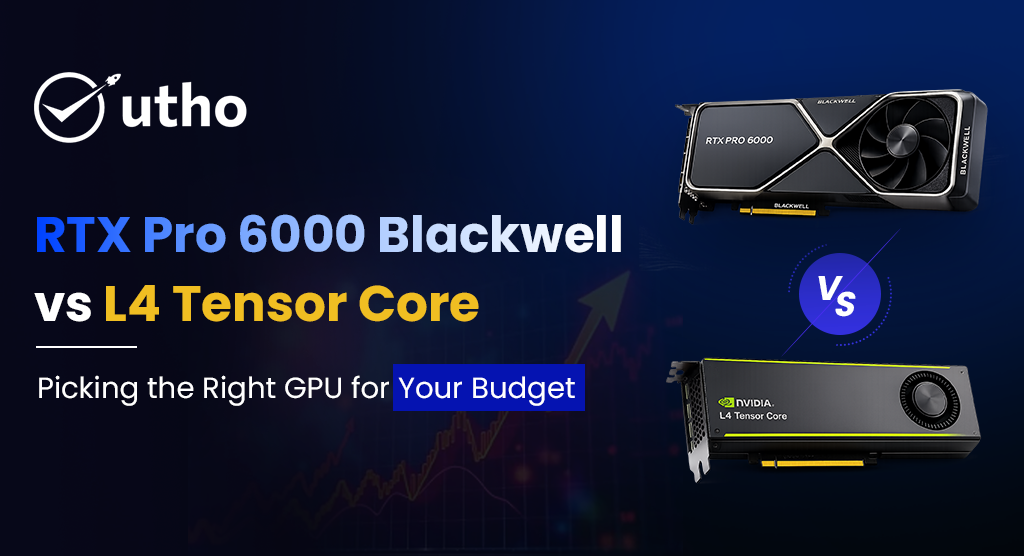
Among NVIDIA’s growing portfolio of AI GPUs, two options are attracting significant attention from startups, enterprises, and AI developers: the NVIDIA L4 Tensor Core GPU and the RTX PRO 6000 Blackwell.
While both are capable of accelerating AI workloads, they are built for different deployment strategies and budgets.
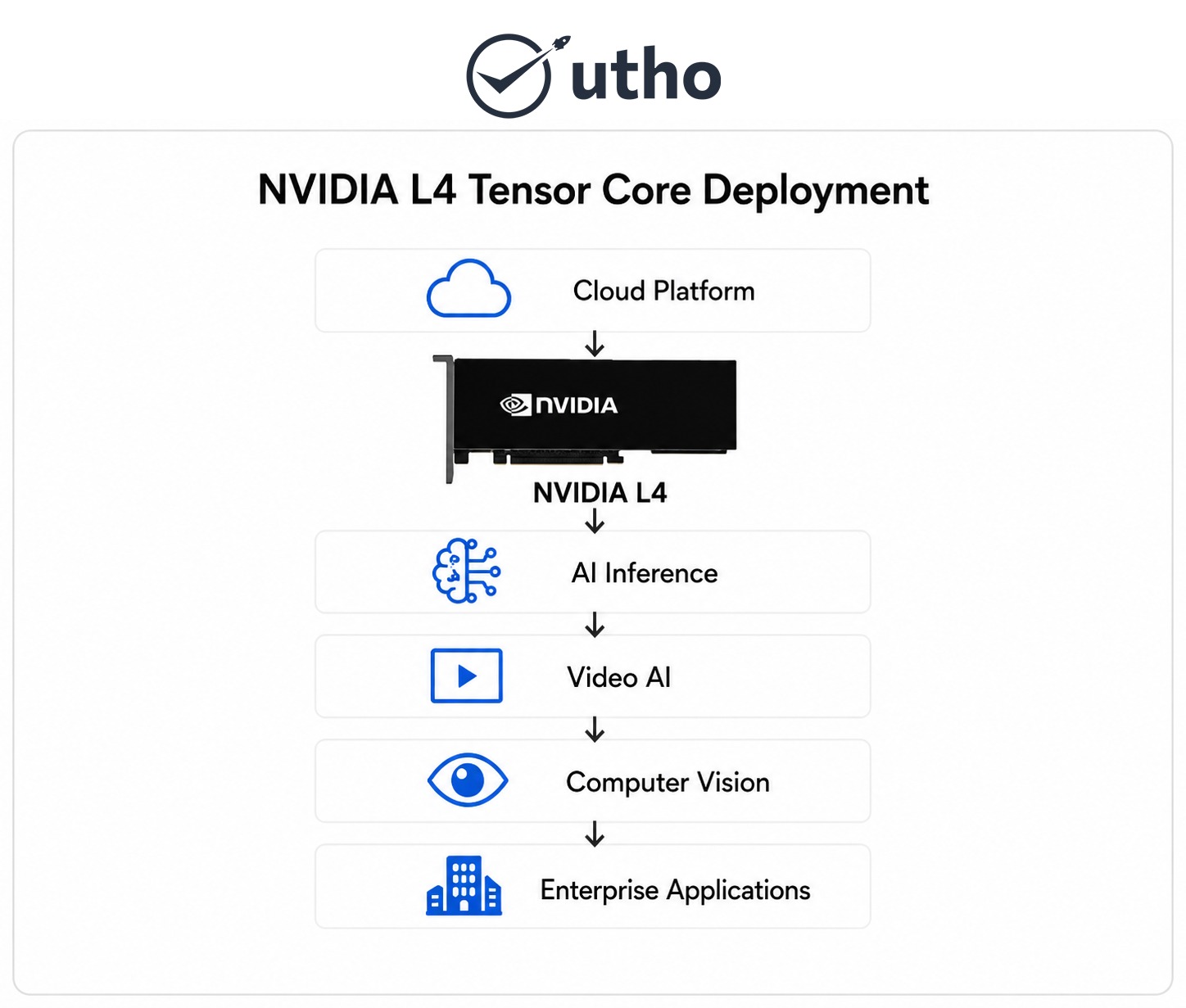
The NVIDIA L4 Tensor Core is designed as an energy-efficient inference GPU that performs exceptionally well for cloud-native applications, video AI, and scalable inference services.
The RTX PRO 6000 Blackwell introduces NVIDIA’s latest Blackwell architecture to enterprise workstations and PCIe servers, offering significantly more memory, next-generation Tensor Cores, and the flexibility to deploy demanding AI models closer to where they are needed.
At first glance, comparing these GPUs may seem straightforward. One appears to be a compact inference accelerator, while the other is a high-performance professional GPU. However, the decision is far more nuanced.
A startup deploying an AI chatbot has different infrastructure requirements than an enterprise building a Retrieval-Augmented Generation (RAG) platform. Likewise, a company running Stable Diffusion image generation workloads has different GPU needs than one serving large language models using a dedicated GPU for LLM inference.
The right choice depends on several factors:
- AI model size
- Available budget
- Memory requirements
- Inference latency
- Deployment environment
- Scalability
- Power efficiency
- Long-term operational costs
In this comprehensive RTX PRO 6000 Blackwell vs NVIDIA L4 Tensor Core comparison, we’ll examine both GPUs across hardware specifications, AI inference performance, memory architecture, deployment flexibility, power consumption, and cost to help you choose the best GPU for LLM inference while selecting the right GPU Cloud India platform or deciding to Rent NVIDIA GPU India for your AI infrastructure goals.
Why GPU Selection Matters More Than Ever in 2026
Only a few years ago, organizations primarily evaluated GPUs based on CUDA core counts or gaming performance. Today, AI infrastructure decisions require a much broader perspective.
Modern AI applications demand more than raw computational power. They require an AI GPU for inference capable of handling increasingly complex inference workloads while maintaining predictable operating costs.
Whether deploying customer support chatbots, AI coding assistants, multimodal vision models, recommendation systems, or enterprise search platforms, infrastructure teams must carefully balance performance with efficiency. Both the RTX PRO 6000 Blackwell and NVIDIA L4 Tensor Core have become popular choices depending on workload requirements.
The Rise of Production AI
Thousands of businesses are now serving AI models continuously rather than occasionally experimenting with them.
Unlike training, inference operates around the clock.
Every user interaction generates GPU workload.
Lower latency translates into better user experience.
Higher throughput allows more users to share the same infrastructure.
Power efficiency directly impacts operational costs.
These factors make GPU selection far more strategic than ever before, whether you’re choosing a GPU for LLM inference, evaluating GPU Cloud India providers, or planning to Rent NVIDIA GPU India for enterprise AI deployments.
The Growth of Edge AI
Not every AI application runs inside hyperscale cloud data centers. Organizations increasingly deploy AI closer to users, especially while adopting GPU Cloud India services or planning to Rent NVIDIA GPU India for regional AI deployments.
Examples include:
- Manufacturing facilities
- Retail stores
- Hospitals
- Financial institutions
- Research labs
- Government agencies
These environments require GPUs that can deliver enterprise AI performance without demanding specialized infrastructure. This is one area where both the NVIDIA L4 Tensor Core and RTX PRO 6000 Blackwell are commonly evaluated as an AI GPU for inference across enterprise deployments.
Memory Is Becoming the New Bottleneck
As language models continue to grow, GPU memory often becomes more important than compute performance, especially when selecting the right GPU for LLM inference.
Insufficient memory forces organizations to:
- Quantize models
- Reduce batch sizes
- Offload computation to CPUs
- Split models across multiple GPUs
Each of these strategies introduces additional complexity and may reduce overall efficiency.
This makes memory capacity and memory bandwidth critical considerations in any RTX PRO 6000 Blackwell vs NVIDIA L4 Tensor Core evaluation, particularly when selecting an AI GPU for inference for production workloads.
NVIDIA L4 Tensor Core Overview
Purpose-Built for Efficient AI Inference
The NVIDIA L4 Tensor Core GPU is built on the Ada Lovelace architecture and is designed specifically for inference, video processing, graphics virtualization, and cloud-native AI applications.
Unlike flagship data center GPUs focused on massive AI clusters, the L4 prioritizes efficiency, versatility, and lower power consumption.
Its compact PCIe form factor makes it easy to deploy inside standard enterprise servers without requiring specialized cooling or complex infrastructure.
This flexibility has made the L4 one of the most popular inference GPUs across cloud providers and enterprise environments, including organizations using GPU Cloud India platforms or choosing to Rent NVIDIA GPU India for scalable AI deployments.
Despite consuming only 72 watts, the L4 delivers impressive acceleration across multiple workloads, including:
- Large Language Model inference
- Video analytics
- Computer Vision
- Stable Diffusion
- Speech AI
- Recommendation engines
- Intelligent document processing
Its 24 GB of GDDR6 memory provides sufficient capacity for many optimized AI models, making it a practical option for organizations prioritizing efficiency over maximum scale.
The L4 is particularly well suited for businesses deploying lightweight to medium-sized AI workloads that require consistent performance with minimal power consumption, making it an excellent GPU for LLM inference for optimized models and a practical alternative to the RTX PRO 6000 Blackwell in many production environments.
NVIDIA L4 Tensor Core Specifications
| Specification | NVIDIA L4 Tensor Core |
| Architecture | Ada Lovelace |
| Memory | 24 GB GDDR6 |
| Interface | PCIe Gen4 |
| Tensor Cores | 4th Generation |
| Power Consumption | 72W |
| Best For | AI Inference, Video AI, Edge Applications |
| Deployment | Standard Enterprise Servers |
NVIDIA RTX PRO 6000 Blackwell Overview
The Next Generation GPU for Enterprise AI Inference
As AI models continue to grow in size and complexity, organizations need GPUs that deliver more than raw compute power. They need higher memory capacity, faster inference, greater deployment flexibility, and the ability to support modern AI frameworks without requiring hyperscale infrastructure. Businesses evaluating an AI GPU for inference often compare deployment flexibility alongside performance.
This is exactly where the NVIDIA RTX PRO 6000 Blackwell stands out.
Built on NVIDIA’s latest Blackwell architecture, the RTX PRO 6000 Blackwell is designed for professional AI workloads, enterprise inference, simulation, rendering, and advanced data science applications. Unlike GPUs that are built exclusively for hyperscale data centers, the RTX PRO 6000 Blackwell brings enterprise-grade AI acceleration into a standard PCIe form factor, making deployment significantly easier.
Unlike hyperscale GPUs such as H200 or B200 SXM that require specialized HGX infrastructure, the RTX PRO 6000 can be deployed inside standard PCIe servers, making enterprise adoption considerably easier.
One of its biggest advantages is memory.
The RTX PRO 6000 comes equipped with 96 GB of GDDR7 ECC memory, giving AI teams four times the memory capacity of the NVIDIA L4 Tensor Core. This additional memory allows organizations to deploy larger language models, run bigger batch sizes, process higher-resolution images, and serve more demanding GPU for LLM inference workloads without relying heavily on model quantization or CPU offloading.
For enterprises building production AI applications, this translates into greater flexibility and a longer infrastructure lifecycle.
The GPU also introduces 5th Generation Tensor Cores, optimized for modern AI workloads including transformer models, multimodal AI, diffusion models, and enterprise inference pipelines. Combined with PCIe Gen5 connectivity, the RTX PRO 6000 offers substantial improvements in throughput and responsiveness for real-world deployments, making it an excellent AI GPU for inference.
Unlike specialized SXM-based accelerators that require purpose-built server platforms, the RTX PRO 6000 integrates into conventional enterprise servers and AI workstations. This makes it particularly attractive for organizations that want to expand AI capabilities without redesigning their existing infrastructure.
Typical deployment scenarios include:
- Enterprise AI Chatbots
- Large Language Models
- AI Coding Assistants
- Stable Diffusion
- Image Generation
- Retrieval-Augmented Generation (RAG)
- AI Agents
- Private AI Infrastructure
- Edge AI Deployments
- Research & Development
For businesses comparing rtx pro 6000 vs l4, the RTX PRO 6000 offers a clear step up in memory capacity, AI throughput, and future scalability while maintaining the deployment simplicity of a PCIe-based GPU. Organizations looking to Rent NVIDIA GPU India often evaluate this option alongside the NVIDIA L4 Tensor Core based on workload size and deployment goals.
RTX PRO 6000 Blackwell Deployment Architecture
Enterprise Server
↓
RTX PRO 6000 Blackwell
↓
Large Language Models
↓
AI Inference
↓
Enterprise Applications
(Professional white-background flow diagram with clean icons for server, GPU, AI model, and enterprise applications.)
NVIDIA RTX PRO 6000 Blackwell Specifications
| Specification | RTX PRO 6000 Blackwell |
| Architecture | Blackwell |
| Memory | 96 GB GDDR7 ECC |
| Interface | PCIe Gen5 |
| Tensor Cores | 5th Generation |
| Memory Type | ECC GDDR7 |
| Deployment | Standard PCIe Server |
| Best For | AI Inference, LLMs, AI Workstations, Enterprise AI |
Hardware Comparison
When comparing GPUs for AI infrastructure, specifications only tell part of the story. The real question is how those specifications translate into production performance, deployment flexibility, and long-term value.
The NVIDIA L4 Tensor Core and RTX PRO 6000 are both PCIe GPUs, making them easier to deploy than SXM-based accelerators. However, they target very different classes of AI workloads.
The L4 emphasizes efficiency, compact deployment, and low power consumption. It is designed for organizations running optimized inference workloads where power efficiency and operating costs are major priorities. It also remains a popular GPU for LLM inference for smaller and optimized language models.
The RTX PRO 6000, on the other hand, is built for organizations that need significantly more GPU memory, greater AI throughput, and the ability to run larger models without sacrificing deployment simplicity. Businesses exploring GPU Cloud India solutions frequently compare both GPUs before deciding whether to Rent NVIDIA GPU India based on their AI infrastructure requirements.
For enterprises planning future AI deployments, both the NVIDIA L4 Tensor Core and RTX PRO 6000 are strong options, but the right AI GPU for inference depends on workload size, scalability needs, and infrastructure strategy. Organizations choosing a GPU for LLM inference through GPU Cloud India platforms often prefer flexible options that let them Rent NVIDIA GPU India without large upfront investments.
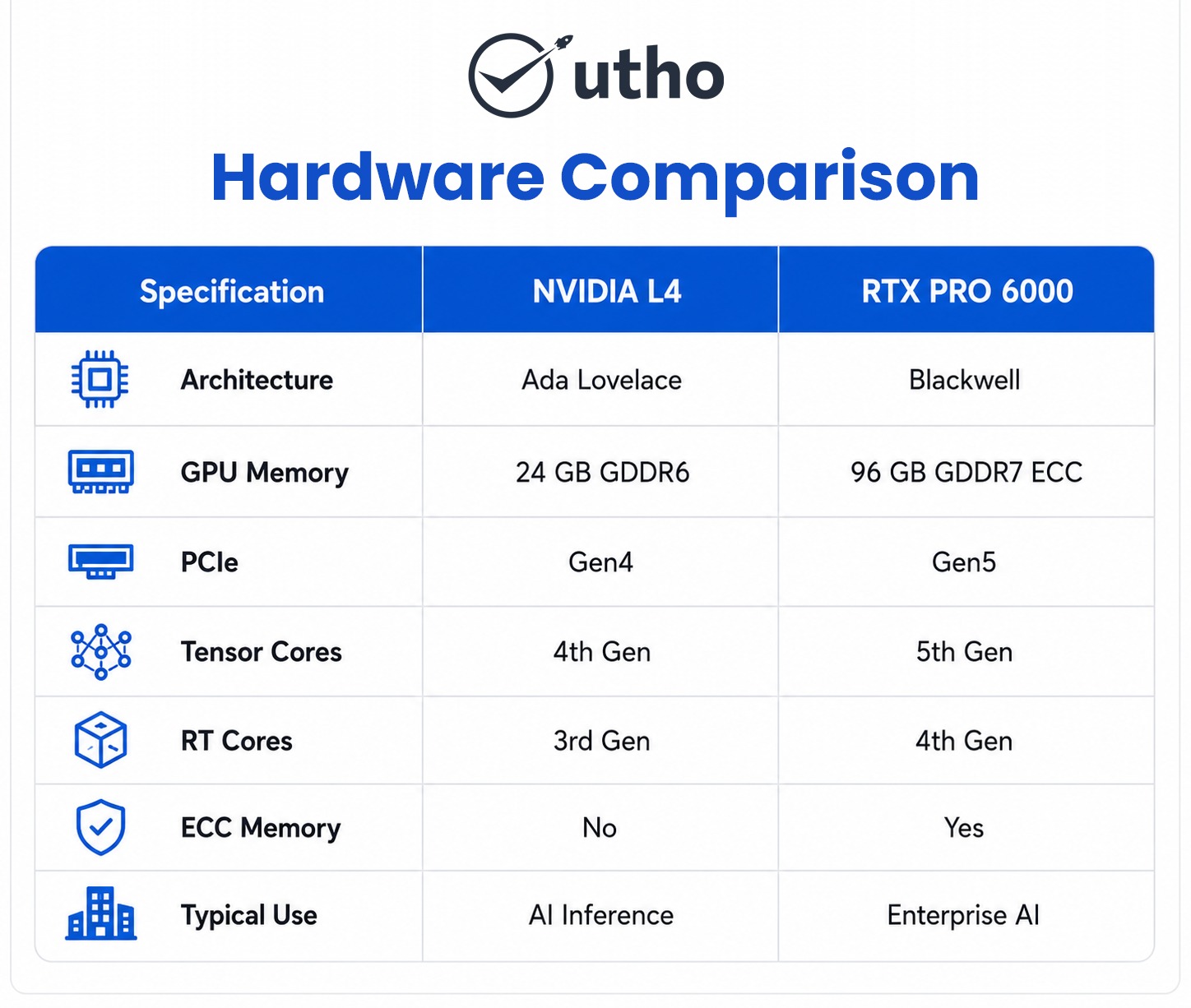
Blackwell vs Ada Lovelace Architecture
Architecture defines how efficiently a GPU executes AI workloads and plays a major role when selecting an AI GPU for inference.
The NVIDIA L4 Tensor Core is based on the Ada Lovelace architecture, which introduced significant improvements in AI inference, graphics processing, and energy efficiency over previous generations. It remains a highly capable platform for mainstream inference workloads.
The RTX PRO 6000 Blackwell moves to the Blackwell architecture, representing NVIDIA’s latest advancements in AI acceleration. RTX PRO 6000 Blackwell introduces improvements in Tensor Core performance, memory technology, and AI-specific optimizations designed for next-generation enterprise workloads.
Rather than focusing solely on raw performance, Blackwell is engineered to improve efficiency across transformer-based AI models, multimodal applications, and increasingly complex inference pipelines.
For organizations planning long-term AI infrastructure, Blackwell provides a stronger foundation for future workloads. Businesses evaluating GPU Cloud India services or planning to Rent NVIDIA GPU India often consider the Blackwell architecture for future-ready AI deployments.
Architecture Evolution Timeline
Ampere
↓
Ada Lovelace
↓
Blackwell
↓
Next-Generation Enterprise AI
Memory Comparison
Memory capacity has become one of the most important considerations when selecting a GPU for LLM inference.
Many modern language models, multimodal AI systems, and image-generation pipelines require significantly more memory than previous generations.
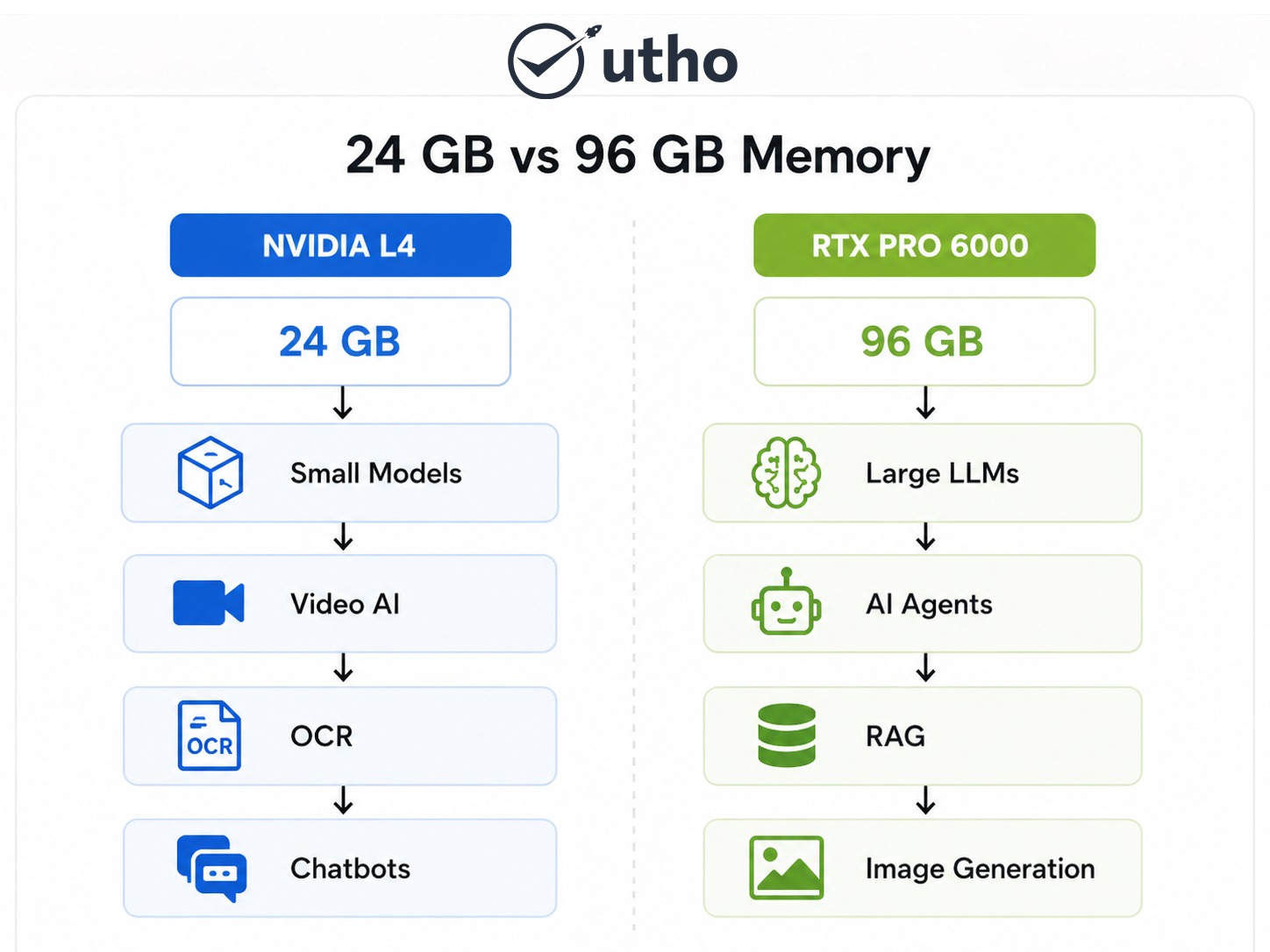
The NVIDIA L4 Tensor Core provides 24 GB of GDDR6 memory, which is sufficient for many optimized AI workloads. Smaller language models, lightweight computer vision applications, recommendation engines, and video analytics can run efficiently within this memory footprint.
However, as AI models continue to increase in size, memory limitations become more apparent.
The RTX PRO 6000 addresses this challenge with 96 GB of GDDR7 ECC memory, allowing organizations to deploy larger models with fewer compromises.
This larger memory pool enables:
- Larger batch sizes
- Reduced CPU offloading
- Better support for long-context inference
- Higher-resolution image generation
- Larger Retrieval-Augmented Generation (RAG) pipelines
- Greater flexibility for enterprise AI applications
For teams evaluating rtx pro 6000 vs l4, memory is often the deciding factor rather than raw compute performance alone. Organizations selecting an AI GPU for inference or a GPU for LLM inference frequently compare memory capacity before choosing a GPU Cloud India provider or deciding to Rent NVIDIA GPU India for production AI workloads.
Memory Comparison Table
| Specification | NVIDIA L4 | RTX PRO 6000 |
| Memory Capacity | 24 GB | 96 GB |
| Memory Type | GDDR6 | GDDR7 ECC |
| Suitable Model Size | Small to Medium | Medium to Large |
| Long Context Support | Limited | Excellent |
| Large Batch Processing | Moderate | Excellent |
AI Inference Performance
Artificial Intelligence workloads have evolved rapidly over the past few years. Organizations are no longer evaluating GPUs solely based on CUDA cores or theoretical AI TOPS. Instead, the focus has shifted toward real-world inference performance—how efficiently an AI GPU for inference serves production AI models while balancing latency, throughput, memory utilization, and operational cost.
Whether you’re deploying a customer support chatbot, building an enterprise AI assistant, serving a Retrieval-Augmented Generation (RAG) application, or running multimodal AI models, inference performance determines the responsiveness and scalability of your application.
This is where the RTX PRO 6000 Blackwell vs NVIDIA L4 Tensor Core comparison becomes particularly relevant.
Although both GPUs are designed to accelerate AI workloads, they target different deployment strategies.
The NVIDIA L4 Tensor Core focuses on delivering exceptional performance per watt for lightweight and medium-sized GPU for LLM inference tasks.
The RTX PRO 6000 Blackwell is engineered to support significantly larger AI models while maintaining higher throughput for demanding enterprise workloads.
Choosing between them depends less on benchmark numbers and more on understanding how your production workload behaves. Many organizations also evaluate GPU Cloud India providers or choose to Rent NVIDIA GPU India before making long-term infrastructure investments.
Suggested Image
AI Inference Pipeline
User Request
↓
AI Application
↓
GPU Memory
↓
LLM Processing
↓
Generated Response
(Minimal white-background flow diagram with blue icons for user, application, GPU, AI model, and response.)
AI Inference Throughput Comparison
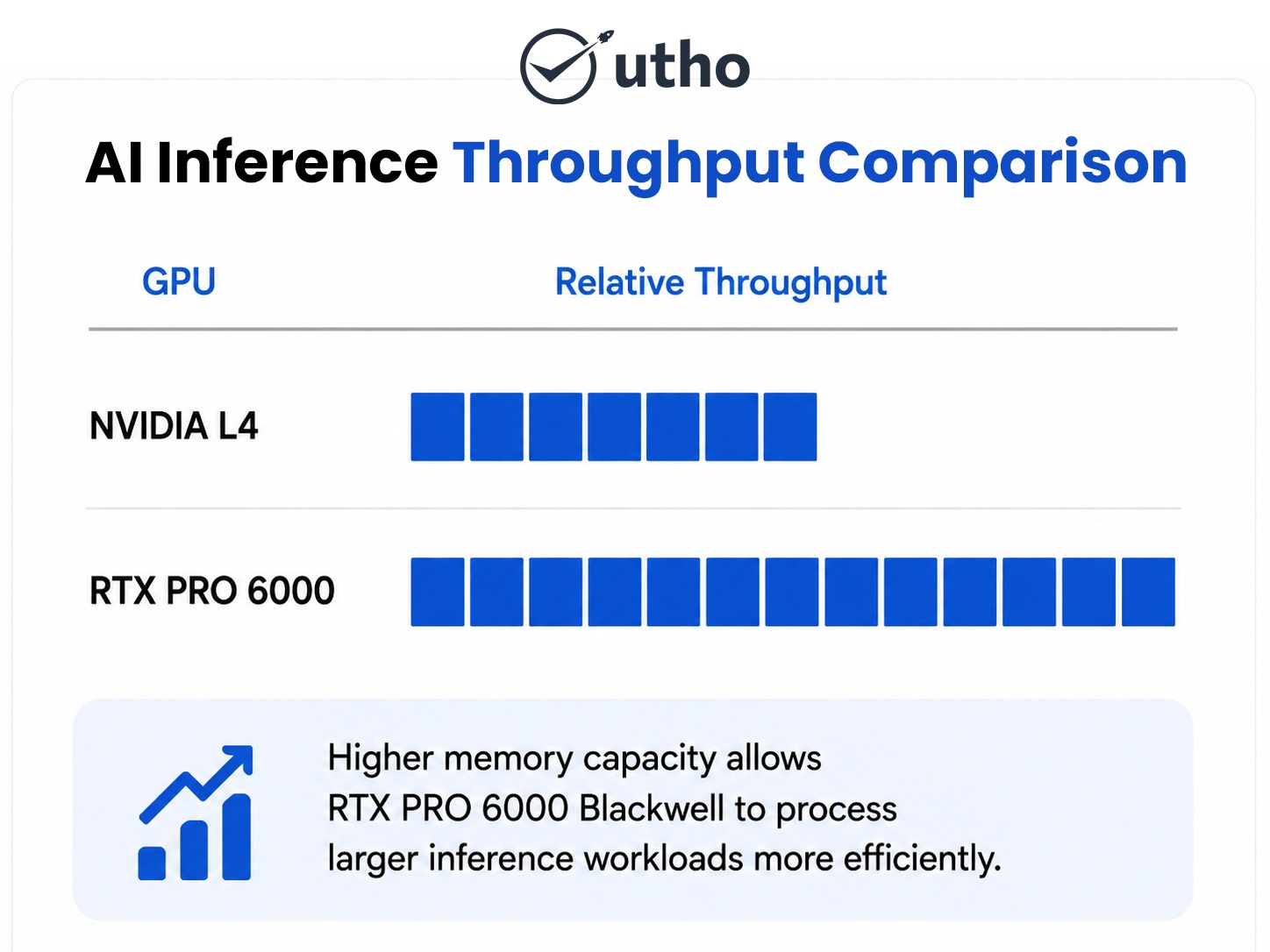
Inference throughput refers to the number of tokens, images, or predictions a GPU can process within a given period.
Higher throughput enables organizations to serve more users using the same infrastructure.
For enterprise AI applications, throughput directly impacts cloud costs and infrastructure utilization, making the choice of an AI GPU for inference increasingly important.
The NVIDIA L4 performs exceptionally well for workloads that fit comfortably within its available memory.
Examples include:
- Customer support chatbots
- OCR
- Speech recognition
- Recommendation systems
- Small RAG deployments
- Image classification
- Video analytics
Because these applications generally require smaller models, the L4 can deliver excellent performance while consuming remarkably little power.
The RTX PRO 6000 Blackwell, however, begins to show its advantage as workload complexity increases.
Its significantly larger memory capacity enables larger batch sizes, allowing more inference requests to be processed simultaneously.
For enterprise deployments where hundreds or thousands of requests must be served every minute, this additional capacity often translates into better infrastructure utilization and lower cost per inference. This makes it a preferred GPU for LLM inference for larger production models. Businesses comparing deployment options through GPU Cloud India platforms often choose to Rent NVIDIA GPU India to scale AI workloads without heavy upfront infrastructure costs.
LLM Serving Performance
Large Language Models have become the backbone of modern enterprise AI.
Applications powered by models such as Llama, Mistral, DeepSeek, Qwen, Gemma, and GPT-style architectures require GPUs capable of managing increasingly large memory footprints while maintaining low response latency.
This is one of the biggest differences in the rtx pro 6000 vs l4 comparison.
The NVIDIA L4 can efficiently serve lightweight and optimized language models.
It is well suited for:
- Internal AI assistants
- Small enterprise chatbots
- Document search
- FAQ automation
- Customer support bots
However, larger foundation models quickly consume available memory.
Organizations often need to:
- Quantize models
- Reduce context length
- Lower batch sizes
- Offload model layers to CPU memory
While these techniques make deployment possible, they may reduce overall inference performance.
The RTX PRO 6000 Blackwell addresses these challenges by providing four times more GPU memory.
This additional memory allows enterprises to deploy larger models while maintaining higher throughput and simplifying infrastructure management.
Suggested Architecture Diagram
Application
↓
API Gateway
↓
RTX PRO 6000
↓
Large Language Model
↓
AI Response
Second Diagram
Application
↓
API Gateway
↓
L4 Tensor Core
↓
Optimized LLM
↓
AI Response
Stable Diffusion & Image Generation
Generative AI has expanded beyond text.
Organizations now deploy diffusion models for:
- Marketing content
- Product visualization
- Design automation
- Image enhancement
- Video generation
- Creative AI workflows
These workloads place significant pressure on GPU memory.
While the NVIDIA L4 performs well for optimized image-generation models, larger resolutions, multiple concurrent users, and advanced diffusion pipelines can quickly consume available VRAM.
The RTX PRO 6000 Blackwell provides considerably greater flexibility.
Its 96 GB memory capacity supports:
- Larger diffusion models
- Higher image resolutions
- Increased batch sizes
- Faster production workflows
- Multiple concurrent image-generation jobs
For design agencies, AI startups, and creative enterprises, this additional memory often results in smoother production pipelines.
Suggested Image
Image Generation Workflow
Prompt
↓
Diffusion Model
↓
RTX PRO 6000 / L4
↓
Generated Image
(Professional vector workflow with AI iconography.)
RAG & AI Agent Workloads
Retrieval-Augmented Generation (RAG) has become one of the fastest-growing enterprise AI architectures.
Rather than relying solely on a language model’s training data, RAG systems retrieve relevant information from internal documents before generating responses.
This dramatically improves factual accuracy while allowing organizations to build AI assistants using proprietary knowledge.
Typical RAG deployments include:
- Enterprise search
- HR assistants
- Legal document analysis
- Healthcare knowledge systems
- Customer support automation
- Financial research platforms
These systems simultaneously manage:
- Vector databases
- Embedding models
- Retrieval pipelines
- Large language models
As a result, GPU memory usage increases significantly.
Organizations comparing rtx pro 6000 vs l4 for RAG deployments often find that the RTX PRO 6000 provides greater headroom for future scaling.
Its additional memory simplifies deployment by reducing the need for aggressive model optimization.
Suggested Infographic
Enterprise RAG Workflow
Enterprise Documents
↓
Embedding Model
↓
Vector Database
↓
LLM
↓
AI Assistant
Computer Vision & Video AI
Not every AI workload involves language models.
Many industries depend heavily on computer vision.
Examples include:
- Smart manufacturing
- Retail analytics
- Traffic monitoring
- Medical imaging
- Security surveillance
- Autonomous inspection
The NVIDIA L4 has become one of the industry’s most popular GPUs for video analytics due to its exceptional efficiency.
Its low power consumption enables organizations to deploy large numbers of inference servers while maintaining predictable operating costs.
The RTX PRO 6000 Blackwell extends these capabilities further by supporting more complex vision models and higher-resolution inference workloads.
For organizations processing large image datasets or deploying multimodal AI applications, its larger memory pool provides additional flexibility.
Suggested Comparison Graphic
| Workload | Best GPU |
| OCR | L4 |
| Video Analytics | L4 |
| AI Chatbot | RTX PRO 6000 |
| Stable Diffusion | RTX PRO 6000 |
| Large RAG | RTX PRO 6000 |
| Computer Vision | Both |
| Enterprise AI Agents | RTX PRO 6000 |
Cost Comparison: Which GPU Delivers Better Value?
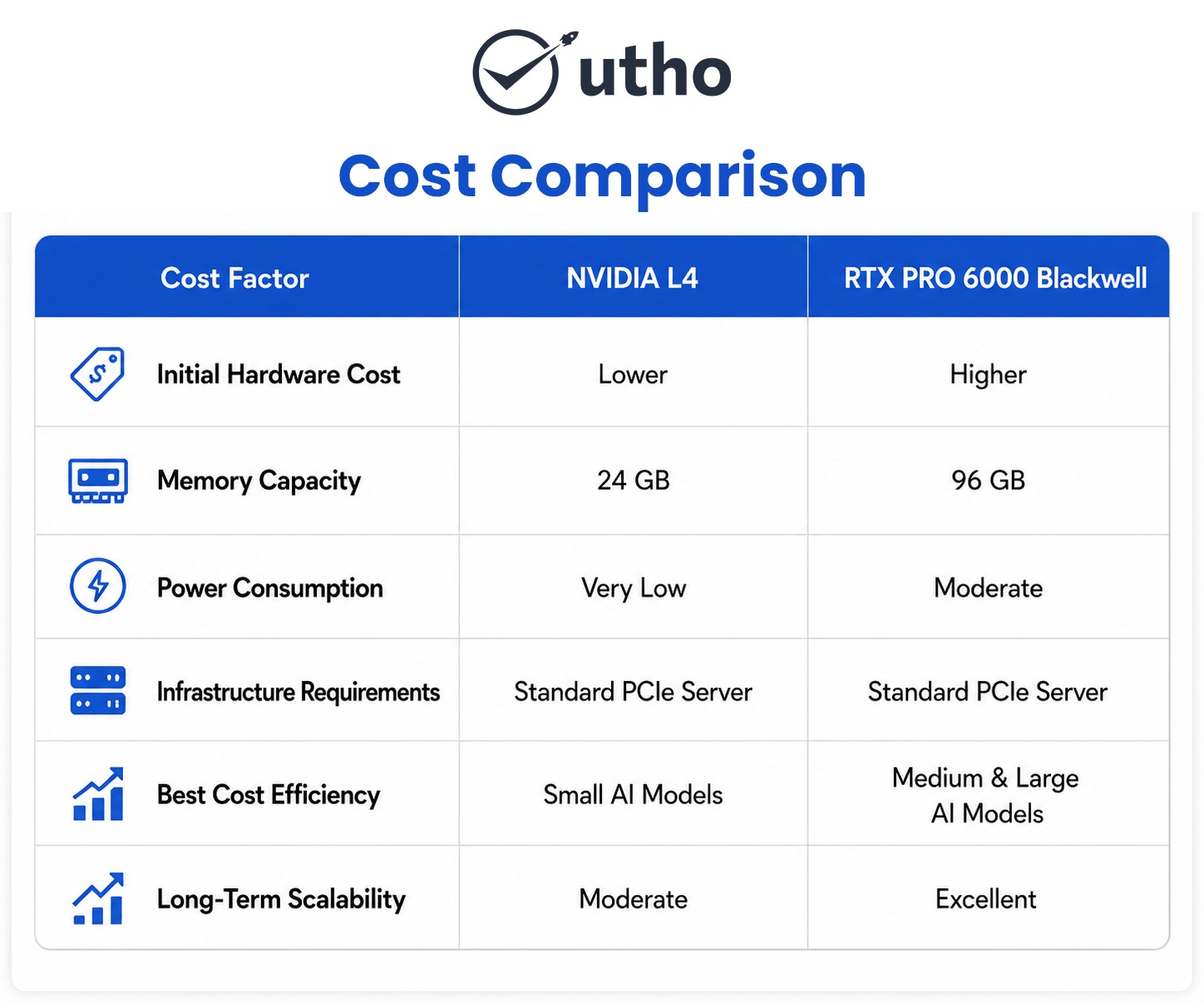
Performance is only one side of the equation when selecting AI infrastructure. For most organizations, the long-term success of an AI project depends just as much on operational costs as it does on raw GPU performance.
When comparing rtx pro 6000 vs l4, many businesses initially focus on the purchase price. However, the true cost of ownership extends far beyond the GPU itself.
A complete AI deployment includes:
- GPU acquisition
- Server hardware
- Power consumption
- Cooling infrastructure
- Networking
- Storage
- Rack space
- Hardware maintenance
- Infrastructure upgrades
- Operational management
These recurring expenses often exceed the original hardware investment over the lifetime of an AI deployment.
The NVIDIA L4 is designed with efficiency in mind. Its low power consumption makes it an attractive option for organizations running lightweight inference workloads at scale. Lower energy requirements also reduce cooling and operational costs, making the L4 particularly appealing for cloud-native deployments and distributed edge environments.
The RTX PRO 6000 Blackwell requires more power than the L4, but it also delivers significantly more GPU memory and compute resources. In many enterprise AI environments, a single RTX PRO 6000 can replace multiple lower-memory GPUs, simplifying infrastructure while improving overall efficiency.
For organizations serving larger language models or high-memory AI applications, investing in fewer but more capable GPUs often results in better infrastructure utilization and lower cost per inference request.
Suggested Infographic
Total Cost of Ownership
GPU Hardware
↓
Power Consumption
↓
Cooling
↓
Networking
↓
Maintenance
↓
Infrastructure
↓
Total AI Operating Cost
(Professional vertical infographic with minimal blue icons on a white background.)
Which GPU Fits Your Budget?
The answer depends on your AI strategy—not just your budget.
Organizations often make the mistake of buying the most powerful GPU available or selecting the cheapest option without considering future workload growth.
Instead, start by asking three questions:
1. What type of AI models are you deploying?
If you’re running:
- OCR
- Recommendation engines
- Small chatbots
- Speech recognition
- Video analytics
…the NVIDIA L4 is often the more economical choice.
However, if your roadmap includes:
- Enterprise AI assistants
- Large Language Models
- AI Agents
- Stable Diffusion XL
- Retrieval-Augmented Generation (RAG)
- Long-context inference
…the RTX PRO 6000 Blackwell provides significantly more flexibility.
2. How Fast Will Your AI Workloads Grow?
Many AI deployments begin with a small proof of concept but quickly expand into production.
Choosing a GPU with limited memory may require costly infrastructure upgrades sooner than expected.
The RTX PRO 6000 offers substantially more headroom for future model growth, allowing organizations to scale without replacing hardware.
3. Is Buying Hardware the Right Decision?
Purchasing enterprise GPUs involves significant capital investment.
Beyond the hardware itself, organizations must also provision:
- Servers
- Cooling
- Redundant power
- Rack infrastructure
- Networking
- Hardware maintenance
For many businesses, renting GPUs provides greater flexibility.
Instead of investing heavily upfront, organizations can scale GPU resources as workloads increase while paying only for the infrastructure they actually use.
Suggested Decision Tree
Small AI Models
↓
Need Low Power?
↓
YES
↓
Choose NVIDIA L4
———————–
Large LLMs
↓
Need More Memory?
↓
YES
↓
Choose RTX PRO 6000
Deploy NVIDIA L4 & RTX PRO 6000 Without Buying New Hardware
After choosing between the NVIDIA L4 Tensor Core and RTX PRO 6000 Blackwell, the next decision is how to deploy your AI workloads. While some organizations invest in on-premises GPU servers, many teams now prefer renting cloud GPUs to avoid large upfront costs, simplify infrastructure management, and scale resources on demand.
If you’re looking for cloud access to these GPUs, Utho provides NVIDIA L4 Tensor Core and RTX PRO 6000 Blackwell instances for AI inference, LLM deployment, computer vision, generative AI, and enterprise AI workloads. This enables developers and businesses to deploy production-ready AI infrastructure without managing physical GPU servers.
Key advantages include:
- NVIDIA L4 Tensor Core and RTX PRO 6000 Blackwell GPU instances
- Enterprise-grade AI infrastructure hosted in India
- Transparent, predictable pricing with no hidden charges
- Fast deployment for AI development, testing, and production
- High-performance networking for AI inference workloads
- Flexible scaling as demand grows
- Suitable for LLM inference, RAG, AI agents, Stable Diffusion, computer vision, and enterprise AI applications
For teams building modern AI applications, renting GPUs through Utho reduces infrastructure complexity while allowing developers to focus on model development and deployment.
Editor’s Note: If your workload is still evolving, starting with cloud GPUs allows you to benchmark performance, estimate operating costs, and choose the most suitable GPU before committing to long-term hardware investments.
Looking to Deploy These GPUs?
Explore NVIDIA L4 Tensor Core and RTX PRO 6000 Blackwell GPU instances on Utho GPU Cloud and choose the configuration that best matches your AI workload.
Final Recommendation
There is no universal winner in the rtx pro 6000 vs l4 comparison because each GPU is designed for a different class of AI workload.
Choose the NVIDIA L4 Tensor Core if your priorities are energy efficiency, lower operational costs, and running lightweight to medium-sized AI inference workloads such as OCR, video analytics, recommendation systems, and optimized chatbots.
Choose the RTX PRO 6000 Blackwell if your organization requires larger GPU memory, support for modern LLMs, AI agents, Retrieval-Augmented Generation (RAG), Stable Diffusion, multimodal AI, or enterprise-scale inference. Its 96 GB of GDDR7 ECC memory and Blackwell architecture make it a stronger long-term investment for businesses expecting their AI workloads to grow.
Rather than selecting a GPU based solely on specifications, evaluate your decision based on:
- Model size
- Memory requirements
- Expected user traffic
- Infrastructure budget
- Scalability needs
- Long-term operational costs
The best AI infrastructure is the one that aligns with your business goals—not simply the one with the highest benchmark score.
Frequently Asked Questions (FAQs)
Is RTX PRO 6000 better than NVIDIA L4 for AI inference?
It depends on the workload. RTX PRO 6000 is better suited for larger AI models, enterprise LLMs, RAG pipelines, and multimodal AI because of its 96 GB memory. NVIDIA L4 is ideal for efficient inference of smaller models with significantly lower power consumption.
Which GPU is better for LLM inference?
For small and optimized language models, both GPUs perform well. For larger models requiring higher memory capacity and larger batch sizes, RTX PRO 6000 is generally the better choice.
Is NVIDIA L4 enough for Stable Diffusion?
Yes, NVIDIA L4 can run Stable Diffusion efficiently for many use cases. However, larger image-generation workloads, higher resolutions, or multiple concurrent users benefit from the additional memory available on the RTX PRO 6000.
Should I buy or rent AI GPUs?
If your AI workloads are variable or still growing, renting GPUs is often more cost-effective than purchasing hardware. Cloud GPU services eliminate upfront capital costs while providing the flexibility to scale resources as demand changes.
Can I rent RTX PRO 6000 and NVIDIA L4 from Utho?
Yes. Utho GPU Cloud provides access to both NVIDIA L4 Tensor Core and RTX PRO 6000 Blackwell instances, enabling businesses to deploy AI infrastructure for development, testing, and production without investing in on-premises hardware.