

Serverless computing is a way of building and running applications without managing servers yourself.
In simple words developers just write code and deploy it. The cloud provider handles everything else like setup scaling updates and maintenance in the background.
Even though it is called serverless servers are still used. The difference is that you do not manage them directly. The cloud provider does all the technical work so you can focus only on your application.
In 2026, serverless computing will become much more advanced and widely used. Earlier, it was mostly used for small tasks or simple applications. But now, it is a key part of modern cloud systems. It powers many types of workloads like startup apps, enterprise platforms, real-time AI systems, and even global edge computing where speed and low latency are very important.
One of the biggest reasons for its growth is saving money. Businesses do not pay for servers when they are not using them. They only pay when their code runs. This makes it cheaper and easy to scale.
Another big benefit is automatic scaling. If an app gets more users suddenly the system can increase power automatically. When users go down it reduces resources on its own. No manual work is needed.
Overall serverless computing has changed how modern apps are built. It reduces work for teams, makes development faster and helps companies focus more on building features instead of managing servers.
Understanding what serverless computing is is important because it helps developers and businesses build better and scalable cloud applications.
What is Serverless Computing?
Serverless computing is a cloud model where developers build and run apps without managing servers. The cloud provider handles everything like:
- Server provisioning
- Scaling
- Load balancing
- Patch management
- Availability and fault tolerance
Developers just deploy their functions or services and the platform runs them when needed.
In 2026 serverless is not only for simple functions. It has become more advanced and now includes:
- Event driven functions (FaaS)
- Serverless systems using containers
- Serverless at the edge
- AI based serverless systems
- Real time data processing systems
Understanding what serverless computing is is important because it helps developers build simple, fast and scalable applications.
How Serverless Computing Works (Modern System)
At the basic level serverless works when something happens like an event. But now the system behind it is much more advanced and powerful.
1. Event Trigger
Everything starts with an event, such as:
- HTTP request from a user
- File upload
- Database update
- IoT sensor data
- Message queue event
- AI prompt request
2. Function Execution
A cloud function is triggered. Popular platforms include:
- Amazon Web Services (AWS Lambda)
- Microsoft Azure Functions
- Google Cloud Functions / Cloud Run
- Cloudflare Workers (at the edge)
These functions are lightweight, stateless units of execution.
3. Automatic Resource Allocation
The platform automatically:
- Allocates CPU and memory dynamically
- Spins up isolated runtime environments
- Executes the function
- Shuts it down after execution (or keeps it warm for reuse)
4. Automatic Scaling
Whether there is 1 request or 1 million requests, the system scales automatically without any manual intervention. This is one of the key benefits of serverless computing in modern cloud systems.
5. Pay-per-Use Billing
You are charged only for what you use:
- Execution time (milliseconds)
- Memory consumption
- Number of requests
There is no idle cost and no need for always-on servers.
Evolution of Serverless
Serverless computing in 2026 has changed a lot compared to before. Earlier it was only used to run small code without managing servers.
Now it has become a full cloud system used for building modern applications.
1. From “Functions Only” to “Full Applications”
In the beginning, serverless was mainly used for small functions. But now it has evolved into full production systems. This is a major shift in what is serverless computing in modern cloud architecture.
Today, serverless can handle:
- APIs
- Backend systems
- Database integrations
- AI pipelines
- Streaming engines
- Full-stack web applications
This means developers can now build complete production-grade systems using serverless architecture. Tools like Vercel and Netlify helped make full-stack serverless very common by simplifying deployment and scaling.
2. Edge Serverless Expansion
One of the biggest improvements is edge computing. This is a key evolution in what is serverless computing.
Instead of running code in one central data center, the code now runs closer to the user (at the “edge”).
This provides several benefits:
- Much lower latency (faster response time)
- Faster global performance
- Less load on central servers
- Better overall user experience
Platforms like Cloudflare Workers helped push this model by allowing code to run in multiple global locations near users.
3. Cold Start Problem Improvements
Earlier, serverless had “cold start” delays. In 2026, this has improved significantly. This improvement strengthens what is serverless computing in real-world performance.
In 2026, this problem has improved a lot because of:
- Pre-warmed execution pools
- Lightweight runtimes like WebAssembly
- Faster container snapshot loading
- AI-based predictive scaling
Cold starts are still not completely gone, but they are now much faster and less noticeable for users.
4. Serverless Containers
Modern systems now support containers, expanding what is serverless computing beyond simple functions.
This means developers can run more complex applications using containers without managing servers directly.
Modern serverless supports:
- Serverless containers
- Long-running managed workloads
- Kubernetes-integrated serverless systems
For example tools like Knative and Google Cloud Run let developers run applications like Docker containers in a fully managed system.
This gives more flexibility than old serverless systems that only supported small functions.
AI Driven Serverless Computing
One of the biggest changes from 2024 to 2026 is the use of AI in serverless computing.
Now serverless is used for:
- AI model usage and inference
- AI agents
- Real time text summarization
- Image generation systems
- RAG systems
Instead of running expensive GPU servers all the time companies now run AI functions that scale automatically when needed.
This makes AI systems cheaper, easier to manage and more efficient.
Key Benefits of Serverless Computing
Serverless computing today has many benefits that make it very useful for modern applications.
1. Massive Cost Efficiency
One of the biggest benefits of serverless computing is that you only pay for what you actually use.
Instead of paying for servers that stay running all the time, cost is based only on real execution.
Modern improvements have made this even more efficient through:
- Fine-grained billing (per millisecond or micro-invocation)
- AI-based cost optimization that adjusts resource usage automatically
- Elimination of idle-time costs (no charge when code is not running)
Because of this, serverless is especially useful for:
- Startups that want to reduce infrastructure cost
- SaaS products with unpredictable usage
- Applications with seasonal or fluctuating traffic
2. Automatic Scaling at Global Level
Serverless systems automatically scale without manual setup.
In 2026, scaling is not limited to a single server or region. It now happens across:
- Multiple regions
- Global infrastructure
- Edge-to-cloud hybrid environments
This means applications can handle sudden spikes in traffic anywhere in the world without performance issues or manual intervention.
3. Faster Development Speed
Serverless allows developers to focus only on application logic instead of infrastructure management.
Developers mainly work on:
- Business logic
- API design
- Data processing
They do not need to worry about servers, scaling, or maintenance.
This leads to:
- Faster product development cycles
- Smaller DevOps teams
- Reduced operational complexity
Overall, companies can build and release products much faster.
4. Built-in High Availability
Modern serverless platforms automatically ensure that applications stay available even if something fails.
This is achieved through:
- Multi-zone redundancy (running across multiple data centers)
- Automatic failover systems
- Distributed execution across regions
No extra configuration is required from developers, as high availability is built into the platform itself.
5. Strong Security Model
Serverless computing is more secure by design.
Key Security Benefits
- It runs for a short time only when needed
- Cloud provider automatically handles security updates
- Each function runs in a separate safe environment
- Built-in system controls who can access what
This makes systems safer because there are fewer chances for attacks compared to normal servers that run all the time and need manual updates.
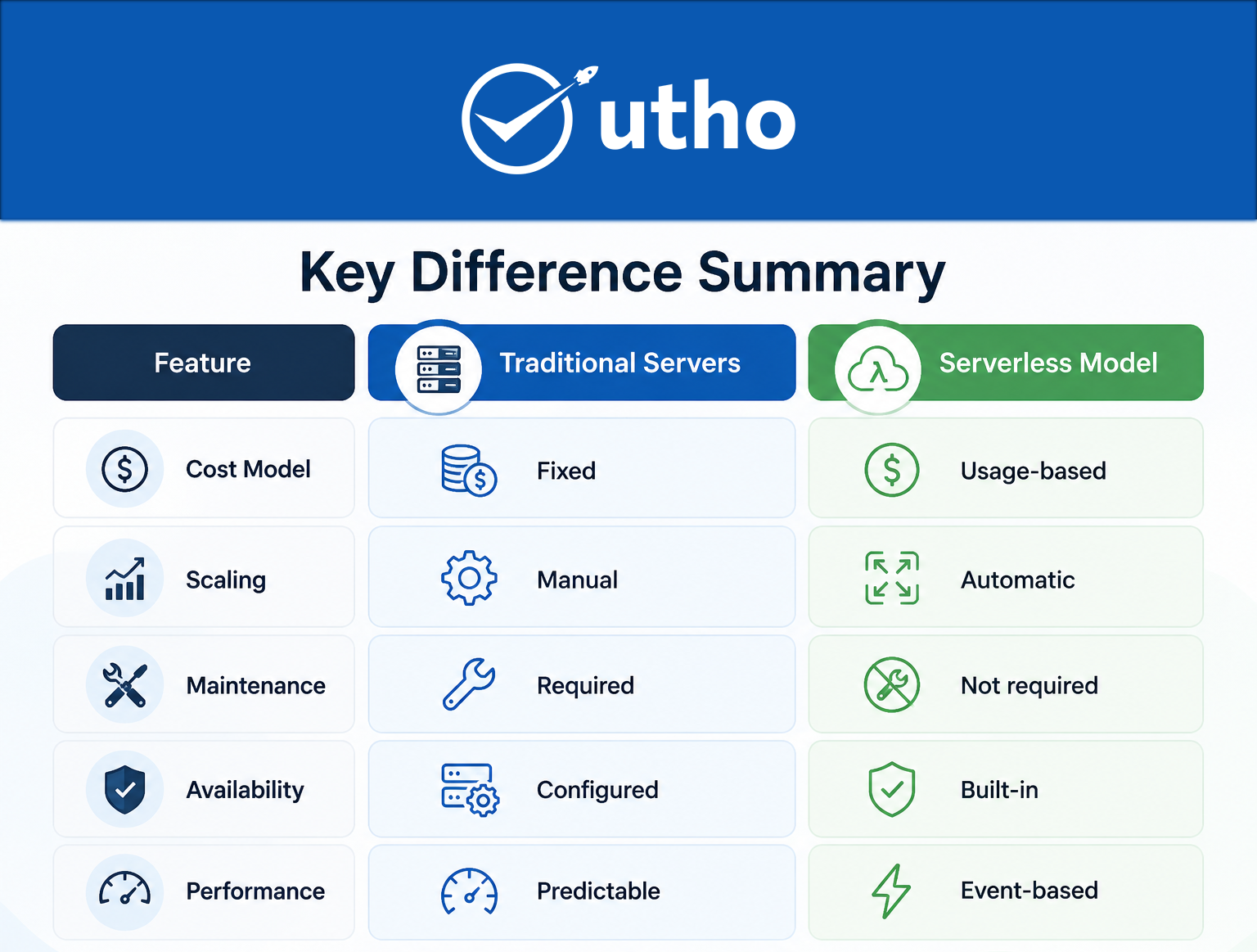
Serverless vs Traditional Cloud Computing
Traditional Server-Based Model
- Always-on servers
- Manual scaling required
- Fixed monthly or hourly costs
- Continuous maintenance needed
- Idle resources still consume money
Serverless Model
- Event-driven execution
- Automatic scaling
- Pay-per-use pricing
- Fully managed infrastructure
- No cost for idle time
In simple terms, serverless computing removes infrastructure complexity and lets developers focus completely on building applications, while the cloud handles everything else automatically.
Modern Serverless Use Cases
Serverless computing in 2026 is not only used for small tasks anymore. It is now used to build full modern applications.
It is used in many industries because it works without manual server management and can scale automatically when needed.
1. Web Applications
Modern web applications are now deeply integrated with serverless architecture.
Instead of relying on traditional always-on servers, modern web apps are split into different serverless components:
- Frontend is hosted on edge platforms for faster global delivery
- Backend APIs run as serverless functions
- Database events trigger automatic business logic
This architecture makes web applications faster, more scalable, and easier to maintain because each part runs independently and scales automatically based on demand.
2. AI Applications
Modern Serverless Use Cases
Serverless computing is now used in many modern systems. It is not only for small functions anymore. It is used to build full applications in many industries.
AI Systems
Serverless is very important for AI systems today.
AI work changes a lot based on user demand so serverless works very well for it.
It is used for:
- Chatbots and AI assistants
- AI tools for work and productivity
- Image and video generation
- Large scale AI processing tasks
Instead of running powerful servers all the time companies only run AI tasks when needed. This saves money and makes systems more flexible.
3. IoT Systems
Serverless is also widely used in IoT systems where many devices send data at the same time.
It is used for:
- Reading sensor data in real time
- Sending instant alerts
- Managing connected devices
Millions of devices can send data together and serverless systems handle it automatically without manual setup.
4. Data Processing
Serverless is also used to process large amounts of data.
It is used for:
- Data pipelines
- Log processing
- Real time data analysis
Instead of running systems all the time serverless runs only when new data comes in. This saves cost and improves efficiency.
5. E-commerce Systems
E-commerce websites use serverless for many daily tasks.
It is used for:
- Order processing
- Payment handling
- Stock updates
- Customer notifications
During big sales serverless helps systems handle heavy traffic without slowing down or crashing.
Challenges of Serverless Computing (2026)
Serverless is powerful but it still has some problems.
- Cold Start
Sometimes when a function is not used for some time it may take a short time to start. This delay is small but can still affect fast systems.
- Vendor Lock In
Most serverless systems depend on one cloud company.
This makes it hard to move from one provider to another because each company has different tools and systems.
- Debugging Difficulty
Serverless systems are made of many small parts.
So when something goes wrong it can be harder to find the exact problem compared to simple systems.
- Execution Limits
Most serverless platforms still enforce certain limits, such as:
- Maximum execution time for a function
- Memory usage restrictions
- CPU constraints
These limits ensure system stability but can restrict very heavy or long-running workloads.
- Cost at Very Large Scale
Although serverless is highly cost-efficient for most workloads, at extremely large and constant usage levels, traditional server-based systems can sometimes become more cost-effective.
This is because continuous heavy workloads may result in higher cumulative execution costs compared to reserved infrastructure.
Security in Serverless
Security has become one of the most important parts of serverless computing because applications now run in highly distributed and event-driven environments.
Modern serverless platforms improve security through several key mechanisms:
- Zero Trust Security
Every request is checked before it is allowed.
Nothing is trusted automatically. Every function must be verified first.
- Separate Access for Each Function
Each function gets its own access and identity.
If one function has a problem it cannot access other systems or data.
- Isolated Running Environment
Every function runs in its own safe space.
This helps prevent one function from affecting another.
- Automatic Security Updates
The cloud provider automatically updates and fixes security problems.
Developers do not need to do this manually.
- Protection from Large Attacks
Serverless systems can block and handle large attacks from the internet.
This protects the system before the attack reaches the main application.
Because of these improvements, serverless is often considered more secure than traditional VM-based systems for many modern workloads.
Serverless + Edge + AI = The New Cloud Stack
In 2026, the biggest transformation is not just serverless itself, but how it combines with other technologies to form a new cloud architecture.
1. Serverless + Edge Computing
When serverless is combined with edge computing, applications run closer to the user instead of a central data center.
This results in:
- Extremely low latency
- Faster global response times
- Better performance for real-time applications
This combination is widely used in global apps like streaming platforms, gaming services, and interactive web applications.
2. Serverless + AI
Serverless is now a core execution layer for AI systems.
It enables:
- On-demand AI inference
- Scalable chatbots and AI assistants
- Real-time predictions and recommendations
Instead of maintaining always-on AI servers, workloads are executed only when needed, making AI systems more efficient and cost-effective.
3. Serverless + Containers
This combination brings flexibility to serverless computing.
It allows:
- Running containerized applications without managing infrastructure
- Supporting both short-lived and longer-running workloads
- Easier deployment of complex applications
It bridges the gap between traditional container systems and modern serverless models.
4. Serverless + Streaming
Serverless is also widely used in real-time data systems.
It powers:
- Live data streaming pipelines
- Event-driven analytics
- Real-time processing of large-scale data flows
This makes it ideal for systems that need instant processing of continuous data.
Future of Serverless Computing
Serverless is rapidly evolving toward a more intelligent and fully automated cloud ecosystem.
1. Fully Autonomous Cloud Systems
Future cloud systems will become self-managing, where infrastructure can:
- Automatically optimize performance
- Auto-scale based on demand
- Self-heal in case of failures
2. AI-Managed Infrastructure
Artificial intelligence will play a key role in cloud operations by:
- Predicting scaling needs before traffic spikes happen
- Optimizing cost in real time
- Automatically detecting and fixing system failures
3. Near-Zero Cold Start Systems
Cold start delays will continue to shrink due to:
- WebAssembly-based runtimes
- Advanced edge execution models
- Snapshot-based instant execution
The goal is near-instant function execution.
4. Unified Cloud + Edge Runtime
Instead of separating cloud regions and edge networks, future systems will likely use a single unified global execution layer where applications run seamlessly anywhere in the world.
Conclusion
Serverless computing in 2026 has evolved into a core foundation of modern cloud architecture rather than just a developer convenience.
It enables:
- Faster application development
- Lower operational costs
- Global scalability
- AI-ready infrastructure
- Edge-first application design
From startups to large enterprises, serverless has become the default approach for building modern, scalable systems.
Even though challenges like vendor lock-in and debugging complexity still exist, its advantages make it one of the most important technologies in today’s cloud ecosystem.
In simple terms, serverless is no longer the future of cloud computing—it is already the present.